Buying Guide
The best wood bar cabinets are not defined by appearance alone. The useful distinction is how well a cabinet organizes bottles, glasses, tools, appliances, and serving items within the room available. The products above are wood-based furniture pieces: the supplied listings commonly specify MDF, engineered wood, particleboard, veneer, or wood-look finishes, sometimes combined with solid wood or metal components. Check the material description carefully if solid wood is a priority.
Measure the intended wall or corner before comparing styles. Width varies substantially across this selection, from the compact WERMO at about 27.5 inches to the 70-inch Maupvit and LUXOAK options. A wide cabinet creates more serving space but can dominate a small dining area. Depth matters too: most pieces are around 15 to 16 inches deep, while the VMU and EpicHome are about 20.9 inches deep because they include refrigerator accommodation.
Also account for door movement, drawer extension, electrical access, and walking space. Sliding doors, as used by WERMO and the wider LUXOAK coffee-bar model, may be useful where a hinged door would interfere with a walkway. Corner-focused furniture can solve a different problem, but none of the selected products should be described as a corner cabinet unless its listing documents that shape.
Match storage to your beverage routine
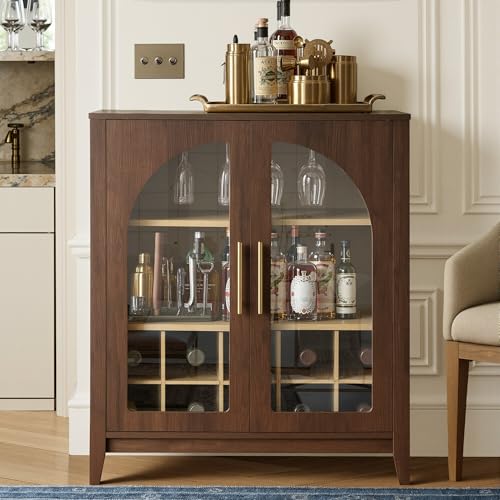
For mostly bottles and glasses, prioritize bottle grids, wine racks, and stemware holders. FORTUNETEC documents six stemware racks and a removable 10-slot bottle rack. X-cosrack lists three detachable wine racks and a detachable glass holder. Maupvit uses hanging wine-glass holders with adjustable shelves, making it more display-oriented.
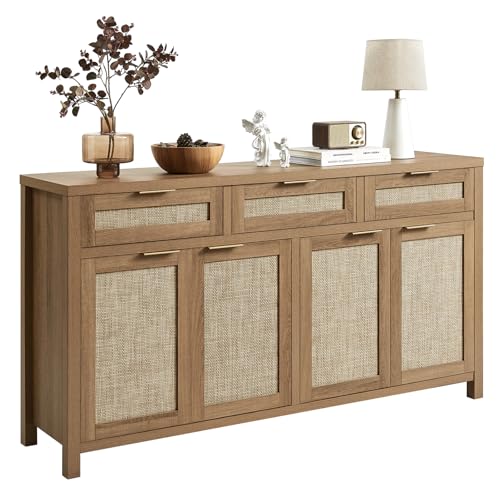
For mixed storage, look for drawers plus enclosed compartments. OKD has three drawers and two side cabinets, while ONBRILL combines four compartments, a sliding drawer, glass racks, a removable bottle grid, and adjustable shelves. These layouts are better suited to bar tools, napkins, coffee supplies, and bottles of different heights than a cabinet with one fixed compartment.
A removable rack can be valuable if your collection changes. It can free space for taller bottles or equipment, but the listing does not establish the exact dimensions of every remaining compartment. Treat rack capacity as a documented feature, not a guarantee that every bottle or glass style will fit.
Decide whether you need cooling
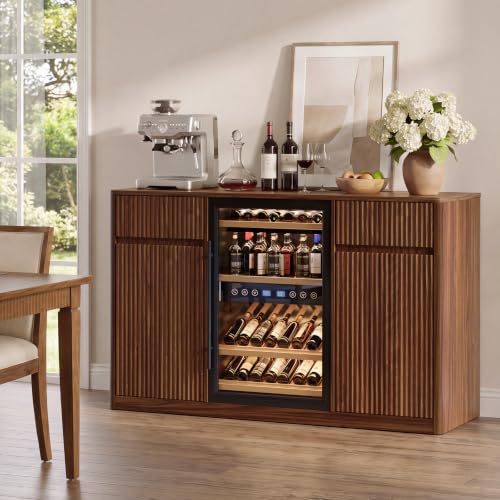
There are three different appliance approaches in this group. VMU and EpicHome provide a dedicated compartment for most mini fridges; both list ventilation or cable-management provisions, and neither includes the refrigerator. These are suitable when you already own, or plan to choose, a separate appliance.
LUXOAK takes the integrated approach with a built-in 24-can beverage cooler and adjustable temperature control from 41°F to 68°F. That makes it the clearest fit for buyers who want chilled drinks in the cabinet itself. However, integrated cooling also means more attention to outlet access, ventilation, package handling, and the cabinet’s heavier listed weight.
If you only need a coffee maker, blender, opener, or phone charger on the countertop, a power station may be more relevant than a fridge. ONBRILL, VMU, and EpicHome list combinations of AC outlets, USB, and Type-C ports. Power features increase convenience, but they do not replace checking the appliance instructions and available household circuit capacity.
Consider presentation and lighting
Glass doors, arched frames, fluted fronts, mesh panels, and LED lighting create different visual effects. Maupvit’s tall arched cabinet uses tempered glass doors and RGB light strips for an illuminated display. COCO DESIGN offers an LED strip with remote-controlled colors, modes, and brightness levels. These features can make bottles and glassware easier to display, but they also add electronics to a piece of furniture.
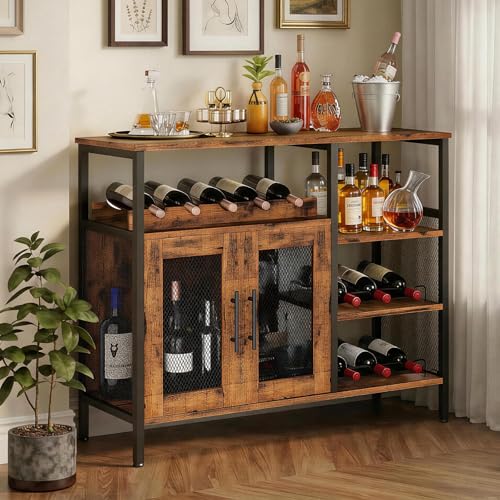
A closed cabinet is generally more visually restrained and can hide bar tools or coffee supplies. WERMO’s sliding doors conceal its compartments and include a removable mirror shelf. OKD and ONBRILL emphasize textured fluted fronts, while X-cosrack uses a mesh door and metal frame for a rustic industrial appearance. Choose the door style based on whether you want visibility, concealment, or a balance of both.
Review construction and safety details
The evidence supports a range of construction approaches rather than one universal material standard. OKD specifies MDF and engineered wood with six wooden support legs. WERMO lists FSC-certified wood with real wood veneer. X-cosrack combines MDF with a metal frame, and FORTUNETEC specifies engineered wood. ONBRILL lists solid wood legs while describing a fluted cabinet design. These details can help set expectations for finish and structure, but the listings do not establish independent durability testing.
Anti-tip hardware appears on several products, including Maupvit, VMU, EpicHome, FORTUNETEC, LUXOAK, and other listed cabinets. Use it as directed, especially with taller furniture such as Maupvit. Stable legs, adjustable feet, rounded edges, magnetic closures, and cable cutouts are useful design details, but each serves a different purpose. Adjustable feet help with uneven floors; an anti-tip kit is intended for anchoring; neither should be treated as a substitute for proper installation.
Plan assembly and delivery
Every selected listing describes assembly instructions or numbered components, but that does not mean assembly requirements are identical. WERMO states a 45-minute assembly, while COCO DESIGN says assembly may take up to one hour. Other listings describe labeled parts and illustrated instructions without giving a time estimate. Use those statements only as planning guidance.
Large cabinets may arrive in multiple packages. LUXOAK specifically notes two packages that may arrive separately, and its integrated cooler makes the item heavier than many compact cabinets. Before ordering, check the route from the delivery point to the room, the available floor area, and whether the cabinet can be anchored to the wall as recommended.
Final recommendation
ONBRILL Fluted Walnut Bar Cabinet ranks first overall in this specification-based comparison under the published weighted criteria.
OKD 60-Inch Fluted Wine Bar Cabinet is the highest-scoring returned product and the first overall specification-based choice. Its combination of a wide tabletop, three drawers, two adjustable-shelf cabinets, six legs, and a documented 150-pound countertop capacity makes it the most balanced option for a dedicated entertaining area. The best wood bar cabinets for other needs are more specialized: choose LUXOAK when an integrated beverage cooler is central, VMU or EpicHome when you need space for a separate mini fridge, WERMO for a narrow room, and FORTUNETEC or X-cosrack for clearly documented bottle and glass organization. Among the top wood bar cabinets, the right choice depends more on layout and equipment needs than on finish alone.
Frequently Asked Questions
Among the best wood bar cabinets, what should I measure before buying a wood bar cabinet?
Measure available width, depth, and height, then add clearance for doors, drawers, outlets, and walking paths. For tall furniture, check ceiling and wall space as well. Appliance-ready models need extra depth and a suitable location for the refrigerator, cord, and ventilation. Also measure the delivery path, including doorways, stairways, and tight turns.
Are these cabinets made from solid wood?
Not all of them. The supplied specifications describe several materials, including MDF, engineered wood, particleboard, veneer, and metal frames. WERMO lists FSC-certified wood with real wood veneer, while ONBRILL specifies solid wood legs. Buyers seeking an all-solid-wood cabinet should verify the complete construction details rather than relying on a walnut or wood-look finish name.
Which cabinet is best for a mini fridge?
VMU and EpicHome are designed with dedicated compartments for most mini fridges, and both provide cable-management or power-related features. The refrigerator is not included with those models. LUXOAK is the better fit when you want an integrated beverage cooler, since its listing includes a 24-can cooler with adjustable temperature control.
Are built-in lights and outlets necessary?
They are optional convenience features. COCO DESIGN and Maupvit document LED lighting for display, while ONBRILL, VMU, and EpicHome list combinations of outlets, USB, and Type-C ports. A cabinet without those features may still be preferable if you want simpler furniture or already have lighting and power nearby. Always follow appliance and electrical-use instructions.
How do I choose between sliding and hinged doors?
Sliding doors can save front clearance, which is useful in a narrow room; WERMO documents that design. Hinged or glass doors may provide easier access or stronger display visibility, depending on the cabinet. Compare the opening direction with nearby furniture, and check whether shelves, racks, and drawers can be reached without moving other items.