Buying Guide
Choosing among the best oe-style headlight assemblies starts with fitment, not appearance. An assembly can look correct while still being wrong for a particular trim, body style, factory lighting package, or model-year transition. The products above are specification-based comparisons drawn from public listing data. They were not installed or tested here, and the ranking does not represent customer sentiment.
Confirm the vehicle configuration
Start with the exact year, make, model, body style, and trim. Then check whether the vehicle has factory halogen, HID/Xenon, projector, LED DRL, or another lighting setup. The TUSDAR Chevy Traverse pair is limited to factory-halogen models, while the Aosky Cadillac SRX pair excludes factory HID and LED headlights. The JSBOYAT Mustang set also excludes certain trims and factory HID/Xenon configurations.
Body-style changes deserve special attention on trucks and SUVs. The Aresparts Silverado listing excludes some Classic and new-body-style applications, and the TUSDAR GMC Sierra listing names several 2007 and 2014 exceptions. These details are more useful than a general statement that a part is an OE replacement. Compare the supplied OEM or Partslink numbers with the original unit when possible.
Decide between a pair and a single side
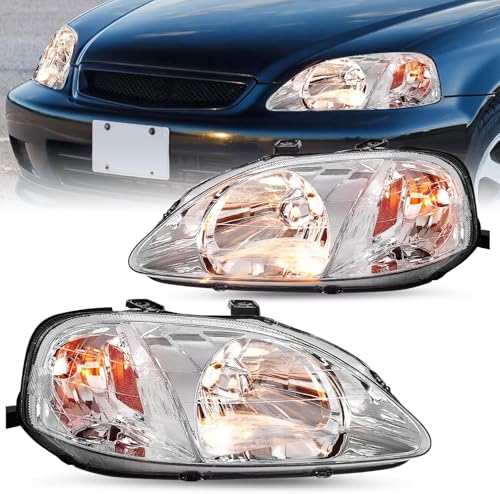
Most selected products are pairs containing driver and passenger assemblies. A pair is appropriate when both lenses are aged, damaged, or visibly mismatched. It can also simplify appearance matching between sides. The listings for the Traverse, Silverado, Mustang, Sierra, Equinox, SRX, Camry, Accord, Civic, and Escape all describe two-side coverage or a pair package.
A single-side assembly can make sense when only one housing is damaged, but it was not prioritized in this comparison because a matched pair is generally easier to compare across applications. Always verify whether the product is sold as one unit or two; packaging language and the unit count can differ.
Check bulb requirements and included components
Bulb compatibility is a major practical distinction. The JSBOYAT Mustang assembly lists an H13 high/low-beam bulb as included, the SOCKIR Equinox set includes 9007 bulbs, and the Aresparts Silverado package includes 9005 and H11 bulbs plus wiring harnesses. Those packages may reduce the number of separate components needed.
Many other assemblies are housing replacements only. The Accord and Civic listings identify their bulb types but say bulbs are not included. The Traverse uses H7 and H11 bulbs, while the Camry uses 9005 and H11 bulbs. Signal and side-marker bulbs may also be separate even when the main headlight bulbs are identified. Make a checklist of every lighting position before ordering.
Compare lens and housing construction
Polycarbonate lenses appear throughout this category because listings commonly associate them with impact resistance and lower weight than glass. The Traverse, Sierra, SRX, Accord, Civic, and Escape products all document polycarbonate construction or related lens details. UV coatings are also listed for several models, including the Traverse, Mustang, Sierra, Camry, and Escape.
Sealing claims vary. The Traverse and Sierra listings describe butyl rubber seals, while the Civic and Equinox products describe sealed housings; the Mustang and Aresparts Silverado listings provide IP67 protection claims. These are useful specifications, but they do not replace checking connectors, vents, mounting tabs, and the condition of the original vehicle wiring during installation.
Consider reflector and projector design
The category includes both reflector-based and projector-style designs, but the selected top 10 are primarily OE-style reflector replacements. The Accord listing specifically describes metal parabolic reflectors and side microprism reflectors. The Equinox listing documents a Z-shaped beam-cutoff design. These features can help explain how a housing is intended to distribute light, but listing descriptions alone do not establish real-world beam performance.
Projector or LED-equipped assemblies should be treated as configuration-specific rather than automatically superior. A projector design may require the correct factory housing, bulb arrangement, or wiring. Confirm that the selected assembly is intended for the vehicle’s original lighting system before choosing an upgraded-looking design.
Review installation details realistically
Plug-and-play and direct bolt-on language appears on many of these products. It generally indicates that the housing is intended to use the vehicle’s original mounting locations and connections without drilling or cutting. The Aresparts Silverado listing goes further by describing included harnesses and a no-cut installation, while the Accord and Civic listings recommend professional installation or omit instructions.
After installation, aim the headlights according to the vehicle manufacturer’s procedure. Even a correctly fitted housing can need adjustment. Check that the low beams, high beams, turn signals, side markers, and any included DRL or LED functions operate correctly. If connectors, bulbs, or mounting points do not match, stop and recheck fitment rather than forcing the installation.
Final Recommendation
JSBOYAT Mustang Halogen Headlight Pair, 2010–2014 ranks first overall in this specification-based comparison under the published weighted criteria.
The TUSDAR Chevy Traverse Headlight Pair, 2013–2017 is the first overall specification-based choice among these best oe-style headlight assemblies because it combines clear fitment, strong sealing documentation, a complete pair, and useful bulb information. The Aresparts Silverado pair is the practical choice when included bulbs and harnesses matter most, while the JSBOYAT Mustang set stands out for its included H13 bulb and detailed IP67 construction claims.
For sedans, the TUSDAR Camry pair and TUSDAR Accord pair provide clear application details, while the JSBOYAT Civic set targets an older, narrower fitment. SUV shoppers can compare the SOCKIR Equinox, Aosky SRX, and TUSDAR Traverse products by factory lighting type and included components. Buyers seeking the top oe-style headlight assemblies should still verify the VIN, trim, body style, bulb type, and OEM reference numbers before ordering.
Frequently Asked Questions
Are the best oe-style headlight assemblies universal?
No. These products are vehicle-specific. The listings identify particular years, models, trims, body styles, and factory lighting configurations. For example, the Mustang, SRX, Traverse, and Camry products each include configuration limits. Treat “OE style” as a design or replacement description, not a guarantee of universal fitment.
Do these headlight assemblies include bulbs?
Some do and some do not. The Aresparts Silverado set includes bulbs and harnesses, the JSBOYAT Mustang set lists an included H13 bulb, and the SOCKIR Equinox set includes 9007 bulbs. The Accord, Civic, Camry, Traverse, Sierra, and SRX listings identify bulb types but state or indicate that bulbs are not included. Confirm every bulb position before purchase.
Is a pair better than a single replacement headlight?
A pair can provide a more consistent appearance and is useful when both original housings are aged. Most products selected here are pairs. A single-side unit may be appropriate for an isolated failure, but you should compare lens clarity, color, mounting points, and lighting configuration with the existing side.
What should I check before installing an OE-style assembly?
Verify the vehicle application, factory headlight type, OEM or Partslink number, bulb socket, connector, mounting tabs, and package contents. Also inspect the vehicle’s wiring and aim the installed headlights afterward. If the listing excludes your body style or factory lighting package, do not assume that a similar-looking housing will work.
No. IP65 and IP67 are technical protection claims stated in some listings, while other products describe sealed housings, silicone, or butyl seals. These specifications can help compare documented construction, but they are not independent durability testing. Installation quality, vents, connectors, road conditions, and vehicle fitment also matter.