Buying Guide
Oscillating electric heaters are intended to move warm airflow across a wider section of a room than a fixed heater. The best oscillating electric space heaters differ mainly in how widely they move, how precisely they regulate temperature, how many operating levels they offer, and how easily they can be placed. The products above are ranked from public listing specifications, not from hands-on testing or customer sentiment.
Start with the room and placement
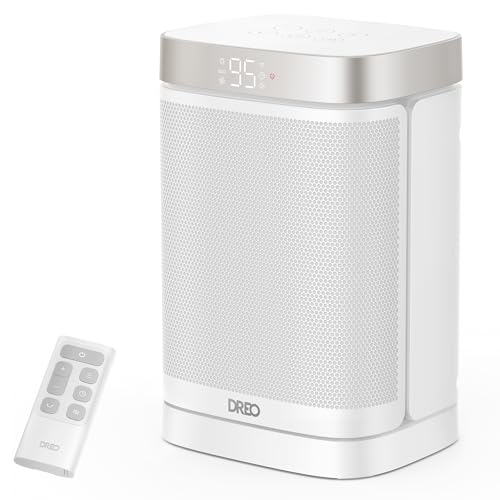
A compact heater is convenient beside a desk, under a workstation, or near a chair. The DREO Atom One and Amazon Basics models are especially portable based on their listed dimensions and weights. A compact body, however, does not automatically mean whole-room heating. The Amazon Basics listing describes personal portability but does not provide a room-coverage figure, while the PELONIS listing gives a 106-167-square-foot range. Treat stated coverage as a product-page reference rather than a guarantee for every room, since insulation, layout, ceiling height, and outdoor temperature affect results.
Tower heaters generally raise the outlet higher and may distribute airflow across a broader vertical area. The Lasko 5586, PELONIS, CAYNEL, and WINHL models use tower-style designs. The DREO 30-inch model goes further with selectable 30-, 60-, 90-, and 120-degree movement. If the goal is to reach more of a large room, broader oscillation is a useful specification to prioritize, but placement still matters. Keep the heater on a stable, open surface and follow the product instructions.
Compare oscillation design
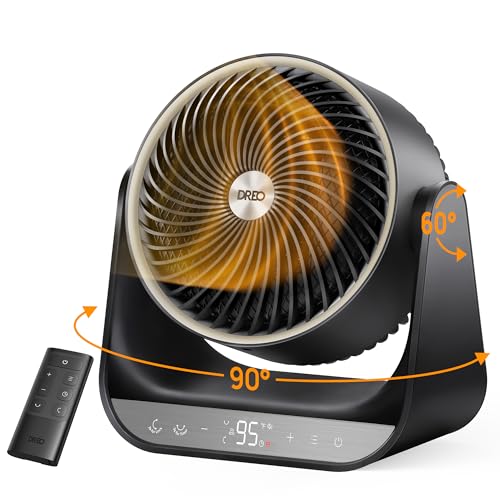
Most selected models document side-to-side oscillation from 45 to 120 degrees. Wider movement can help redirect airflow across more positions, while a narrower sweep may be adequate for a desk or chair. The DREO 3D model documents 60-degree vertical and 90-degree horizontal oscillation, making it distinct from products that only describe horizontal movement. The DREO fan-and-heater combo and DREO large-room tower document 120-degree horizontal movement.
Oscillation does not increase the heater’s maximum electrical output. A 1500W unit remains a 1500W unit whether its housing is stationary or moving. Instead, oscillation changes where the heated air is directed. Look for a model whose sweep matches the seating area or room shape, and avoid placing objects directly in front of the outlet.
Evaluate heat settings and thermostats
A 1500W rating appears frequently in this category, but control flexibility separates the models. WINHL lists 700W, 1000W, and 1500W levels. The DREO fan-and-heater combo lists five heating levels, while the DREO 30-inch tower adds five heat levels, ECO mode, and three fan levels. Simpler models such as the Amazon Basics heater use high, low, and fan-only settings.
A thermostat or ECO mode can reduce manual adjustment by responding to the selected temperature or ambient conditions. The DREO Atom One and DREO 3D model specify a 41-95°F range with 1°F increments. BREEZOME lists a 59-95°F range. These figures describe control ranges, not a promise that a heater will maintain a particular temperature in every room. Buyers who want fine adjustment should favor a documented temperature range and increment over vague claims of smart control.
Check timers and remote controls
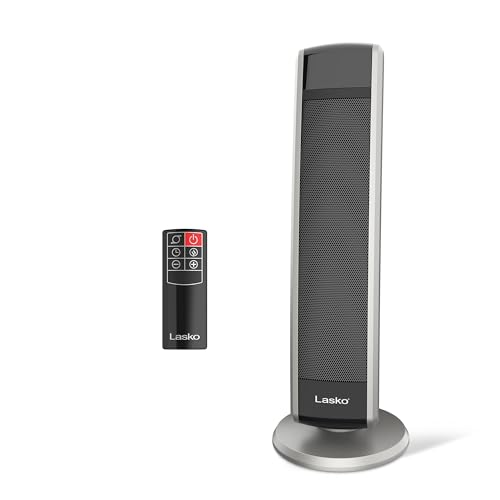
Timers are useful when you want the appliance to stop after a set period. Selected models offer 8-, 12-, or 24-hour timer functions. The BREEZOME MG33QN provides the longest documented timer range in this selection, while the Lasko and PELONIS models list 8-hour timers. A remote is convenient when the heater is across the room or when changing settings from bed. The Amazon Basics listing does not document a remote or timer, so it is better suited to straightforward nearby operation.
Treat safety features as essential specifications
The selected listings commonly identify tip-over and overheat protection. Several also mention ETL certification, flame-retardant materials, cool-touch housings, enhanced plugs, child locks, or automatic power-off functions. These features are useful safeguards, but they do not make unsafe placement acceptable. Plug a heater directly into an appropriate wall outlet when the instructions require it, keep flammable materials away, and never cover the unit. A safety lock, such as the one documented for CAYNEL, can help prevent unintended control changes but is not a substitute for supervision.
Consider noise and portability claims carefully
Noise figures are product-page claims and are not independently verified here. The Amazon Basics listing states 43dB, while PELONIS states 50dB. These numbers can help organize the comparison, but fan speed, room acoustics, and listener distance can change the experience.
Handles, low listed weight, and smaller dimensions make relocation easier. The DREO Atom One, Amazon Basics, and CAYNEL models are among the lighter selected designs. Taller towers may offer broader airflow positioning but occupy more vertical space and can be less convenient to store.
Final Recommendation
DREO 30-Inch Large Room Heater ranks first overall in this specification-based comparison under the published weighted criteria.
The DREO 30-Inch Large Room Heater is the highest-scoring returned product and the first overall specification-based choice among the best oscillating electric space heaters. Its documented 120-degree movement, multiple heat and fan levels, ECO mode, child lock, cool-touch housing, and 25dB claim create the broadest feature package for shoppers focused on coverage and control.
For vertical and horizontal circulation, the DREO 3D Oscillating Whole Room Heater is the more specialized alternative. The DREO Tower Fan and Heater Combo is the better fit when year-round fan operation matters. The Lasko 5586 stands out for its 3-year limited warranty and onboard remote storage, while BREEZOME MG33QN offers a 24-hour timer and a broad temperature range.
Among the more compact choices, DREO Atom One emphasizes fine thermostat adjustment, Amazon Basics keeps controls simple and weight low, CAYNEL adds a safety lock, and WINHL supplies three power levels. PELONIS offers a useful stated coverage range for shoppers comparing mid-size rooms. Together, these top oscillating electric space heaters cover a wide range of placement, control, and scheduling priorities without relying on volatile marketplace metrics.
Frequently Asked Questions
What should I look for in the best oscillating electric space heaters?
Prioritize documented oscillation range, heating wattage, thermostat behavior, safety protections, timer length, and placement requirements. A wider sweep can distribute airflow more broadly, while a thermostat and ECO mode can reduce repeated manual adjustments.
Is a 1500W oscillating heater suitable for every room?
Not necessarily. Many selected products use 1500W heating, but suitability depends on room size, insulation, drafts, ceiling height, and the desired temperature. PELONIS provides a specific 106-167-square-foot listing range; other products should be compared using their own published guidance.
Is a tower heater better than a compact heater?
Neither design is universally better. A tower may position airflow higher and provide a broader format, while a compact model is easier to move and place near one person. Choose based on available floor space, seating position, and whether you need whole-area circulation or personal warmth.
Do oscillating heaters use less electricity?
Oscillation changes airflow direction but does not by itself reduce the heater’s rated power draw. ECO modes and thermostats may adjust heating operation according to the selected temperature, but actual electricity use depends on settings and operating conditions.
Can I leave an oscillating space heater running unattended?
Use the timer and automatic protections only as described in the product instructions, and follow all placement and outlet guidance. Tip-over and overheat protection are helpful documented features, but supervision and safe operation remain important.