Buying Guide
Choosing among the best tower electric space heaters starts with matching documented controls and design to the room. This comparison uses public listing information, not hands-on testing. Wattage, oscillation, timers, thermostats, and safety features are useful comparison points, but stated coverage should be treated as guidance rather than a guarantee.
Match the heater to the room
A 1500W rating appears on most selected models, but wattage alone does not indicate how broadly warmth will be distributed. The DREO 30-inch model states coverage up to 300 square feet and offers oscillation from 30 to 120 degrees. The DREO 20-inch model states coverage up to 250 square feet with 70-degree oscillation. PELONIS lists up to 280 square feet for its 30-inch model and 106-167 square feet for its 23-inch model.
For a bedroom, office, or living room, place a tower where airflow can move into the occupied area without blocking walkways. Wider oscillation may help distribute air across more of a room, while a fixed or narrower design may suit focused personal warmth. BLACK+DECKER positions the BHTI06 for personal spaces, while the larger DREO and PELONIS towers document broader room use.
Compare ceramic and quartz designs
Most selected products use PTC ceramic heating. The ceramic models pair heating with features such as fan operation, oscillation, thermostat control, and multiple modes. The BLACK+DECKER BHTI06 uses dual quartz tubes with an integrated fan, providing a different radiant-heating format for focused warmth.
No heating design should be assumed to perform better in every room. Compare the airflow, controls, timer, and placement information documented for each model. A ceramic tower with oscillation may suit distributed airflow, while a quartz tower with manual controls may suit a user seated near the heater.
Review heat settings and thermostats
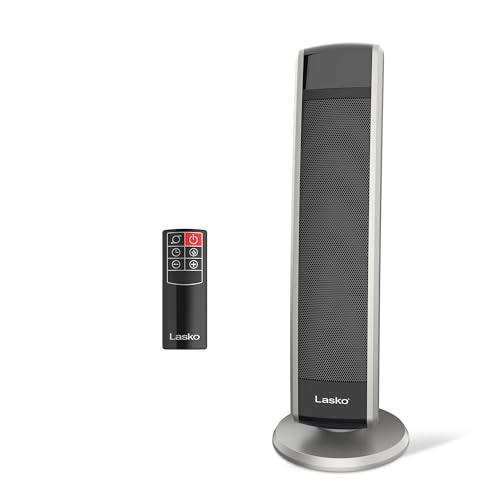
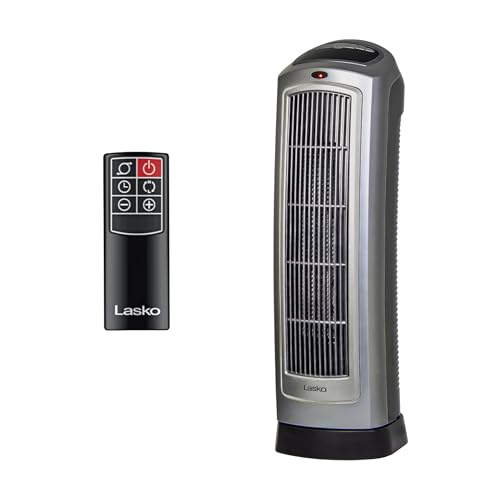
Two heat settings support basic low-or-high operation. The Lasko 5586, Lasko 5775, Honeywell HCE317, and BLACK+DECKER BHTI06 document two primary heat settings. The Lasko FH500 and FHV820 offer three heat settings, while the DREO 30-inch model lists five heat levels plus ECO and fan modes.
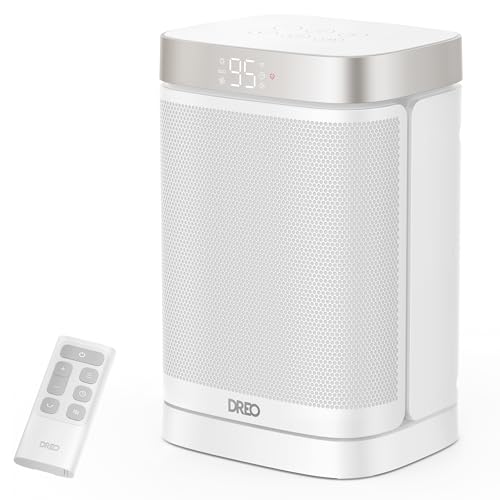
Thermostat features can help maintain a target temperature rather than running continuously at one setting. The DREO 20-inch model offers 1°F adjustments across a 41-95°F range, and the DREO 30-inch model also documents precise temperature control. PELONIS, Lasko, Honeywell, and the combination towers list adjustable or programmable thermostat functions. These are available controls, not independent measurements of temperature accuracy.
Consider oscillation, noise, and placement
Oscillation moves warm airflow across a wider area than a fixed outlet. The DREO 30-inch heater documents the broadest adjustable range in this selection. The PELONIS 30-inch model lists 75-degree oscillation, and the DREO 20-inch model lists 70 degrees. Lasko and Honeywell also document widespread or optional oscillation.
Noise claims vary. DREO lists 25 dB for the 30-inch model and 34 dB for the 20-inch model. PELONIS lists operation below 55 dB on its 30-inch model and 50 dB on its 23-inch model. These are listing figures rather than independent measurements, so use them as comparison points. For a bedroom or office, a documented quiet design and timer may be useful.
Check timers and remote controls
The DREO models and PELONIS 30-inch model document 12-hour timers. Several Lasko models and the PELONIS 23-inch heater document timers up to eight hours. Honeywell lists one-, two-, four-, and eight-hour settings. BLACK+DECKER does not document a timer in the supplied listing.
Remote controls are documented for both DREO models, both PELONIS models, and the selected Lasko digital and combination models. Honeywell lists digital controls without a remote. If the heater will sit near a bed or sofa, remote access may be convenient; otherwise, top-mounted or manual controls may be sufficient.
Prioritize safety documentation
All selected products document at least one protective feature, though details vary. Overheat protection and tip-over shutoff appear frequently. Honeywell lists dual overheat protection and a 360-degree tip-over switch. DREO lists child lock, cool-touch housing, and additional protections. Lasko documents cool-touch exteriors and overheat protection on the selected models, while PELONIS and BLACK+DECKER document tip-over and overheat protection.
Use a heater on a suitable indoor outlet and keep nearby items clear. Do not cover the unit, place it in a hazardous location, or ignore the manufacturer’s instructions. Safety features support comparison but do not replace careful operation.
Consider year-round utility and size
The Lasko FHV820 and FH500 combine a ceramic heater with a tower fan, offering multiple heat settings and fan speeds for seasonal use. This can reduce the need for separate appliances, but these units are taller and may occupy more floor space. The FH500 lists a 13-by-13-inch footprint, while the FHV820 stands 38.65 inches tall.
For smaller spaces, the Honeywell HCE317, Lasko 755320, and BLACK+DECKER BHTI06 have shorter tower profiles. The DREO 20-inch model combines a compact height with a stated 250-square-foot coverage figure. Check dimensions, carrying handles, and weight before choosing a permanent location.
Final Recommendation
DREO 30-Inch 120° Oscillating Heater ranks first overall in this specification-based comparison under the published weighted criteria.
DREO 30-Inch 120° Oscillating Heater is the first overall specification-based choice among these best tower electric space heaters. Its documented 300-square-foot coverage, adjustable 120-degree oscillation, five heat levels, precise control, quietness claim, 12-hour timer, and extensive protection package give it the most specification-aligned fit across the published criteria. The DREO 20-Inch Large-Room Ceramic Heater is a quieter compact alternative, while the PELONIS 30-Inch Ceramic Tower Heater emphasizes thermostat control and large-room positioning.
For simpler operation, the Lasko 5586 and Lasko 755320 provide digital controls, remotes, oscillation, and safety features. Honeywell suits shoppers prioritizing a slim footprint and detailed protection features. The Lasko FHV820 and FH500 are among the top tower electric space heaters for year-round fan-and-heater utility. BLACK+DECKER is the selected quartz option for focused personal warmth.
Frequently Asked Questions
Are tower electric heaters suitable for large rooms?
Some models are documented for larger spaces, but coverage varies. The DREO 30-inch model lists up to 300 square feet, the PELONIS 30-inch model lists up to 280 square feet, and the DREO 20-inch model lists up to 250 square feet. These figures come from product listings and should be treated as guidance. Placement, insulation, ceiling height, and outdoor temperature can affect comfort.
Is ceramic or quartz better for a tower heater?
Neither category is automatically better for every use. Ceramic models commonly combine PTC heating with fan operation, oscillation, thermostats, and multiple modes. The BLACK+DECKER BHTI06 uses dual quartz tubes with an integrated fan and is positioned for personal-space heating. Compare the documented features and placement needs of the individual product.
Which best tower electric space heaters have the longest timers?
The DREO 20-inch, DREO 30-inch, and PELONIS 30-inch models document 12-hour timers. Several Lasko models and the PELONIS 23-inch heater document timers up to eight hours. Honeywell lists one-, two-, four-, and eight-hour choices. BLACK+DECKER does not document a timer in the supplied listing.
Do these heaters include remote controls?
Remote controls are documented for both DREO models, both PELONIS models, and the selected Lasko digital and combination models. Honeywell lists digital controls without a remote, and BLACK+DECKER lists manual controls. Check which functions the remote operates on the model you choose.
What safety features should I compare?
Look for documented overheat protection and tip-over shutoff, then consider cool-touch housing, child lock, flame-retardant materials, certification, and automatic shutoff details. These features do not replace safe use: maintain clearance, use the recommended outlet, keep the heater upright, and follow the manufacturer’s instructions.