Buying Guide
Choosing among the best outdoor circuit breaker panels starts with the electrical layout rather than the enclosure alone. The selected products are load centers or outdoor circuit breaker enclosures documented for exterior use. They differ substantially in service rating, available spaces, circuit count, breaker system, and included components. The right choice depends on the planned load, the number of branch circuits, the available mounting area, and the compatibility requirements of the installation.
Confirm the panel type
A main-breaker panel includes a factory-installed primary breaker, while a main-lug load center is arranged around incoming lugs and may be used where a separate disconnect is provided. The Square D Homeline 100A 6-Space Load Center is a compact main-lug example. The ABB PowerMark Gold 125A Main-Lug Load Center is more flexible because its listing describes conversion between main-lug and main-breaker configurations.
Do not treat a main-lug model and a main-breaker model as interchangeable without confirming the planned arrangement. The service configuration, disconnect location, conductor sizes, and local requirements determine which design is appropriate. A qualified electrician should verify those details before installation.
Match amperage to the electrical plan
The selected range includes 100A, 125A, and 200A panels. A higher amp rating is not automatically better if the upstream service, conductors, or intended load does not support it. The Siemens SN 200A 8-Space Load Center and the Square D Homeline 200A 20-Space Load Center are both documented for 200A systems, while the Square D Homeline 100A models are aimed at smaller service or distribution requirements.
Use the required rating as a compatibility filter, not as the only ranking factor. A 125A panel can be a better fit than a 200A panel when the electrical design calls for 125A and the available space is appropriate. Conversely, a larger property or service upgrade may need the additional capacity documented by the ABB PowerMark Gold 200A 32-Space Load Center.
Count spaces and circuits carefully
Spaces are the physical breaker positions. Circuit totals may be higher when the panel accepts tandem breakers, so compare both numbers. The ABB 200A 32-Space Load Center offers 32 spaces and up to 64 circuits. The ABB PowerMark Gold 200A 20-Space Load Center and Square D Homeline 200A 20-Space Load Center each list 20 spaces and 40 circuits.
Smaller panels can still be suitable when expansion is limited. The Square D Homeline 100A 12-Space Load Center supports up to 24 circuits, while the 8-space Square D model supports up to 16. The six-space Square D model supports up to 12 with tandem breakers. Leave room for the actual breaker types required by the installation instead of assuming every listed circuit maximum will be available in every configuration.
Evaluate outdoor protection
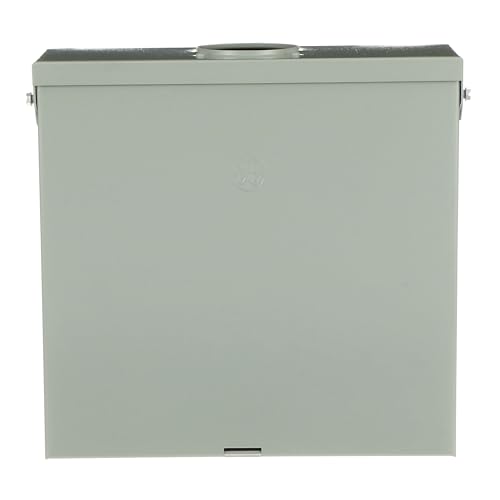
Outdoor enclosure terminology matters. NEMA 3R appears across many of the selected metal load centers, including the ABB, Square D, and Siemens options. The listings describe these enclosures as rainproof or weather-resistant, but that does not eliminate the need for correct mounting, hubs, covers, and sealing practices. Product enclosure protection is only one part of an outdoor installation.
The best outdoor circuit breaker panels should be matched to the mounting location and feed direction. The ABB 125A Main-Lug Load Center and the ABB 200A 20-Space Load Center document top- or bottom-feed support. That can help when conduit routes or service-entry direction constrain placement, but the installer still needs to confirm the permitted configuration.
Compare interrupt ratings
Interrupt ratings indicate the fault-current interruption capacity stated by the listing. Several selected products document 22 kA or 22,000 AIC/AIR ratings, including the ABB 32-space model, ABB 125A kit, Siemens SN panel, and Square D 100A models. The Siemens W0202MB1200CU listing confirms an outdoor 200A enclosure and UL listing but does not supply an interrupt rating in the provided evidence.
Do not fill in missing electrical specifications from a similar model. If the available listing does not state the value needed for the project, consult the manufacturer documentation or a qualified professional. Breaker and panel ratings must be considered together with the available fault current and system design.
Check breaker and wiring compatibility
Breaker families are not universal. The ABB listings identify compatibility with THQL, THQP, GFCI, or AFCI breakers, while the Square D models use Homeline features such as plug-on neutral and tandem-breaker support. The Siemens SN listing specifies Siemens plug-on neutral and a factory-installed ground bar. These details should guide selection before any purchase.
Wire-entry information can also matter. The Square D Homeline 100A 12-Space model documents box lugs accepting specified copper and aluminum ranges. The ABB 125A kit lists split neutral holes for #14–4 AWG wire. The Siemens SN panel lists more than 4 inches of wire-bending space. These are useful documented differences, but they do not replace checking the complete installation instructions.
Consider included breakers and enclosure size
Some products are sold with a main breaker only, while others include branch breakers. The ABB 125A 12-Space Panel Kit includes six 20A, one 30A, and one 50A breaker. The ABB 200A 32-Space model includes three 20A and one 30A breaker. The ABB 200A 20-Space model also includes a stated group of branch breakers. Included components may reduce separate sourcing, but verify that the supplied ratings and breaker family fit the intended circuits.
Physical dimensions are another practical filter. Larger-capacity panels generally need more wall area, and the ABB 32-space model is listed at 34.2 inches high. Smaller six- and eight-space designs may fit tighter locations, but they provide less expansion. Confirm clearances, working space, conduit entry, and mounting requirements before choosing based only on cabinet dimensions.
Final Recommendation
ABB PowerMark Gold 200A 32-Space Load Center Kit ranks first overall in this specification-based comparison under the published weighted criteria.
ABB PowerMark Gold 200A 32-Space Load Center Kit is the highest-scoring returned product and the first overall specification-based choice among the best outdoor circuit breaker panels. Its 32 spaces, up to 64 circuits, 22 kAIC rating, NEMA 3R enclosure, copper bus, breaker compatibility, and included breakers give it the broadest documented capability in this comparison.
For a more compact 200A layout, the ABB PowerMark Gold 200A 20-Space Load Center and Square D Homeline 200A 20-Space Load Center are logical alternatives. The ABB 125A 12-Space Panel Kit is notable when included branch breakers are useful, while the Square D 100A 12-Space model offers plug-on neutral wiring and 24-circuit potential. Smaller installations can consider the 8-space or 6-space Square D models, provided their ratings and available positions match the plan.
Among the top outdoor circuit breaker panels, the most important final checks are service amperage, circuit count, enclosure suitability, breaker compatibility, interrupt rating, conductor requirements, and local installation rules. Product listings provide a starting comparison; they do not replace the panel instructions or professional electrical review.
Frequently Asked Questions
What makes the best outdoor circuit breaker panels different from indoor load centers?
The selected outdoor models document weather-resistant or rainproof enclosures, commonly NEMA 3R. That enclosure rating is intended for outdoor exposure, but installation still requires appropriate mounting, conduit fittings, covers, clearances, and adherence to local requirements. An indoor panel should not be substituted solely because its amperage and space count look similar.
Is a 200A panel always preferable to a 100A or 125A panel?
No. The panel must match the service, conductors, calculated load, and planned installation. A 200A model offers a higher stated rating, but it may be unnecessary or unsuitable for a 100A or 125A design. The ABB and Square D models in this comparison show why rating, spaces, and breaker configuration should be evaluated together.
What is the difference between spaces and circuits?
Spaces are physical breaker positions. A panel may list a larger circuit total when tandem breakers are supported. For example, the selected ABB 32-space model lists up to 64 circuits, while the Square D 6-space model lists up to 12. Confirm which breaker types are permitted before relying on the maximum circuit figure.
Do all outdoor panels include branch breakers?
No. Some listings specify only a main breaker, while others include branch breakers. The ABB 125A Panel Kit and ABB 200A models document included branch breakers. Other products may require separate breakers, so check the exact package contents and confirm compatibility with the panel manufacturer’s system.
Can a main-lug panel replace a main-breaker panel?
Not automatically. A main-lug design may be appropriate where a separate disconnect is provided, while a main-breaker model integrates the primary breaker. The ABB 125A Main-Lug Load Center documents convertible main-lug/main-breaker configuration, but the installation still needs to follow the manufacturer’s instructions and applicable electrical requirements.