Buying Guide
The best oven-safe bowl sets are not all designed for the same job. Some are compact ramekins for desserts and sauces, while others are large handled crocks for soup or individual casserole dishes with lids. The most useful comparison starts with the food you prepare, the serving size you need, and whether the bowls will move directly from an oven to a table, refrigerator, or lunch bag.
Start with the documented heat limit
“Oven safe” is useful, but a stated temperature limit gives more practical context. The selected products range from KooK’s documented 350°F limit to stated limits of 480°F, 482°F, and 500°F on several porcelain and ceramic sets. A higher documented limit may provide more flexibility for baking or reheating, but it does not replace the manufacturer’s handling instructions.
MALACASA’s 6-ounce ramekins and DELLING’s 24-ounce soup bowls are both listed to 500°F. LE TAUCI’s large soup bowls and DOWAN’s handled bowls are listed to 482°F. The LE TAUCI bowls with silicone lids are listed to 480°F for both the body and lid. By contrast, the KooK cocottes clearly state 350°F, making them better suited to recipes that remain within that range.
Also check whether every included component has the same heat guidance. Among the selected products, the LE TAUCI covered soup bowls explicitly document oven use for the silicone lids, but they also caution against inverted use.
Match capacity to the meal
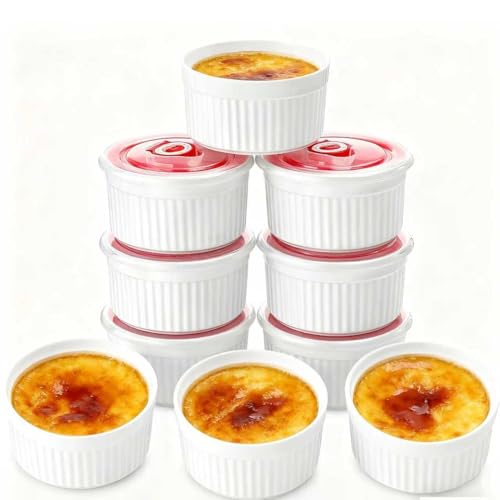
Capacity is one of the clearest differences between these sets. The 4-ounce LE TAUCI ramekins and 6-ounce MALACASA ramekins are aimed at crème brûlée, custard, soufflé, sauces, snacks, and other small portions. Mfacoy’s 8-ounce ramekins provide a little more room while retaining a compact footprint.
For individual baked meals, the 12-ounce LOVECASA and KooK cocottes offer a middle ground. Their lids and handles make them suitable for personal casseroles, pot pies, baked pasta, crisps, and similar dishes. Home Beets’ 16-ounce oval dishes provide more room and favor gratins, baked pasta, brie, and pot pies rather than liquid-heavy servings.
For soup and substantial meals, the larger options are more appropriate. DOWAN lists 26 ounces, while both selected LE TAUCI soup sets list 28 ounces. DELLING lists 24 ounces. Mora’s open porcelain bowls list 25 ounces and can serve soup, cereal, pasta, and other everyday foods. Remember that stated capacity may describe a full-fill amount, so leave room for toppings, bubbling, and comfortable carrying.
Decide whether handles matter
Handles are a major design distinction in oven-safe bowls. LE TAUCI, DOWAN, DELLING, LOVECASA, KooK, and Home Beets document handles or a handled form. These can make a hot dish easier to transfer, particularly when the contents are liquid or the bowl is going from oven to table.
Open bowls without handles, such as the Mora set, are more familiar for cereal, soup, and everyday dining but require a different approach when hot. Small ramekins also generally prioritize compact baking over carrying convenience. If you regularly prepare French onion soup, chili, or pot pies, a double-handle crock is a more targeted design than a standard open bowl.
Consider lids for storage and reheating
Lids make a set more useful after cooking. The LOVECASA and KooK cocottes include lids for individual portions, while Mfacoy’s ramekins use lids with date-tracking dots. The LE TAUCI 28-ounce bowls add vented silicone lids and describe them as leak-proof for storage and portability.
Covered designs are helpful for leftovers, meal prep, and moving food between locations, but they add parts that must be stored and cleaned. They can also have different heat instructions from the ceramic body. If you mostly bake and serve immediately, an open bowl or ramekin may be simpler. If you regularly refrigerate portions, a lid can justify choosing a slightly less specialized shape.
Check storage shape and available cabinet space
Stackability is particularly valuable because ceramic and porcelain sets can occupy substantial shelf space. LE TAUCI’s 28-ounce bowls use straight walls that nest, while DOWAN, DELLING, MALACASA, and Mora describe stackable or space-saving forms. LOVECASA says the mini cocottes are stackable and that the lids can be leaned beside the bowls.
Handled soup crocks and lidded cocottes generally need more vertical or side-to-side room than small ramekins. Before choosing a six-piece family set, measure the shelf where it will live and account for handles, lids, and the widest part of each bowl.
Look at the cleaning and surface claims
The selected products commonly describe smooth glazed ceramic or porcelain surfaces and dishwasher compatibility. MALACASA lists a smooth GLIDECOAT glaze, while DOWAN describes a scratch-resistant glazed surface. Mora highlights a lead-free glaze and scratch-resistant formula. These claims can help narrow the options, but they are product specifications rather than independent test results.
Silicone lids, embossed exteriors, and handles may add cleaning considerations compared with a plain, smooth bowl. The DOWAN embossed design and the LE TAUCI lidded set’s separate silicone components are examples of features that add utility while also creating more surfaces and parts to manage.
Final recommendation
LE TAUCI 28 oz Bowls with Silicone Lids ranks first overall in this specification-based comparison under the published weighted criteria.
LE TAUCI’s 28-ounce French onion soup bowls are the first overall specification-based choice among these best oven-safe bowl sets. They combine a stated 482°F oven limit, large capacity, dual handles, stackable walls, and dishwasher-friendly glazed ceramic. For covered storage, the LE TAUCI 28-ounce bowls with silicone lids are a stronger fit. For family quantity, DELLING provides six 24-ounce handled porcelain bowls with a stated 500°F limit.
Choose MALACASA or Mfacoy for compact ramekin work, LOVECASA or KooK for lidded individual casseroles, and Home Beets for oval baked dishes. Mora is the simpler open-bowl option for everyday meals. These top oven-safe bowl sets differ most in capacity, heat documentation, handling, and storage, so the best match depends on the recipes and serving sizes you use most.
Frequently Asked Questions
What should I look for in the best oven-safe bowl sets?
Start with a documented oven temperature limit, then compare capacity, material, handles, cleaning instructions, stackability, and whether lids are included. Also verify whether the stated heat guidance applies to lids as well as bowl bodies.
Are ramekins suitable for full meals?
Small ramekins are generally better for desserts, custards, soufflés, sauces, and small sides. The selected 4-ounce, 6-ounce, and 8-ounce options are compact. For soup or a full individual casserole, a 12-ounce cocotte or a 16-ounce baking dish provides more room.
Are handled soup bowls better for hot food?
Handles can make a hot bowl easier to carry from oven to table, especially for liquid dishes. They do not eliminate the need for appropriate oven mitts or careful handling. DOWAN, DELLING, and LE TAUCI’s large soup bowls all document handled designs.
Can lidded oven-safe bowls go from the oven to the refrigerator?
The bowl and lid instructions must be checked separately. Mfacoy lists its porcelain bodies as oven and freezer safe, while the LE TAUCI covered soup bowls document heat resistance for the ceramic body and silicone lid. Follow the specific product guidance and allow hot food to cool appropriately before storage.
Which set is easiest to store in a small kitchen?
Look for documented stackability and consider the footprint of handles and lids. Small ramekins usually occupy less space, while several selected soup bowls and cocottes also describe nesting or stackable designs. A lidded set may save food-storage space but require room for the extra components.