Buying Guide
Choosing among the best pine coat hooks starts with the room, the installation surface, and the items you expect to hang. A compact wall board can work well for a few daily coats, while a longer organizer or freestanding tree is more suitable for a busy household. These rankings use supplied listing descriptions and specifications rather than hands-on testing or customer opinions.
Choose wall-mounted or freestanding
Wall-mounted racks keep the floor clear and suit narrow hallways, small apartments, mudrooms, and entryways with limited circulation space. WEBI, Dseap, SKOLOO, and Kuhome are straightforward wall-mounted choices. Their boards provide fixed hook locations and require the wall, anchors, or studs to support the installation.
A freestanding stand offers different flexibility. Haddockway can be configured at three listed heights, from 39.5 inches to 68.8 inches. That can help when children and adults share a room or when drilling is undesirable. The trade-off is a floor footprint, so place the base where it will not obstruct a walkway.
Match the hook style to your items
Triple hooks provide more than one hanging position per mounting point. Kuhome, Dseap, SKOLOO, and WEBI use multi-position designs that can accommodate coats, hats, bags, scarves, or leashes. This can increase practical capacity on a shorter board, but bulky garments may overlap when the rack is heavily loaded.
Simple hooks create a more conventional layout. HBCY Creations uses five metal hooks, while JAC HouseHold, GUDGI, and Evermagin add separate coat and key hooks. Those arrangements are useful when coats, keys, mail, and accessories should have distinct places.
Umbra uses flip-down wooden hooks. They fold away when not needed, allowing the rack to function as a decorative wall feature between uses. The listing provides individual and total capacity information for the selected eight-hook configuration, but the stated per-hook limit should still guide the intended load.
A stated capacity is useful only when its scope is clear. WEBI ties its listed capacity to concrete walls or brick, while Kuhome provides a per-hook figure. SKOLOO gives a 30-pound capacity, but the listing does not clarify whether that figure applies to each hook or the whole rack. Umbra provides both individual and total figures for its selected version.
Other products do not provide numeric capacity information. That does not establish that they are weak; it means the supplied evidence offers less guidance for comparing loads. JAC HouseHold describes an 80-pound capacity for its shelf organizer, while GUDGI and Evermagin describe reinforced or load-bearing hooks without giving a numeric limit. Follow the installation instructions and make sure the wall surface and anchors are appropriate for the expected load.
Measure length and spacing
Measure the available wall before choosing a rack. Kuhome is listed at 38.58 inches long, and Evermagin measures 35 inches, so both need a relatively open wall. JAC HouseHold is listed at 29 inches, while HBCY Creations measures 24 inches. WEBI and the compact Dseap and SKOLOO boards are closer to 17 inches and may fit smaller sections.
Spacing matters as much as overall length. WEBI documents wide hook spacing, while Dseap and SKOLOO use 16-inch hole-spacing details for mounting. A shorter rack can still be practical when its hooks are arranged to reduce crowding. If you expect to hang thick coats beside backpacks, prioritize documented spacing rather than judging from hook count alone.
Consider shelves and accessory storage
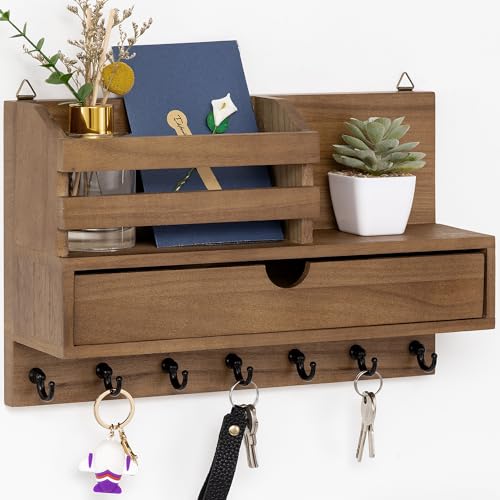
A coat rack becomes more useful when it handles the small items that otherwise collect on a table. JAC HouseHold combines shelves, coat hooks, key hooks, and a mail section. GUDGI adds a display shelf, mail storage, and glasses storage. Evermagin provides a shelf, key holder, and mail organizer alongside seven coat hooks and four key hooks.
These integrated designs are well suited to household entryways where coats, keys, mail, and accessories need designated places. They are less appropriate for a minimalist wall where only outerwear needs to be hung. HBCY Creations, Dseap, or SKOLOO may be easier to place above a bench, inside a mudroom, or beside a bedroom door.
Review assembly and mounting details
Installation information varies. Dseap and SKOLOO are described as pre-assembled, and WEBI arrives with the hooks mounted to the pine board. Kuhome lists screws, drywall anchors, and screw-cover plugs in the package. Haddockway uses tool-free freestanding assembly, avoiding wall drilling entirely.
Shelf organizers may require more positioning because they are deeper and combine several functions. JAC HouseHold describes supplied screws and instructions, while GUDGI describes a pre-assembled organizer that still requires some assembly. Before drilling, identify studs where possible, compare the supplied anchors with your wall type, and account for the organizer’s depth above the floor or a bench.
Final recommendation
WEBI Rustic Pine Wall Coat Rack ranks first overall in this specification-based comparison under the published weighted criteria.
Among the top pine coat hooks, the selected products differ in documented load support, pine material evidence, hanging storage capacity, installation practicality, and layout versatility.
WEBI Rustic Pine Wall Coat Rack is the first overall specification-based choice among these best pine coat hooks.
WEBI combines solid pine, thick one-piece hooks, wide spacing, pre-assembly, and clearly documented mounting details. Its stated capacity is tied to concrete walls or brick, so buyers should not treat that figure as universal. JAC HouseHold is the better match when shelf, key, and mail storage matter, while GUDGI and Evermagin also provide broad entryway organization.
For long wall coverage and many multi-position hooks, Kuhome is a strong fit. Umbra suits shoppers who prefer a decorative flip-down design with individual and total capacity information. Choose HBCY Creations for a simple farmhouse-style board, Dseap or SKOLOO for compact pre-assembled triple-hook racks, and Haddockway when adjustable freestanding height is more important than preserving floor space.
The right selection depends on wall dimensions, expected load, preferred hook layout, and whether shelves or accessory storage are necessary. Treat unsupported capacity assumptions cautiously, use appropriate mounting hardware, and compare the documented dimensions with the installation location before ordering.
Frequently Asked Questions
What makes pine coat hooks different from generic wood hooks?
Pine is specifically documented in the selected products as solid pine, pinewood, New Zealand pine, or real pine wood. That distinguishes these products from listings that only say “wood” or identify another material.
Are wall-mounted or freestanding pine coat hooks better for a small entryway?
Wall-mounted racks generally preserve floor space, making WEBI, Dseap, SKOLOO, or HBCY Creations practical starting points for narrow areas. A freestanding Haddockway stand avoids drilling and offers adjustable height, but its listed footprint still needs clear floor space. Measure both the wall and walking path before choosing.
Which best pine coat hooks include shelves or mail storage?
JAC HouseHold, GUDGI, and Evermagin are the selected products with documented shelf and entryway organization features. JAC HouseHold describes a two-tier shelf and mail-and-key section. GUDGI includes a display shelf, mail storage, and glasses hanger. Evermagin combines a display shelf, key holder, and mail organizer with coat and key hooks.
How many hooks do I need for a household?
Count the people using the entryway and the items that need daily access. Five simple hooks may be enough for a couple or secondary room, while seven coat hooks plus key hooks can suit a busier family area. Triple hooks increase hanging positions, but thick coats can overlap. A shelf organizer may reduce the need to use a coat hook for keys or accessories.
What should I check before installing a pine wall rack?
Check the rack’s length, depth, hole spacing, supplied hardware, and any stated wall-surface limitations. WEBI documents 16-inch stud-spacing holes and includes anchor types, while Dseap and SKOLOO also describe 16-inch spacing. Confirm that the wall can support the expected load, use suitable anchors, and leave clearance for coats, bags, and the rack’s depth.