Buying Guide
Choosing the best solid wood coat hooks starts with deciding whether you need a floor-standing coat tree, a fixed wall rack, or separate hooks. The selected products cover all three formats, but they solve different storage problems. A freestanding tree can be moved and may provide more hanging positions, while a wall-mounted rack keeps the floor clear. Individual hooks offer the most control over spacing and height.
Choose the layout before the finish
Measure the intended location before comparing wood species or colors. Wall racks in this group range from compact boards around 16.5 inches long to a 36-inch design. A shorter board can fit beside a door or in a narrow hallway. A longer board spreads garments across the wall and may reduce crowding, but it needs a broader clear section.
Freestanding designs need floor clearance as well as vertical clearance. The VASAGLE 10-hook coat tree has an 18.5-inch tri-legged base, while the Muwuele tree lists a footprint of about 15.7 inches square. The VASAGLE adjustable tree and Pipishell rack also use triangular bases. These formats can work in an entryway corner, but the base should not obstruct a walkway.
Compare hook count with actual use
Hook count is useful, but it does not automatically indicate how much clothing can hang comfortably. The VASAGLE 10-hook rack and Muwuele 12-branch rack offer the most documented positions in this selection. They suit shared entrances or households where coats, bags, hats, and scarves need separate locations.
Wall-mounted choices are more compact. Individual Felidio hooks are different: their separate placement lets you create wider spacing for thick coats or lower positions for children.
Check how the listing defines capacity. Some products give a per-hook figure, some provide a whole-rack figure, and some provide both. VASAGLE documents both per-arm and total guidance. Muwuele documents branch and total figures. Optish supplies per-hook and overall numbers. These claims are useful for comparison, but the wall itself, mounting method, and condition of the hardware still affect real-world suitability.
Solid wood does not mean identical construction
The phrase solid wood covers several documented materials in this group. VASAGLE lists solid wood, Pipishell lists knot-free pine, and HBCY Creations identifies solid Russian pine. Other examples use rubberwood, beech, or bamboo. Muwuele specifically identifies FAS rubber wood, while Felidio and QUELLANCE describe beech-based construction.
Look for the exact material when appearance matters. Beech often gives a lighter wood look, pine supports a rustic appearance, and rubberwood is used in several furniture-style freestanding designs. A finish or color name does not by itself establish the wood species, so rely on the construction and specification fields rather than assuming that a walnut or brown finish means walnut lumber.
Consider added storage features
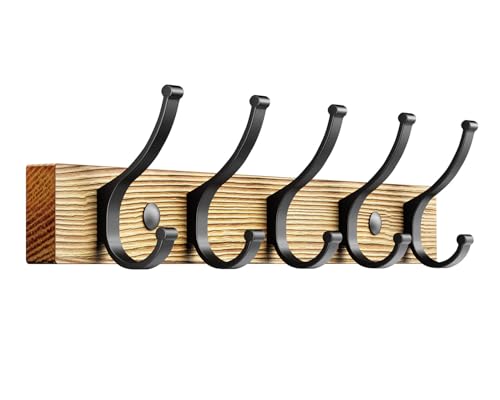
A simple peg rack is usually the easiest format to understand. The Optish and HOMEBROS racks use five hooks on compact boards, while Felidio provides separate hooks for a more customized arrangement. If you need a place for keys or small accessories, HBCY Creations adds a shelf above five hooks.
The QUELLANCE rack uses six flip-down hooks that retract when not needed. This can help a narrow area look less crowded. WEBI uses triple hooks and wide spacing, giving each position multiple hanging points. Freestanding trees provide a different kind of flexibility: Pipishell and the adjustable VASAGLE model can be configured for different heights, which may be helpful in a family entryway.
Review installation requirements
Wall-mounted products require more than simply placing the rack against a wall. Check the included hardware, mounting-hole spacing, and wall type. WEBI lists 16-inch hole-to-hole spacing intended to match standard wall studs. Other racks include anchors or expansion tubes, but the supplied hardware may not be appropriate for every wall surface.
Preassembly can reduce setup time. WEBI arrives with its hooks mounted, HOMEBROS requires no assembly, and QUELLANCE includes mounting components and drill bits. Freestanding products vary as well: Pipishell states tool-free setup, while VASAGLE provides numbered parts and instructions. Separate Felidio hooks require several individual mounting decisions, but that extra work gives you more control over the final arrangement.
Match the rack to your room
For an entryway shared by several people, start with VASAGLE or Muwuele because their tree formats document many hanging positions. For a family that needs different heights, the adjustable VASAGLE rack and Pipishell are more targeted choices. For a wall where floor space is limited, WEBI, Optish, HOMEBROS, and QUELLANCE keep storage vertical.
For a rustic room with a useful ledge, HBCY Creations adds shelf space. For a modular layout, Felidio gives you four independent beech hooks. The best solid wood coat hooks are therefore the ones whose mounting format, dimensions, and documented capacity fit the room—not simply the product with the most hooks.
Final Recommendation
Muwuele Solid Wood Coat Rack with 12 Hooks ranks first overall in this specification-based comparison under the published weighted criteria.
VASAGLE Solid Wood Coat Rack with 10 Hooks is the first overall specification-based choice among these best solid wood coat hooks because it combines a high documented hook count, solid wood construction, a defined base, and specific load guidance. Muwuele is the stronger alternative when 12 branches and adjustable heights matter most, while the adjustable VASAGLE model is well suited to mixed-height households.
For wall storage, WEBI is the most useful wide-rack choice, Optish and HOMEBROS are compact five-hook options, and QUELLANCE is the distinctive pick when retractable hooks are desirable. HBCY Creations adds a shelf, Felidio supports a custom layout, and Pipishell offers a compact freestanding format. Together, these top solid wood coat hooks cover the main layouts without relying on volatile marketplace claims.
Before ordering, confirm the available wall or floor space, identify where studs or suitable anchors are located, and compare the stated load format with the items you plan to hang. That final check is especially important for heavy coats, crowded family entrances, and wall-mounted designs.
Frequently Asked Questions
What should I look for in the best solid wood coat hooks?
Start with documented wood construction, the number and type of hooks, dimensions, and installation information. Then consider whether a wall rack, freestanding tree, shelf rack, or separate hook set fits your room. A stated capacity is helpful, but it should be considered alongside the mounting surface and hardware.
Are freestanding solid wood coat trees better than wall racks?
Neither format is universally better. A freestanding tree can be repositioned and may provide many hanging points, as shown by Muwuele and VASAGLE. A wall rack such as WEBI or HOMEBROS preserves floor space but requires suitable mounting. Choose based on the room layout and whether permanent wall installation is acceptable.
Which selected rack is useful for children and adults?
The adjustable VASAGLE solid wood coat rack and Pipishell both document three height options. These configurations can make different sections accessible to children or adults. Muwuele also documents three adjustable heights, giving it similar flexibility in a freestanding tree format.
Do wall-mounted coat hooks need studs?
Not always, but the wall type and hardware determine the appropriate installation method. WEBI specifically lists 16-inch mounting-hole spacing intended for wall studs. Other products include anchors or expansion tubes. Review the supplied instructions and confirm that the mounting method suits your wall before loading the rack.
Are separate wood hooks useful for unusual wall spaces?
Yes. Felidio’s four separate beech hooks can be installed at a spacing and height that suit the available wall. This is useful when a continuous rack would not fit or when coats, bags, and children’s items need different positions. The trade-off is that each hook must be measured and mounted individually.