Buying Guide
The best plastic bowl sets are not all designed for the same job. The selected products divide into two useful groups: compact meal bowls for serving cereal, soup, snacks, and salads, and larger nesting sets intended for mixing, storing, and transporting food. Start by identifying which workflow matters most, then compare capacity, storage, cleaning, heat-use guidance, and handling details.
Meal-bowl sets such as Ohola and HEYCOME are best when you want several similarly sized bowls for household dining. Ohola documents 26-ounce bowls, while HEYCOME lists 12 bowls in six colors but does not provide a capacity. These sets can work for cereal, soup, rice, salads, snacks, and similar meals. Their simpler format generally means fewer pieces to organize, but neither selected design includes lids.
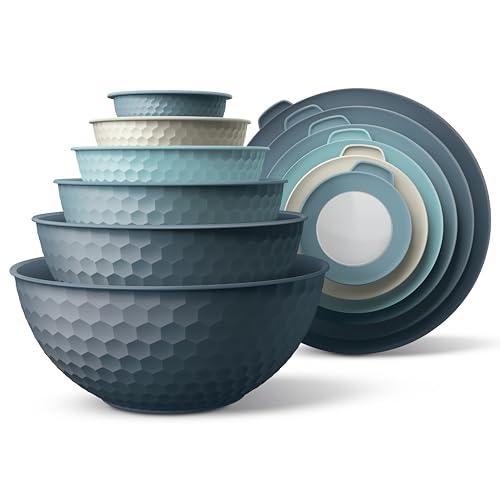
Mixing and storage sets are more flexible. Zulay Kitchen, COOK WITH COLOR, BoxedHome, and Bakken Master each document six bowls with multiple capacities and matching lids. Freshmage also supplies six nesting bowls with lids, with sizes from 0.3 to 5.3 quarts. These designs are better suited to ingredient preparation, baking, serving, leftovers, and food transport because the bowls cover both small and large tasks.
Compare capacity ranges
Capacity is one of the clearest differences between these products. The largest mixing sets reach approximately 5.8 quarts, giving you room for salads, batter, or larger batches. The smallest listed sizes, such as 0.32 quart, are more suitable for measured ingredients, chopped toppings, sauces, or small portions.
A broad range is useful only if you have room to store it. If your main need is serving individual meals, a set of eight similarly sized bowls may be more practical than six bowls in very different sizes. If you bake, meal prep, or frequently store leftovers, the wider ranges from Zulay Kitchen, COOK WITH COLOR, BoxedHome, and Bakken Master provide more task coverage.
Look for nesting and cabinet efficiency
Every selected mixing set documents nesting or stackable storage in some form. Nesting lets smaller bowls sit inside larger ones, reducing the shelf footprint when the set is not being used. Freshmage separately notes that its lids can be stored in piles, which addresses a common storage issue with lidded sets.
The meal-bowl products also document stackability. This is useful for compact cabinets, dorm rooms, offices, and travel-oriented use. However, stackability does not tell you the total stored height or how easily the bowls separate, so leave enough clearance for the complete stack and consider whether you prefer a single nested column or multiple smaller stacks.
Decide whether lids are essential
Lids make a major difference if the bowls will move from preparation to refrigeration or transport. Zulay Kitchen describes tight-fit lids that help prevent spills, while Bakken Master describes matching lids for storing and transporting food. COOK WITH COLOR and BoxedHome likewise position their lids for storage and on-the-go use.
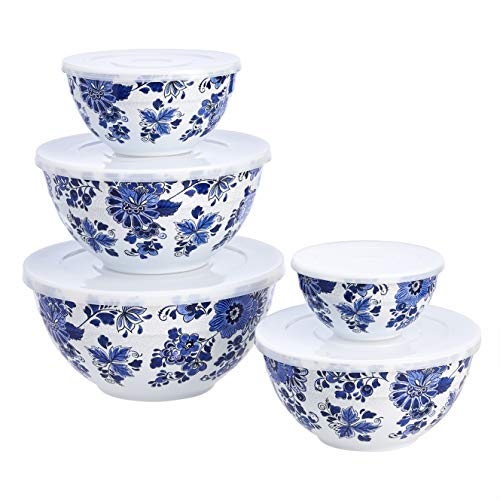
Check the heat instructions before reheating. Several sets specify microwave use with lids removed, and Freshmage explicitly says its lids should not go in the microwave. Amazon Basics does not recommend microwave use for the melamine set. These details matter because a bowl that stores leftovers may still require a separate uncovered container for reheating.
Review cleaning and appliance guidance
Dishwasher compatibility is widely documented across the selected products, but the wording varies. Top-rack guidance appears for Freshmage, COOK WITH COLOR, BoxedHome, and Amazon Basics. That is more specific than simply saying dishwasher safe, so follow the supplied placement instructions.
Microwave and freezer use are also not interchangeable. Zulay Kitchen, COOK WITH COLOR, BoxedHome, and Bakken Master list both microwave and freezer suitability for the bowls. Freshmage does the same while excluding the lids from microwave use. Amazon Basics lists dishwasher use but explicitly excludes microwave use. For meal prep, read the bowl and lid instructions separately.
Consider material and durability claims carefully
The listings describe several designs as lightweight, unbreakable, shatter-resistant, break-resistant, or made from durable plastic. Those descriptions indicate the intended positioning, but they do not replace independent testing. Plastic and wheat straw fiber sets may appeal to households seeking an alternative to glass or ceramic, especially where dropped dishes are a concern.
Amazon Basics uses BPA-free melamine and describes the bowls as break resistant. The meal-bowl options from Ohola and HEYCOME use wheat straw fiber and emphasize lightweight handling. Zulay Kitchen, COOK WITH COLOR, BoxedHome, and Bakken Master identify food-safe or BPA-free plastic materials. Avoid assuming that similar material language means identical construction; compare the exact care and heat guidance for the set you choose.
Check stability and handling features
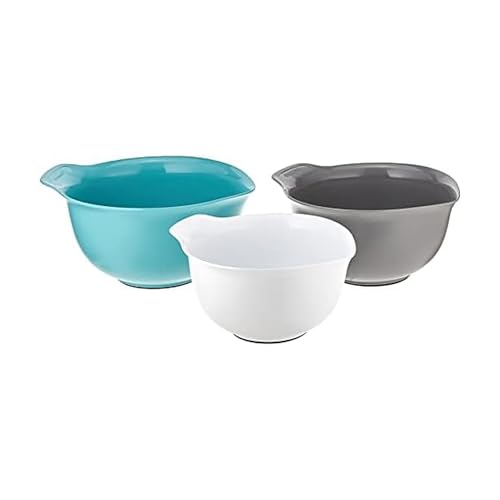
Stability features can make mixing and pouring easier. OXO documents wide grips, pour spouts, and non-slip bases. KitchenAid also lists non-slip bases and pour spouts across its three bowls. Amazon Basics specifies non-slip bases, while BoxedHome describes a rubber layer intended to reduce skidding.
For meal bowls, HEYCOME lists a non-slip wall pattern and an anti-slip ring on the bottom. These details show why it is useful to distinguish between a bowl designed for countertop mixing and one designed primarily for holding meals.
Final recommendation
Zulay Kitchen 12-Piece Bowls With Lids ranks first overall in this specification-based comparison under the published weighted criteria.
Zulay Kitchen 12-Piece Bowls With Lids is the first overall specification-based choice among the best plastic bowl sets. Its six capacities, six lids, nesting design, non-slip construction, and stated microwave, freezer, and dishwasher utility give it the broadest documented role across preparation, storage, and serving. The top plastic bowl sets for specialized needs are different: choose OXO for grip and mixing control, Amazon Basics for melamine serving with non-slip bases, or Ohola for straightforward 26-ounce family meal bowls.
Before ordering, verify the required capacity, whether lids are included, and whether microwave use applies to the bowls, the lids, or neither. Also confirm that the stored stack fits your cabinet and that the cleaning instructions match your dishwasher routine. Those checks are more useful than relying on a general label because the selected sets vary substantially in purpose.
Frequently Asked Questions
What should I look for in the best plastic bowl sets?
Prioritize the features that match your routine: multiple capacities for mixing, lids for storage, nesting for compact cabinets, and clear dishwasher or microwave instructions. Stability features such as non-slip bases and pour spouts are especially useful for countertop preparation.
Are plastic bowl sets microwave safe?
Some selected sets are documented as microwave safe, including Zulay Kitchen, COOK WITH COLOR, BoxedHome, and Bakken Master. Freshmage says to remove its lids before microwaving, while Amazon Basics states that its melamine set is not for microwave use. Always follow the product-specific guidance.
Are bowls with lids useful for meal prep?
Yes, when the set documents tight-fitting lids and freezer or refrigerator use. Zulay Kitchen, Freshmage, COOK WITH COLOR, BoxedHome, and Bakken Master all include features relevant to storing food. Check whether the lids are microwave safe before reheating.
Which selected set is best for mixing?
OXO is the clearest mixing-focused choice because its listing documents wide grips, pour spouts, non-slip bases, and three nested sizes. KitchenAid also lists pour spouts and non-slip bases, making it another suitable option for mixing and pouring.
Are wheat straw fiber bowls plastic bowls?
The supplied listings market the Ohola, HEYCOME, and other wheat straw fiber products as plastic or reusable bowl sets. They are category-relevant here because they independently function as reusable meal bowls, but their material descriptions differ from polypropylene, melamine, or other plastic formulations.