Buying Guide
The best plastic jar openers are not all built around the same motion. Some are jar keys that lift the edge of a lid and release the vacuum. Others use teeth, circular openings, raised surfaces, or textured material to improve contact while the user twists. A good choice depends on the lid types in your kitchen, the amount of hand control available, and whether the opener needs to stay in one drawer or travel between locations.
Start with the opening mechanism
A vacuum-seal release can matter more than raw grip. CerAiCoae documents a hook that slides beneath the rim and lifts until the seal releases. FDKYOEK and Yolev also describe a lift-first method before twisting. This style addresses the initial resistance created by a sealed jar, after which the lid may be easier to turn by hand.
Other tools rely on direct contact. Haikole and JJUNW describe non-slip teeth or surfaces that grip the lid while the handle is used. Chef Craft takes a different approach with a raised design that wraps around the lid. These designs can be convenient when the main issue is slipping rather than a strong vacuum, but the supplied listings do not establish that one mechanism works better in every situation.
Match the opener to lid sizes
Lid compatibility is one of the most useful specifications to check. Haikole and JJUNW list a 1- to 3.5-inch range, making their documented coverage relatively clear. Those details are helpful when a household uses several common container sizes.
Several other selections, including Chef Craft, use broader language such as working with most lid sizes. That can be useful, but it is less precise than an actual diameter range. FDKYOEK specifically says it is not for canning jars, so buyers should not treat a compact jar key as a universal solution for every sealed container. If canning jars or unusually wide lids are common in your kitchen, the documented limitations deserve attention before choosing.
Consider grip shape and leverage
A comfortable handle is important for users with weak hands, arthritis, or limited dexterity, but the supplied evidence varies in specificity. Haikole lists a contoured grip and non-slip teeth. JJUNW describes an ergonomic easy-hold handle and minimal operating pressure, while CCHOME emphasizes a comfortable grip and a simple construction without moving parts.
Longer handles can provide more leverage, although leverage depends on the lid, contact point, and how the tool is used. The compact jar keys from FDKYOEK, Haikole, JJUNW, and Yolev may be easier to store, but their shorter formats offer less documented handle length than the larger multi-size designs.
Look for a shape that can be held securely without pinching. Rounded edges are documented for FDKYOEK, Yolev, and Haikole, while CCHOME is described as having no sharp edges or points. These are construction details, not guarantees of comfort for every user, so individual hand size and mobility still matter.
Material descriptions help distinguish a basic plastic tool from a mixed-material design. Haikole and Yolev specify ABS, while CCHOME identifies high-density ABS. FDKYOEK, zuylikxy, LUSTRIB, and JJUNW describe plastic construction without giving the same level of material detail.
Care instructions are also uneven. Haikole, Yolev, JJUNW, and CCHOME are described as dishwasher safe. CerAiCoae uses a one-piece ABS body with no springs or hinges, which may simplify the physical design, but its listing does not provide a dishwasher instruction. For any tool without explicit cleaning guidance, follow the product instructions rather than assuming dishwasher compatibility.
Decide whether a multipack helps
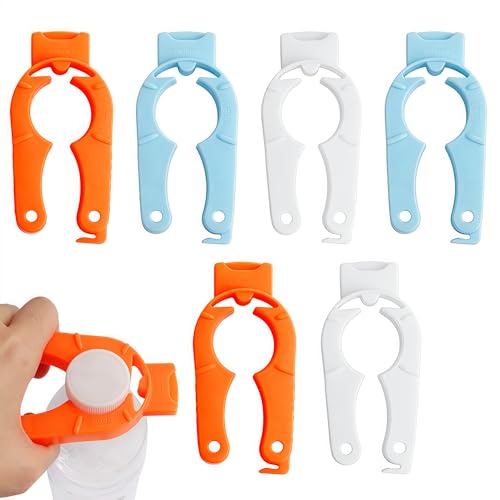
Multipacks are useful when more than one person uses the kitchen or when an opener should be kept in several places. Yolev and LUSTRIB provide six-piece sets, while CerAiCoae also supplies six color-varied tools. JJUNW and zuylikxy provide three pieces, and FDKYOEK and Taefuwr provide two. Color variety can make tools easier to distinguish, but it does not by itself indicate stronger opening performance.
A single tool may be preferable when drawer space is limited or when one opener will stay beside a frequently used storage area. Consider whether additional pieces will actually be stored where they are needed; otherwise, a larger set may add clutter rather than convenience.
Think about portability and secondary tasks
Compact designs are easier to keep in a drawer, bag, or travel kit. FDKYOEK, Haikole, JJUNW, Taefuwr, and Yolev all document compact storage or portable use. Taefuwr is also listed for soda and beer bottles, and LUSTRIB is described for twist-off caps, pop-top lids, and pull-tab cans. These added tasks may be useful in kitchens, camping gear, or outdoor kits.
Secondary uses should not distract from the primary jar-opening requirement. A broad feature list is valuable only when the tool still offers a suitable grip and contact method for the lids you use. For a jar-focused purchase, start with seal release and lid range, then use portability and multipurpose functions as tie-breakers.
Final recommendation
JJUNW 3-Piece Plastic Jar Key Opener Set ranks first overall in this specification-based comparison under the published weighted criteria.
Haikole Plastic Jar Key Opener is the first overall specification-based choice among these best plastic jar openers. Its combination of ABS construction, non-slip teeth, contoured grip, dishwasher suitability, and clearly stated 1- to 3.5-inch coverage gives it the most specification-aligned balance of documented features.
The top plastic jar openers for larger households are JJUNW and Yolev because their multipacks support several storage locations. For a simpler purchase, CCHOME, FDKYOEK, zuylikxy, and Chef Craft offer compact plastic jar-key or gripper formats with different levels of documented coverage.
No selection here represents a hands-on performance test. The ranking reflects the supplied specifications and features, including construction, opening method, stated compatibility, care instructions, and storage utility.
Frequently Asked Questions
Are the best plastic jar openers suitable for canning jars?
Not automatically. FDKYOEK specifically says it is not for canning jars, and several other listings do not state a canning-jar range. Check the documented diameter and mechanism before using any compact jar key on a wide or unusually tight lid.
Haikole and JJUNW list a 1- to 3.5-inch range. Those are more precise claims than listings that simply say the tool works with most lids.
Is ABS plastic different from a general plastic listing?
ABS is a named plastic material, so it gives more construction detail than a listing that only says plastic. Haikole, Yolev, and CCHOME identify ABS, while several other selected products use a general plastic description. Material detail does not by itself establish better opening performance.
Should I choose a multipack or one opener?
Choose a multipack when tools will be kept in different drawers, shared among users, or carried in more than one kit. A single tool may be more practical when storage space is limited. The best option depends on where and how often the opener will be used.
Can these openers replace a dedicated bottle opener?
Some selected products are explicitly listed for bottle caps or other containers. Taefuwr is described for soda and beer bottles, while LUSTRIB is listed for twist-off caps, pop-top lids, and pull-tab cans. A jar-only design should not be assumed to perform those additional tasks unless the listing documents them.