Buying Guide
The best stainless steel jar openers differ mainly in how they contact the lid, how widely they adjust, and how much handle support they provide. The products selected here are manual kitchen tools with stainless steel parts, but they are not identical: some use adjustable jaws, some add rubber or silicone traction, and one selected set documents a three-point vacuum-release design. Because this is a specification-based comparison rather than a hands-on test, treat the stated dimensions and features as the basis for matching a tool to your kitchen.
Start with the lid range
Lid diameter is the most useful specification when comparing an opener. A tool that fits a narrow range may work well for everyday jam or condiment jars but may not accommodate a wide-mouth pickle or sauce container. Kichwit documents a 1- to 3.7-inch range, which is suitable for many common jars. StarBlue, Solusoul, and Amadething each document coverage from 0.4 to 4.1 inches. Rolitwils lists 0.4 to 4 inches, while Kunovo gives a maximum size of 4.4 inches.
The broadest stated range in this group belongs to the XISHIUYIS wood-handle two-pack, which documents 1.25- to 5.2-inch lids. That may be useful if large pantry containers are part of your routine. However, a broader range does not automatically mean a better fit for every user. If your containers cluster around ordinary condiment sizes, a smaller compact design may be easier to position and store.
One limitation is worth noting: Gulfmew describes a three-point contact and vacuum-release method but does not provide a lid-diameter range. That design should be considered when the opening process matters more than a precise adjustable measurement, but shoppers who need dimensional compatibility should favor a product with a stated range.
Compare the gripping surface
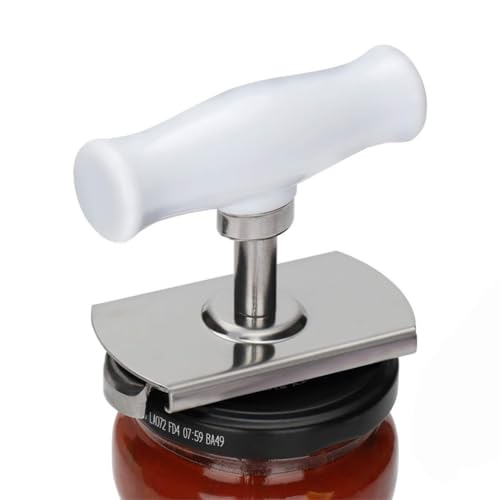
Stainless steel provides the structural element in these selected products, but the part touching the lid varies. Kichwit specifies stainless steel teeth. Rolitwils adds silicone lining to the adjustable jaw and includes a separate anti-slip pad. Wahijihe uses a removable rubber gear sleeve, while Amadething documents rubber on the stainless steel teeth. These additions are intended to improve contact or help protect the lid, based on the supplied listings.
A rubber or silicone component may be useful for smooth or slippery lids, but it may also require cleaning. Amadething specifically warns that oil on the rubber can cause slipping and recommends removing the pad, cleaning it, and drying it before use. This is practical information to consider if the opener will be used around oily sauces, dressings, or cooking ingredients.
Products with wood handles take a different approach. StarBlue, Solusoul, and the XISHIUYIS wood-handle set use solid or polished wood grips. These handles may appeal to shoppers who prefer a traditional hand feel, while green non-slip handles on the XISHIUYIS two-pack emphasize a stated anti-slip surface. The supplied evidence does not establish which material feels best, so the choice should follow your preference for handle material and maintenance.
Look for leverage that matches your hand strength
Many selected openers are marketed for weak hands or arthritis, but the useful specification is the mechanism supporting that purpose. Rolitwils documents gear-assisted twisting. Kunovo describes a lever principle in which a smaller input force produces a larger output force. These are design descriptions, not independent performance results.
Longer handles can provide more room for a two-handed grip or additional leverage, but length alone does not establish ease of use. By contrast, compact products such as Kichwit are easier to keep in a drawer based on their listed dimensions. When hand strength is a concern, compare the mechanism, gripping surface, and handle shape together instead of relying on a single phrase such as effortless.
Also consider how the opener is positioned. Adjustable clamp designs generally require aligning the teeth or jaw with the lid before twisting. Gulfmew’s documented three-point design uses a lift-and-release step before turning the lid. Choose the interaction that seems easiest to understand and repeat in your kitchen; the listings do not provide hands-on usability measurements.
Consider versatility beyond one jar
A jar opener is more useful when it covers the containers you actually use. Wahijihe explicitly mentions beverage bottles, jam jars, pickles, salsa, and other twist-off lids. StarBlue describes jars and bottle caps, while the XISHIUYIS products mention sauce, pickle, spice, honey, olive oil, and similar containers. Kunovo specifically calls out jam and jelly jars and gives a 4.4-inch maximum.
Some products emphasize portability. Rolitwils is described as compact and portable for picnics, camping, or RV trips. The XISHIUYIS sets and Gulfmew two-pack also offer more than one opener, which may be useful for a spare, a second kitchen, or shared use. A two-pack is not automatically more convenient, though; it also means two pieces to organize.
Avoid assuming that every multifunctional claim covers every lid or bottle. Match the documented container examples and size range to your needs. If you mainly open standard condiment jars, Kichwit may provide enough coverage. If you regularly use large containers, check the stated maximum before choosing.
Plan cleaning and storage
Storage details are easy to overlook. Compact openers such as Kichwit are suited to drawer storage, while Wahijihe documents both drawer and wall-hook options. Gulfmew adds top-mounted hanging holes and states that the opener can be rinsed or placed in a dishwasher. Solusoul says the stainless steel head can be rinsed, and the XISHIUYIS wood-handle design is described as compact for drawer storage.
Material care matters as well. Several listings describe stainless steel as rust-resistant or resistant to corrosion, but that does not eliminate the need to follow the manufacturer’s cleaning directions. Wood handles may be preferable for grip comfort, yet they can call for more careful handling than a fully synthetic grip. Rubber and silicone parts should be kept clean and dry when the listing provides that instruction.
Final recommendation
Rolitwils Adjustable Jar Opener with Non-Slip Pad ranks first overall in this specification-based comparison under the published weighted criteria.
Rolitwils is the first overall specification-based choice among the best stainless steel jar openers returned here. Its 0.4- to 4-inch adjustment range, stainless steel jaw, silicone contact surface, separate anti-slip pad, and documented gear-assisted design give it a balanced feature set in this comparison.
StarBlue is an alternative for shoppers who prefer a wood handle and a stated maximum of 4.1 inches. Choose Wahijihe if a compact jar-and-bottle tool with a removable rubber sleeve suits your routine. Solusoul and XISHIUYIS offer two-piece formats, with the XISHIUYIS wood-handle set standing out for its 5.2-inch maximum. Kichwit remains a straightforward compact option for common jar sizes, while Gulfmew is the distinctive pick for a documented vacuum-release approach.
Together, these top stainless steel jar openers cover adjustable clamps, rubber- or silicone-assisted gripping, wood and plastic handles, two-piece sets, and a three-point contact design. Before choosing, measure the lids you use most and decide whether storage, handle material, or grip maintenance is the deciding factor.
Frequently Asked Questions
What should I check before buying the best stainless steel jar openers?
Check the documented lid range first, then compare the gripping surface and handle design. Rolitwils covers 0.4 to 4 inches, while the XISHIUYIS wood-handle two-pack lists 1.25 to 5.2 inches. If your preferred product does not state a range, as with Gulfmew, confirm that its contact method suits your containers.
Are stainless steel jar openers suitable for weak hands?
Many selected listings describe features intended for weak hands or arthritis, including adjustable clamps, gear-assisted twisting, lever principles, spring-loaded power, wood handles, and non-slip surfaces. These descriptions explain the design purpose but are not independent tests of required force. Users should select a handle and mechanism they can position and twist comfortably.
Is an adjustable clamp better than a vacuum-release opener?
Neither design is universally better. An adjustable clamp provides a stated fit range and grips the lid edge, as shown by Rolitwils, Kichwit, and StarBlue. Gulfmew documents a three-point contact method intended to release the vacuum before the lid is turned. Choose based on whether precise lid sizing or a vacuum-release step better matches your containers and preferences.
How should rubber or silicone gripping parts be maintained?
Follow the supplied care guidance. Amadething specifically says oil can make its rubber pad slip and recommends cleaning and drying it before use. Rolitwils uses silicone on the jaw and includes a separate anti-slip pad, while Wahijihe uses a removable rubber sleeve. Keeping these contact parts clean and dry is a sensible maintenance practice, but the listings do not provide a universal cleaning schedule.
Do two-packs make sense for a kitchen?
A two-pack can provide a spare, support use in two locations, or allow another household member to keep one nearby. Solusoul, XISHIUYIS, and Gulfmew are selected two-piece options. The trade-off is additional storage, and a two-pack does not by itself indicate wider lid coverage or easier operation. Compare each set’s actual range and handle design before deciding.