Buying Guide
Choosing among the best plastic welding systems starts with identifying how the tool joins plastic. The products in this comparison fall into four documented designs: hot staplers, airless welders, hot-air welders, and extrusion welders. Each design creates a different repair workflow, so wattage alone does not determine suitability.
Match the welding method to the repair
Hot staplers embed heated metal staples across a crack. They are represented by the AUSGUN, VCTSELITY, SHALL, Diymore, and SEESII systems. This approach is particularly relevant to bumper cracks, broken tabs, dashboards, toys, and other parts where reinforcement is needed. Staple shape matters: the listings identify flat, wave, inside-corner, outside-corner, V, W, and L patterns. A kit with several patterns gives more documented options for straight seams, corners, and irregular breaks.
Airless welders melt plastic rods or filler directly against the repair surface. JOUNJIP and Treasea document this format, with interchangeable tips, rods, mesh, and temperature information. This design is useful when the repair requires filler material or when the user wants to rebuild a tab or blend a surface rather than only bridge a crack with a staple.
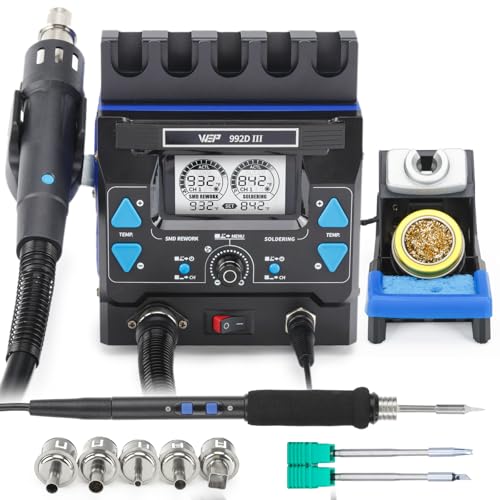
Two-in-one systems combine these approaches. VEVOR and SEESII pair a hot stapler with a soldering iron, while AUSGUN and VCTSELITY include rod-related accessories alongside staple equipment. A dual-tool setup can separate structural reinforcement from surface finishing, but it also adds tools and steps to the workflow.
Hot-air equipment is designed for sheet, membrane, tarp, roofing, and other thermoplastic work. SWIGRANCE documents a 1600W hot-air gun with multiple nozzles and a 40-650°C range. This is materially different from a small bumper stapler. The CHMING unit goes further into extrusion work, using separate heating systems for the base material and welding rod. Its evidence covers PVC, PE, PP, HDPE, PVDF, roofing waterproofing, geomembranes, pond liners, and pipeline repair.
Compare heat control, not just wattage
The best plastic welding systems provide enough heating information to help users understand the intended work. SWIGRANCE specifies a nine-level temperature knob and a 40-650°C range. CHMING provides a digital 200-380°C display. JOUNJIP documents heating to 525°F, while Treasea lists an adjustable maximum of 250°C. These details are more useful for matching heat to a thermoplastic than a wattage number alone.
Hot staplers often emphasize rapid heating and activation controls instead of a broad temperature dial. VCTSELITY lists 220W and an LED, AUSGUN lists 230W and temperature-control protection, and SEESII lists 150W with rapid staple heating. SHALL documents a pressure-activated switch that operates when staples are loaded and pressed. Diymore documents three-second heating but does not list adjustable temperature control. When comparing these designs, consider whether your priority is repeatable temperature adjustment or fast staple insertion.
Check material documentation
Material compatibility should come from the supplied rod and application information rather than a general assumption. AUSGUN and VCTSELITY list extensive rod compatibility, while CHMING documents PVC, PE, PP, HDPE, and PVDF. JOUNJIP identifies thermoplastic materials and provides PP and PolyPlaz rods.
For a system without listed rods, pay attention to what it actually includes. SHALL and Diymore are staple-focused kits in the supplied evidence. They may be suitable when the repair plan centers on embedded reinforcement, but the listings do not document filler-rod compatibility. VEVOR includes PP rods, so its rod-based scope is narrower in the evidence than its staple range.
Evaluate the accessory package
Accessories determine which repair methods are possible immediately. VEVOR includes three tips, 1,000 staples, rods, mesh, sandpaper, pliers, a knife, and a screwdriver. AUSGUN includes 1,200 staples, 120 rods, five stainless-steel meshes, foil, sandpaper, pliers, and a knife. VCTSELITY includes 1,002 staples, 100 rods, mesh, foil, and a sponge. SEESII includes 200 staples, 20 rods, pliers, a utility knife, and sandpaper.
Airless and hot-air systems use a different accessory logic. JOUNJIP supplies boot and triangle tips, mesh, tape, a stand, brush, and rods. SWIGRANCE supplies flat, round, speed-welding, and grooving nozzles, plus a replacement heating element and seam roller. CHMING documents an extrusion system with compatible 3.0-4.0mm rods, but its listing emphasizes the welder’s industrial operating specifications rather than a large hand-tool bundle.
Consider handling and safety details
Look for evidence about grip, lighting, overheating protection, cooling, and electrical configuration. AUSGUN lists a handguard and temperature-control protection. VCTSELITY and VEVOR document LED lighting, while JOUNJIP identifies UL certification. SWIGRANCE lists automatic cooling and instructs users to return the temperature knob to zero before shutdown. CHMING documents cold-start protection and a five-minute cold-air cooldown.
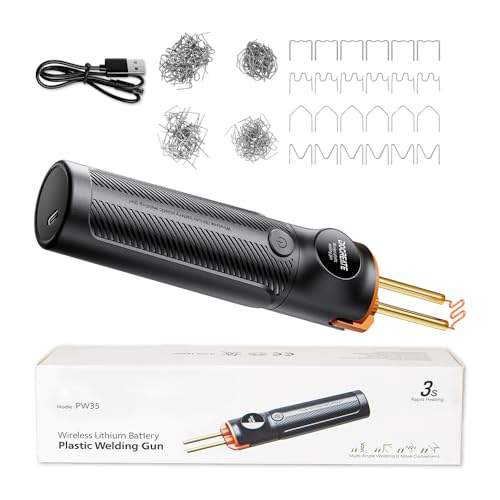
Portable systems solve a different handling problem. SHALL uses a USB-C rechargeable battery, a battery meter, a locking case, and auto-cooldown. Diymore uses a 4000mAh battery and adjustable welding angles. These features can help when the repair location is away from an outlet, although neither listing documents plastic welding rods. For corded systems, confirm the electrical specification: VCTSELITY and JOUNJIP identify US-oriented voltage details, and CHMING specifies 110V and 60Hz.
Plan the repair sequence
A documented repair sequence generally involves cleaning the surface, selecting a staple or rod, heating the plastic, reinforcing or filling the break, and smoothing the finished area. VEVOR and SEESII explicitly separate crack repair from surface finishing with their two-tool configurations. AUSGUN includes smoothing heads, while JOUNJIP identifies different tips for small tabs and bumper work. Sandpaper, mesh, foil, and cutting tools can support preparation and finishing, but the supplied evidence does not establish a particular result for any system.
Use the product’s stated material and accessory information as the boundary for selection. A compact cordless stapler is a different tool from a 1600W hot-air gun or an extrusion machine. Matching that design to the repair type is more informative than treating every plastic welder as interchangeable.
Final Recommendation
SWIGRANCE 1600W Hot Air Plastic Welder ranks first overall in this specification-based comparison under the published weighted criteria.
SWIGRANCE 1600W Hot Air Plastic Welder is the first overall specification-based choice among these best plastic welding systems.
Its documented 1600W output, 40-650°C adjustment, nine-level control, broad nozzle set, and automatic cooling make it the highest-scoring option under the published criteria. It is aimed at hot-air sheet, membrane, tarp, roofing, liner, boat, RV, and bumper work rather than small staple-only repairs.
CHMING 1600W Hand Extrusion Welder is the specialist choice for extrusion work. It documents dual heating, digital temperature control, broad material coverage, a rotatable head, and a 2.25 kg/h extrusion rate. VEVOR is the most complete documented dual-tool format for general crack repair and finishing. Treasea and JOUNJIP offer airless designs with adjustable or specified heat and filler-related accessories. For stapled automotive repairs, AUSGUN, VCTSELITY, SEESII, SHALL, and Diymore each emphasize different combinations of power, staple variety, portability, or finishing tools.
Among the top plastic welding systems, the right selection depends on whether your work calls for extrusion, hot air, rod melting, or staple reinforcement. Keep material compatibility and the included tips, rods, staples, mesh, and handling details central to the decision.
Frequently Asked Questions
What are the best plastic welding systems for car bumper cracks?
The selected hot-stapler kits are the most directly documented for bumper cracks. VEVOR, SEESII, AUSGUN, VCTSELITY, SHALL, and Diymore all list automotive bumper applications or bumper-focused repair features. VEVOR and SEESII additionally include a separate soldering iron for surface finishing, while AUSGUN and VCTSELITY include rods and reinforcement accessories.
Which plastic welding system is suited to roofing or pool-liner work?
SWIGRANCE is the clearest match because its supplied applications include TPO roofing, vinyl flooring, pool liners, membranes, tarps, and RV repair. It also includes flat, round, speed-welding, and grooving nozzles. CHMING documents roofing waterproofing, geomembranes, pond liners, and pipeline repair, but its extrusion design is intended for heavier fabrication work.
Are cordless plastic welders useful for repairs away from outlets?
SHALL and Diymore are the cordless options in this selection. SHALL documents a 2000mAh battery, USB-C charging, a battery meter, and auto-cooldown. Diymore documents a 4000mAh battery, three-second heating, and adjustable welding angles. Both listings focus on hot staples and do not list plastic welding rods, so they are best evaluated as portable staple-repair tools.
What should I check before welding a specific plastic?
Check whether the listing names that plastic type and whether compatible rods or staples are included. AUSGUN and VCTSELITY list extensive rod compatibility, while CHMING documents PVC, PE, PP, HDPE, and PVDF. JOUNJIP identifies thermoplastic materials and supplies PP and PolyPlaz rods. If the material is not documented, the supplied evidence does not establish compatibility.
No. VEVOR and SEESII explicitly pair stapling with soldering-iron finishing. AUSGUN includes smoothing heads, and several kits include sandpaper, mesh, foil, or knives. SHALL and Diymore are documented primarily around cordless staple repair. Review the included tips, rods, mesh, abrasives, and other tools before assuming a kit covers both reinforcement and finishing.