Buying Guide
The best hot air soldering stations blend a hot air gun with a benchtop soldering iron, then back them up with tight temperature control and interchangeable nozzles. Whether you are reworking smartphone boards, soldering QFN packages, or shrinking tubing, the right combination of features makes daily work faster and more repeatable.
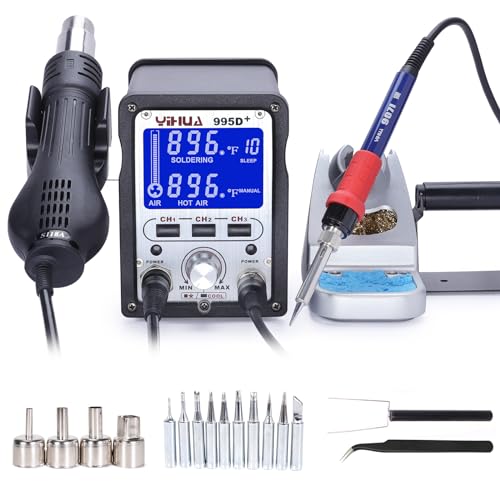
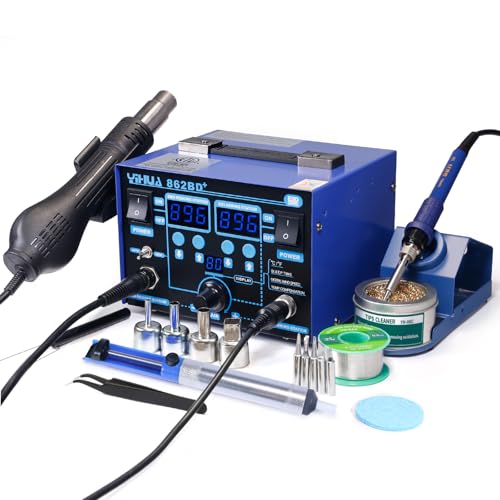
Hot air stations come in two broad formats. 2-in-1 units pair a soldering iron with a hot air gun in one chassis, sharing power supplies and displays. Single-tool stations focus purely on hot air rework, often reaching higher airflow and ceiling temperatures than 2-in-1 models. If you already own a quality soldering iron, a dedicated hot air station such as the YIHUA 959D or WEP 959D may give you more headroom. If you need both functions on a small bench, a 2-in-1 like the YIHUA 995D+, YIHUA 862BD+, or Bakon 852D+ consolidates the setup.
Match Temperature Range to Your Work
The temperature ceiling determines which components you can safely rework. Look for adjustable ranges that start near 212°F so you can shrink tubing or dry surfaces without overshooting.
Prioritize PID Temperature Control
PID programs cycle in milliseconds to monitor the actual heating-element temperature and correct drift. This is what separates a precision tool from a basic hot air gun. The YIHUA 995D+, YIHUA 862BD+, WEP 2009D-II, and WEP 959D all advertise PID stabilization, which keeps the nozzle close to the set temperature even when airflow changes.
Evaluate Airflow and Nozzle Options
Airflow volume, often measured in liters per minute, shapes how quickly heat transfers to a component. Higher airflow stations like the YIHUA 959D, rated at up to 120 L/min, move heat faster across larger areas. Nozzle variety matters too. Kits with three to five nozzles, including the WEP 959D’s quick-change system and the WEP 8858-V’s compact holder, let you match nozzle diameter to component size for more focused heating.
Look for Safety and Standby Modes
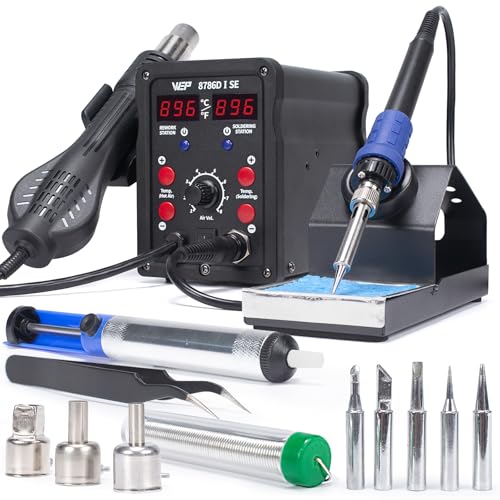
Hot air guns left on a bench can scorch surfaces or burn out heating elements. Auto-standby cooling, like the system in the WEP 2009D-II and YIHUA 959D, drops temperature to 212°F when the gun is parked. Sleep modes for the soldering iron, found on the YIHUA 8786D I and WEP 8786D-I SE, extend tip life between sessions. Fail-safe protection, such as the exclusive system in the YIHUA 8786D I, adds an extra alarm and heating cut-off if airflow is interrupted.
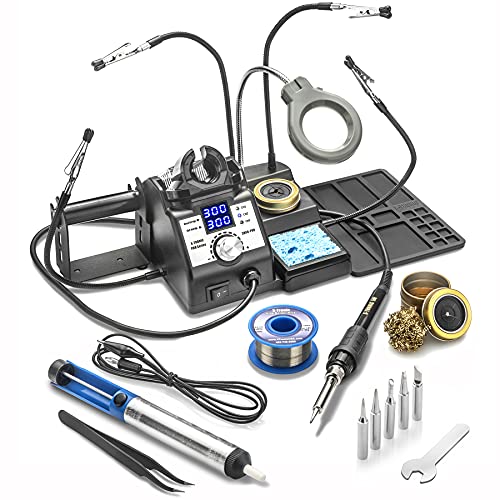
Larger 2-in-1 stations trade space for higher wattage and richer accessory bundles. Look at the included tips, nozzles, solder wire, desoldering pumps, and tweezers; a complete kit reduces the need for separate purchases.
Final Recommendation
Bakon 852D+ 2-in-1 Heat Gun and Soldering Iron Kit ranks first overall in this specification-based comparison under the published weighted criteria.
After comparing temperature range, PID precision, airflow control, nozzle coverage, safety features, and dual-system integration, the YIHUA 995D+ stands as the first overall specification-based choice among the best hot air soldering stations. Its dual-core microcomputer, three preset memory channels, and broad programming options make it equally capable for advanced hobbyists and professional technicians, while still pairing a soldering iron and hot air gun in a single chassis. If you prefer a higher-temperature hot air gun with a 932°F ceiling and dedicated presets, the YIHUA 959D is a strong alternative, and if a compact bench footprint matters most, the WEP 8858-V delivers solid single-tool performance in a small package. Together, these picks represent the top hot air soldering stations covered in this guide, balancing bench space, safety, and rework capability.
Frequently Asked Questions
What temperature range should I look for in the best hot air soldering stations?
A range that starts near 212°F and reaches at least 896°F covers most SMD rework and shrink-tubing tasks. Stations such as the Bakon 852D+ and YIHUA 959D add a 932°F ceiling for lead-free alloys and stubborn connectors, giving extra margin when working on dense boards.
Is a 2-in-1 station better than a dedicated hot air rework station?
It depends on your workflow. 2-in-1 units like the YIHUA 995D+, YIHUA 862BD+, and WEP 882D combine soldering iron and hot air functions in one chassis, saving bench space. Dedicated hot air stations like the YIHUA 959D, WEP 959D, and WEP 2009D-II focus on airflow and temperature, often reaching higher ceilings, but require a separate soldering iron for through-hole work.
Why is PID temperature control important?
PID programs continuously compare the actual heating-element temperature to the set value and adjust power in milliseconds. This keeps the nozzle steady during airflow changes, reducing the risk of overheating small components. Stations such as the YIHUA 995D+, YIHUA 862BD+, WEP 2009D-II, and Bakon 852D+ all advertise PID stabilization.
What safety features should the best hot air soldering stations include?
Auto-standby cooling when the gun returns to the holder, sleep modes for the soldering iron, and fail-safe protection against airflow loss are all worth checking. The YIHUA 8786D I includes an exclusive fail-safe alarm and heating cut-off, while the WEP 2009D-II adds a buzzer prompt and digital calibration for safer daily operation.
More nozzles let you match the airflow diameter to the component, concentrating heat where it is needed and protecting surrounding parts. The WEP 959D ships with five nozzles and a quick-change system, while kits like the WEP 8786D-I SE and WEP 882D bundle three nozzles alongside solder wire, tweezers, and a desoldering pump for a complete starter setup.