Buying Guide
The best polyurethane office furniture casters are not selected by wheel material alone. A useful comparison also considers the mounting interface, wheel diameter, stated load support, swivel construction, and the floor surfaces named in the listing. Most products here are replacement sets for rolling office chairs, while the evidence is most specification-aligned for standard press-in stems rather than threaded furniture mounts.
Start with the mounting fit
Before ordering, remove one existing caster and measure its stem. Several selected products identify the common 7/16-inch by 7/8-inch, or 11 mm by 22 mm, press-in stem. The Office Oasis, HOSALI, HOLKIE, BF BRIGHTFIELD, RidRed, Minewill, Sytopia, LPHY, OFFICE OWL, and TESUMI listings all provide standard-stem information or describe compatibility with most office chairs. That does not mean every chair uses the same socket. IKEA exclusions appear repeatedly, so an IKEA chair should not be treated as compatible without separate confirmation.
A plate-mounted caster is a different design from a press-in chair wheel. The selected products are primarily chair-caster replacements, with a stem intended to fit an existing chair base. If you are converting a cabinet, worktable, or other office furniture item, verify that the furniture accepts the chosen stem or use a product with a documented plate mount. Do not assume that a chair caster can replace a plate caster without an appropriate socket or adapter.
Choose wheel diameter for clearance and movement
The selected sets include 2-inch and 3-inch designs. Two-inch options such as RidRed, Minewill, and Sytopia can suit buyers who want a more compact profile. Three-inch options such as The Office Oasis, HOSALI, HOLKIE, BF BRIGHTFIELD, LPHY, and TESUMI provide a larger wheel format. The listing evidence does not establish a universal performance advantage for one diameter, so compare the replacement height with your desk and chair posture.
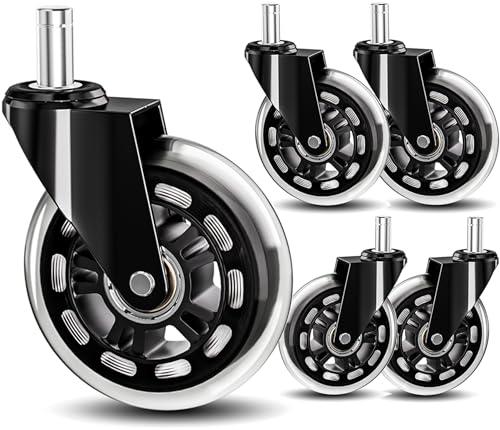
Wheel size also affects the visual proportion of the chair. Clear or transparent designs, including The Office Oasis, LPHY, and TESUMI, may look less visually heavy, while black and gray options offer a more understated appearance. These are finish choices, not verified indicators of durability.
Check the floor language
Polyurethane is repeatedly described as soft, non-marking, or floor-friendly across the selected listings. The named surfaces include hardwood, laminate, tile, vinyl, marble, concrete, stone, and carpet, although coverage differs by product. TESUMI is especially clear about its limitation: the listing recommends low-pile carpet but not high-pile carpet. That kind of restriction matters more than a broad phrase such as “all floors.”
A polyurethane tread may be a sensible option when a workspace includes hard flooring that could be marked by harder wheels. Still, the supplied evidence consists of manufacturer or public listing descriptions, not independent floor testing. Keep floors clean, inspect the tread periodically, and follow the product’s own surface guidance.
Compare load-support claims carefully
Several listings state a total capacity for a five-wheel set. HOSALI, HOLKIE, BF BRIGHTFIELD, LPHY, and TESUMI list the current price, while Sytopia lists the current price. RidRed and Minewill state the current price. These figures are useful comparison points, but they are listing claims rather than results from an independent test in this review. They also may not account for uneven loading, chair-base strength, floor transitions, or dynamic movement.
For ordinary office use, the more important step is to confirm that the caster set and chair base are suitable for the intended user and chair. Avoid treating the largest stated number as a guarantee. A stable fit, correctly seated stem, and intact chair base are essential regardless of the printed capacity.
Look at swivel and bearing details
The selected listings commonly mention precision bearings, double-row bearings, or 360-degree rotation. The Office Oasis describes multiple precision-bearing elements, while RidRed mentions double-layer precision ring balls and Minewill identifies built-in precision ball bearings with a double-row wheel design. These details support a reasonable expectation of maneuverability based on the listings, but they are not hands-on test results.
If the chair must turn frequently in a confined desk area, prioritize a clearly described swivel design. If the workspace is shared, the quiet-rolling descriptions may also be relevant. “Quiet” remains a product claim here, not a measured decibel result.
Installation and maintenance checklist
Most selected chair casters use a pull-out and push-in replacement process without tools. Before installation, turn the chair over, remove the old wheel, inspect the socket for damage, and compare the new stem with the old one. Press the replacement fully into place and check that it is seated evenly before putting weight on the chair. A caster that does not fit cleanly should not be forced.
After installation, rotate and roll the chair slowly, checking for wobble or interference. Hair and debris can collect around bearings and wheel forks, so periodic inspection is sensible. Warranty terms vary: The Office Oasis lists lifetime coverage, LPHY lists three years, and several others list one year or replacement support. Keep the order information and verify the current warranty terms before relying on them.
Final recommendation
HOLKIE 3-Inch Roller Blade Casters ranks first overall in this specification-based comparison under the published weighted criteria.
HOLKIE is the first overall specification-based choice among the best polyurethane office furniture casters. It combines a polyurethane wheel shell, a clearly stated standard stem, tool-free installation, quiet-rolling design, a 650-pound set capacity, and a stated TÜV test reference. The best polyurethane office furniture casters for a different chair may be HOSALI if you want a similar 3-inch format, RidRed or Minewill for a compact 2-inch design, or TESUMI when low-pile carpet guidance matters.
Among the top polyurethane office furniture casters, the final choice should follow fit first, then wheel diameter and surface needs. Confirm the stem, inspect your chair base, and treat capacity and floor claims as documented listing specifications rather than independent performance guarantees.
Frequently Asked Questions
Among the best polyurethane office furniture casters, are polyurethane casters suitable for hardwood office floors?
The selected listings commonly describe polyurethane wheels as non-marking or floor-friendly for hardwood, laminate, tile, vinyl, and related surfaces. That makes them a reasonable category to consider for hard floors, but actual results can depend on debris, floor finish, wheel condition, and the chair base. TESUMI specifically limits its carpet guidance to low-pile carpet, so surface instructions should be checked product by product.
What stem size is common for office chair casters?
A frequently listed size is 7/16 inch by 7/8 inch, also expressed as 11 mm by 22 mm. The Office Oasis, HOSALI, HOLKIE, BF BRIGHTFIELD, RidRed, Minewill, Sytopia, LPHY, OFFICE OWL, and TESUMI listings describe this standard or a closely matching version. Measure your existing caster before ordering, because IKEA and other special chair bases may use different fittings.
Are 2-inch or 3-inch wheels better for an office chair?
Neither size is universally better from the supplied evidence. Two-inch models can provide a compact profile, while 3-inch models provide a larger wheel format. Compare the replacement height with your desk, foot position, chair base, and flooring. The listing’s dimensions and compatibility information should guide the decision rather than diameter alone.
Most selected products describe tool-free installation: pull the old caster from the chair base and press the new stem into the socket. Installation still requires a correctly matching stem and an undamaged socket. Do not force a replacement that does not seat properly. After installation, test each wheel and check for wobble before normal use.
Should a stated caster capacity be treated as a guarantee?
No. Capacity figures are public listing claims in this comparison, not independent test results. They may not reflect uneven loading, movement, chair-base strength, or floor conditions. Use the figures for comparison, remain within the manufacturer’s stated guidance, and inspect the complete chair assembly before use.