Buying Guide
The best power tool router jigs are not interchangeable. A circle guide controls a pivot radius, a dado jig references an edge or workpiece, and a hinge template confines the router to a defined mortise. Start with the cut you make most often, then confirm that the jig is designed for your router type and base pattern.
Match the jig to the routing task
For straight grooves and dadoes, the POWERTEC Router Dado Jig 71923 is the most purpose-built option in this comparison. Its adjustable fence can be set against a sample workpiece, and its stated groove range covers common cabinet and shelving work. The built-in cut-line indicator is another useful alignment feature. It accepts a 1-inch bushing and lists compatibility with POWERTEC and other guide rails and edge clamps, but the required straight bits and some dust-collection equipment may be separate.
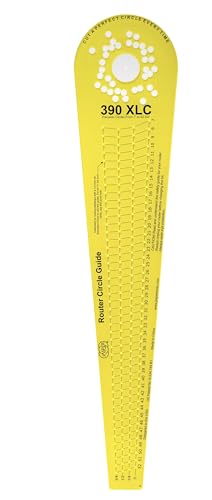
Circle-cutting jigs vary mainly by router compatibility and diameter range. The Jasper 390 XLC is intended for compact, trim, and cordless routers and provides indexed settings from 7 to 52-3/4 inches. The Sigerio model covers 10 to 58 inches and uses a multi-hole base for handheld-router mounting. The Imbot 4-in-1 model is less specialized but adds arc routing, groove milling, and guide-bushing functions. Choose the narrowest design that covers your project instead of selecting functions you will not use.
Check adjustment and working range
Adjustment range matters when the jig will serve more than one project. The Imbot Adjustable Rectangle Router Jig uses rails and sliding nuts to form square, rectangular, or custom frames, with a stated maximum working area of 24 by 24 inches. Its four quick clamps are intended to help prevent shifting during repetitive cuts. This is a practical format for mortises, drawer-handle slots, and panel work, but its large frame needs more setup room than a small template.
A fixed hinge template can be quicker when every project uses the same hinge size. The Gohelper 4-Inch Fixed Door Hinge Jig is built around a 4-inch template, while the Milescraft 1222 Hinge Mate 150 focuses on 3- and 3-1/2-inch hinges. Adjustable templates such as the Guhiwuk and Sebupar models cover more hinge sizes and corner profiles. More adjustment can increase versatility, but it also makes compatibility and alignment checks more important.
Evaluate construction and stability
Aluminum appears across several selected designs, including the POWERTEC, Guhiwuk, Gohelper, Imbot, and Sigerio models. Listing evidence describes aluminum alloy, 6061 aluminum, or thickened aluminum construction; it does not establish hands-on rigidity or cutting performance. Treat material as a specification, not a guarantee. Look for documented clamping, anti-skid pads, countersunk bases, or mounting hardware that supports the setup you need.
The Sebupar hinge jig uses reinforced engineering plastic with non-slip protective pads. That may be easier to handle than a large metal frame, while the aluminum alternatives may suit buyers prioritizing a metal template. The Milescraft model is a compact design with a built-in stop and included guided bit, and it is explicitly listed for both doors and jambs.
Verify router and accessory compatibility
Compatibility is the most important pre-purchase check. A jig may fit many handheld routers but still require a matching screw pattern, bushing style, collet size, or base design. The POWERTEC listing specifies Porter-Cable-style guide-bushing bases and includes a 1-inch bushing. The Jasper listing limits the 390 XLC to compact, trim, and cordless routers. The Sigerio and Imbot listings use multi-hole mounting patterns but still advise checking unusual or non-standard routers.
Door jigs also have distinct boundaries. The Guhiwuk listing supports common door hinge sizes and includes a depth gauge. Sebupar explicitly describes door-only use and says it is not for jamb mortising. Gohelper’s fixed template is listed for doors and jambs, while the Vorhixa kit adds lock and latch tools for standard door thicknesses and backsets. Confirm whether you are routing a door leaf, a jamb, or both before ordering.
Consider included components and workflow
Included bits and hardware can simplify setup, but they do not remove the need to confirm bit size, depth, and router fit. Guhiwuk, Sebupar, Gohelper, and Vorhixa list combinations of router bits, self-centering hinge bits, screwdriver bits, manuals, or mounting parts. The POWERTEC includes a bushing but specifies that straight bits are separate. Circle jigs may include pivot pins, calibration hardware, or mounting pieces, as documented for the Jasper model.
For occasional hinge work, a focused template may be easier to store and understand. For remodeling or repeated door preparation, the Vorhixa kit’s hinge, lock, and latch functions may reduce the number of separate guides. For furniture work, the POWERTEC, rectangle-frame Imbot, Jasper, Sigerio, and Imbot 4-in-1 designs cover more varied routing patterns.
Final Recommendation
POWERTEC Router Dado Jig 71923 ranks first overall in this specification-based comparison under the published weighted criteria.
POWERTEC Router Dado Jig 71923 is the first overall specification-based choice among the top power tool router jigs.
It ranks first because its listing provides unusually specific information about groove width, fence adjustment, alignment, bushing compatibility, guide rails, edge clamps, and dust collection. It is the clearest fit for adjustable dado routing. The Imbot Adjustable Rectangle Router Jig suits large rectangular layouts, while the Jasper 390 XLC is focused on circles with compact routers. For doors, choose Guhiwuk or Sebupar when hinge-size flexibility matters, Milescraft for common 3- and 3-1/2-inch hinges, Gohelper for a fixed 4-inch template, or Vorhixa when lock and latch preparation are also part of the job. Sigerio and the Imbot 4-in-1 model suit buyers who need broader circle or multi-function coverage.
The final choice among the best power tool router jigs should follow the documented compatibility and cut range rather than a general-purpose label. Confirm the router base, required bit or bushing, workpiece dimensions, and whether the template is intended for a door, jamb, circle, dado, or rectangular layout.
Frequently Asked Questions
Confirm the router type, base or screw-hole pattern, required bushing or bit, working range, and whether the jig is for a door, jamb, circle, dado, or rectangular layout. Compatibility statements differ across models.
Which selected jig is designed specifically for dado cuts?
The POWERTEC Router Dado Jig 71923 is the dedicated dado model in this comparison. It lists an adjustable fence, a 1/4- to 1-1/4-inch groove range, a cut-line indicator, a dust port, and guide-rail and edge-clamp compatibility.
Are door hinge jigs interchangeable between doors and jambs?
No. The listings differ. Milescraft and Gohelper describe door-and-jamb use, while Sebupar is specified for door leaves only. Guhiwuk emphasizes door hinge installation. Verify the intended surface before routing.
Which jig covers the largest documented circle range?
The Sigerio 4-in-1 Router Circle Cutting Jig lists a 10- to 58-inch range. The Jasper 390 XLC lists 7 to 52-3/4 inches and is specifically designed for compact, trim, and cordless routers.
Does a multi-purpose jig replace every specialized guide?
Not necessarily. The Imbot 4-in-1 model lists circle cutting, arc routing, groove milling, and guide-bushing functions, but a dedicated dado or hinge jig may provide more task-specific alignment features. Choose according to the work you perform.