Buying Guide
The best porcelain baking dishes are not all designed for the same job. A deep family-size pan can be ideal for lasagna, while a small individual dish may be better for side portions, desserts, or reheating leftovers. The products above include single pans and multi-piece sets, so compare the format as carefully as the material label.
A single large rectangular dish is the most direct choice when your recipes regularly involve family casseroles, baked pasta, roast chicken, or lasagna. The DOWAN dish is listed at 4.2 quarts, and the MALACASA single dish is listed at 4.4 quarts. Both use a deep rectangular design with handles, making them oriented toward substantial meals and serving.
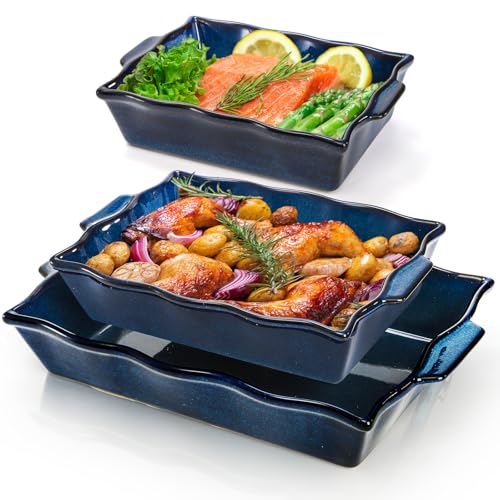
Sets provide more flexibility but require more cabinet space. Pyrex offers 2-, 3-, and 4-quart dishes, while Estmoon lists four capacities from 0.8 to 3 quarts. MALACASA TARA lists 1.5-, 2.8-, and 4-quart sizes. Peohud instead gives dimensions of 7.5, 11, and 14 inches. These ranges can cover different portions without requiring one oversized pan for every recipe.
Check the temperature and appliance language
Do not treat every ceramic or porcelain dish as interchangeable. The supplied listings vary in how specifically they describe heat use. Estmoon, DOWAN, MALACASA TARA, and VICRAYS list oven use up to 500°F. Howise and Sweese identify oven compatibility but do not provide a maximum temperature in the supplied evidence.
Temperature transitions also matter. SOUJOY warns against placing a hot dish directly into cool water. For any selected dish, follow the maker’s instructions about preheating, freezing, and moving between hot and cold environments.
Microwave, refrigerator, freezer, and dishwasher claims should also be checked individually. Pyrex lists dishwasher use and a preheated-oven limit. DOWAN lists microwave, refrigerator, dishwasher, and oven compatibility. Peohud lists oven, microwave, refrigerator, and dishwasher use, while VICRAYS lists the same group. Staub’s supplied evidence confirms oven-to-table use but does not establish microwave or dishwasher compatibility, so those uses should not be inferred.
Match the size to portions
Small dishes can be useful when a full-size casserole would leave too much unused space. Sweese’s 8-inch square format is aimed at compact baking, and Staub’s two rectangular dishes are also smaller than the large family pans. These formats can work for brownies, smaller casseroles, side dishes, or serving portions, subject to the recipe and the dish’s available interior space.
For larger meals, look for a stated capacity rather than relying only on an outside measurement. A deeper dish may help contain layered foods, but the supplied data does not establish cooking-time or performance advantages, so recipes should still guide filling and timing.
Evaluate handles and storage
Double handles are common across this category and can make a filled dish easier to move from oven to counter or table. DOWAN, Howise, Peohud, SOUJOY, Sweese, and the MALACASA products all document handled designs. Handle size can affect the amount of clearance needed in an oven or cabinet, so compare the stated dimensions carefully; some listings include handles in their measurements and others exclude them.
Storage is another meaningful difference. Pyrex, Estmoon, MALACASA TARA, Peohud, VICRAYS, and SOUJOY document nesting or stackability. Howise documents a nested two-piece design. These features are particularly useful when buying a set, because separate pieces can otherwise consume more shelf space. Staub’s supplied listing confirms two pieces but does not document stackability, so it receives less storage credit here.
Consider serving and finish
Porcelain and stoneware dishes can move from oven to table, but the exact presentation varies. SOUJOY uses a hand-painted floral and wavy pattern, VICRAYS specifies a reactive glaze, and MALACASA TARA uses a speckled khaki-and-white finish. Staub documents a vitreous glass porcelain-enamel finish and oven-to-table use. The plain white options from DOWAN, Howise, and Sweese offer a simpler look based on their supplied color descriptions.
A smooth or glazed surface is frequently documented for cleanup. Pyrex, DOWAN, Estmoon, Peohud, Sweese, and MALACASA products identify glazed or smooth finishes and dishwasher compatibility where stated. These details support easier maintenance as a specification-based consideration, but they are not a substitute for hands-on testing or a guarantee about every baked-on ingredient.
Read material claims precisely
The listings use porcelain, ceramic, and stoneware terminology in overlapping ways. Pyrex and Staub identify stoneware, while several other products describe ceramic construction and also use porcelain in their titles or features. Material language alone should not determine the choice. Look for additional documentation such as lead-free or cadmium-free claims, temperature limits, appliance compatibility, glazing, and handling features.
The most specification-aligned material documentation in this selection includes Estmoon’s lead-free and cadmium-free statements, DOWAN’s lead-free ceramic description, Peohud’s heavy lead-free porcelain wording, and Pyrex’s statement that it is made without lead or cadmium. These are listing claims rather than independently verified test results, so they should be read as supplied product information.
Final Recommendation
Estmoon Four-Size Porcelain Bakeware Set ranks first overall in this specification-based comparison under the published weighted criteria.
Pyrex 3-Piece Ceramic Bakeware Set is the first overall specification-based choice among these best porcelain baking dishes because it combines three clearly listed capacities with stackable storage, dishwasher use, oven-to-table serving, and a smooth glazed interior. Its 450°F preheated-oven limit should be observed.
Choose DOWAN if your priority is one deep, large-capacity pan with a stated 500°F oven limit and broad appliance compatibility. Estmoon is a strong alternative when four sizes are more useful than one large dish. MALACASA TARA and Peohud are practical multi-size sets with stackability, handles, and high-temperature oven documentation.
For presentation, SOUJOY, VICRAYS, MALACASA TARA, and Staub provide more distinctive finish details. Howise is a sensible two-piece nested option, while Sweese is better suited to compact recipes. These are the top porcelain baking dishes in this comparison based on documented specifications, not customer sentiment or hands-on performance.
Frequently Asked Questions
What should I check before buying the best porcelain baking dishes?
Check the interior capacity, outside dimensions, maximum stated oven temperature, and whether the measurements include handles. Then verify microwave, refrigerator, freezer, and dishwasher compatibility for the exact product. A set may offer more cooking flexibility, but a single deep pan may be easier to store and better suited to regular family-size recipes.
Are these porcelain baking dishes safe for stovetops?
The supplied evidence does not support stovetop use for the selected products. VICRAYS and Peohud specifically state that their dishes are not for direct fire or induction cookers, and Staub specifically excludes stovetop use. Treat these products as oven bakeware unless the individual listing provides different instructions.
Which selected dish is best for a large family meal?
DOWAN is a strong specification-based fit because it lists a 4.2-quart capacity, deep rectangular construction, double handles, and oven use up to 500°F. Capacity alone does not determine recipe yield, so follow the recipe’s recommended pan size.
Do porcelain baking dish sets save cabinet space?
Some do, but only when nesting or stackability is documented. Pyrex, Estmoon, MALACASA TARA, Peohud, VICRAYS, SOUJOY, and Howise provide that type of storage information. Staub’s supplied listing confirms two pieces but does not state that they stack. Compare the complete outside dimensions, including handles where applicable, before choosing a multi-piece set.
Can a hot baking dish go straight into cold water?
Do not assume that it can. SOUJOY specifically warns against putting the dish into cool water immediately after oven or microwave use. Ceramic and porcelain products can be sensitive to abrupt temperature changes, and each product’s care instructions should take priority. Allowing a dish to cool gradually is the cautious approach when the listing provides a thermal-change warning.