Buying Guide
Choosing among the best large baking dishes starts with the food you make most often, the available oven space, and how you move and store a full pan. A large dish is not defined by one universal dimension: the selected products range from 9 x 13-inch formats to a 16 x 11-inch ceramic pan, and stated capacities range from 4 quarts to 6 quarts. Compare interior measurements where available, because exterior dimensions may include handles.
Capacity and interior dimensions
For family casseroles, lasagna, baked pasta, and holiday sides, capacity and depth matter together. The Roeveca lists a 6-quart capacity and 3.5-inch height, giving it the most documented room in this comparison. The HUSANMP lists 5.4 liters and a 3.58-inch height, while the Artena lists 5.1 quarts and a 3.45-inch height. These are useful choices when the goal is to prepare a substantial dish in one vessel.
A 4- to 4.8-quart dish can still be large enough for many standard casserole recipes. The DOWAN red dish lists 4.2 quarts and 3.1 inches of height. MALACASA offers a 4.8-quart model and a 4.4-quart straight-sided model. The straight-sided design is specifically described as allowing more capacity, but its listed 9 x 13 measurements include the handles. Check rack clearance and the true interior length before buying.
Material and temperature limits
Ceramic and porcelain options are useful when the dish also needs to serve at the table. The Roeveca is listed as oven safe to 482°F, the DOWAN red dish to 500°F, and the Artena to 400°F. The DOWAN embossed dish and MALACASA products are described as oven safe without a numerical limit in the supplied evidence. Do not assume that an unspecified temperature rating matches another product’s stated limit.
Glass offers visibility and a nonporous cooking surface. The Pyrex Deep model is specified for a preheated oven, microwave, and freezer. Glass is also described as resisting stains, odors, or absorbed flavors in several listings. Follow the manufacturer’s temperature-transition instructions, particularly when moving bakeware between very cold and hot environments.
Metal is a different fit. The Glad pan uses carbon steel, a nonstick coating, and a raised diamond texture described as increasing airflow. Its 460°F heat resistance suits baking and roasting, but the listing calls for hand washing. Metal may be preferable when you want a lighter pan or easy food release, while ceramic and glass may better match oven-to-table presentation.
Handles and serving
Large dishes become harder to move when filled, so handle design deserves as much attention as capacity. Wide or double handles can provide more room for oven mitts and support direct serving. The HUSANMP has no integrated handles identified in the supplied evidence, so it may be less convenient to lift when hot or full.
A pan with handles may require more rack width and cabinet space. Measure the outside, not just the nominal cooking size, when checking your oven and storage area.
Lids and food storage
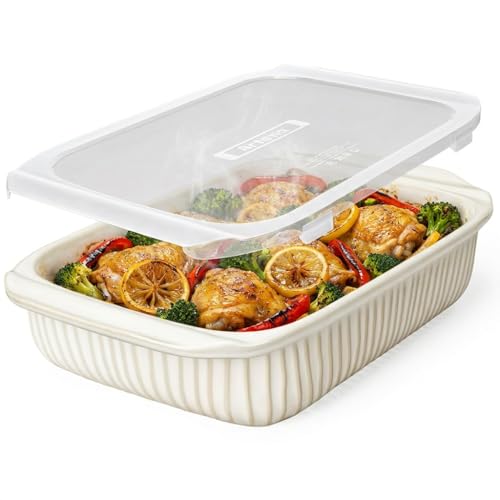
A lid is valuable if the dish will move from cooking to refrigeration. The Artena includes a PP lid designed for refrigerator storage and spill-resistant transport, though it is not airtight. Pyrex includes a BPA-free plastic lid that is freezer, microwave, and top-rack dishwasher safe.
A lid should not automatically be treated as an oven-safe cover. The supplied listings describe the lids primarily for storage, transport, or reheating. Remove plastic lids before oven use unless the product instructions specifically permit otherwise. If you rarely store leftovers in the same dish, a lid may add bulk without adding much utility.
Cleanup and storage
Smooth glazed ceramic surfaces are repeatedly described as easy to clean, and the selected ceramic dishes from Roeveca, Artena, DOWAN, and MALACASA list dishwasher compatibility. Glass dishes from HUSANMP and Pyrex also support dishwasher cleaning. The Glad pan is the exception in this group: hand washing is specified to preserve its nonstick coating.
Storage is another practical distinction. Among the selected dishes, individual large pans with handles and lids may need more cabinet clearance. Measure shelf height and width before choosing a deep or handled design.
Matching a dish to your routine
Choose the Roeveca when maximum documented capacity is the priority. Choose the Pyrex Deep dish or HUSANMP when clear glass and storage flexibility matter. The Artena is a strong fit for covered transport, while the DOWAN red dish suits shoppers who want a high stated oven limit and handles. For table presentation, consider the MALACASA, DOWAN embossed, or Mora designs. The Glad is the clearest metal alternative for nonstick release and roasting versatility.
Final Recommendation
DOWAN 9 x 13-Inch Deep Ceramic Baking Dish ranks first overall in this specification-based comparison under the published weighted criteria.
The final choice among the best large baking dishes depends on the documented features that match your intended use.
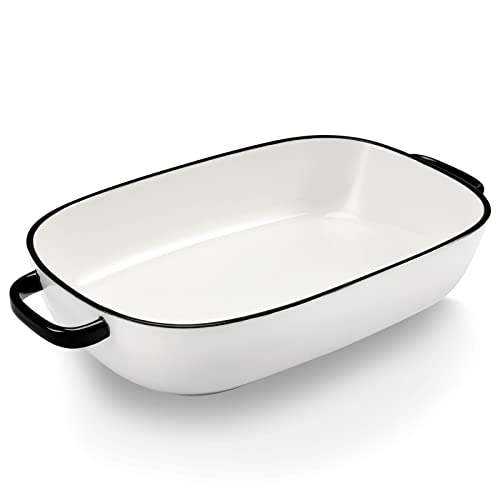
Roeveca 6-Quart 16 x 11-Inch Ceramic Baking Dish is the highest-scoring returned product and the first overall specification-based choice. Its 6-quart capacity, 16 x 11-inch footprint, 3.5-inch depth, 482°F oven rating, handles, and broad appliance compatibility give it the most complete documented profile for large family cooking.
Among the top large baking dishes, the HUSANMP is a compelling deep glass alternative, while the Artena adds a storage lid and the DOWAN red dish offers the highest stated ceramic oven limit. For a lighter metal format, the Glad provides a nonstick carbon steel design but requires hand washing. Ultimately, the best match depends on whether your priority is maximum capacity, transparent glass, covered storage, oven-to-table presentation, or nonstick release.
Frequently Asked Questions
What size should I look for in the best large baking dishes?
The selected products show that large formats commonly use 9 x 13-inch proportions, while some extend to 15 or 16 inches overall. Capacity is equally important: the listed options range from 4 quarts to 6 quarts, with depth between about 3 and 3.58 inches on several models. Compare interior dimensions and allow room for handles inside your oven.
Are ceramic or glass baking dishes better for large casseroles?
Neither material is universally better. Ceramic options in this comparison emphasize oven-to-table serving, handles, and glazed surfaces. Glass options provide visibility and are described as nonporous or resistant to stains and odors. Check the documented temperature range and appliance compatibility for the specific dish rather than relying on material alone.
Can a baking dish with a plastic lid go in the oven?
The supplied listings describe plastic lids for refrigerator storage, transport, freezer use, microwave reheating, or top-rack dishwasher cleaning. They do not establish that the lids are oven safe. Remove a plastic lid before oven baking unless the manufacturer’s instructions explicitly say otherwise.
What should I check before buying a deep baking dish?
Check the interior length and width, depth, capacity, maximum oven temperature, handle clearance, lid instructions, and cleaning method. Also measure your oven rack and cabinet. Some listings include handle size in the external dimensions, so a nominal 9 x 13-inch dish may occupy more space than expected.
Which selected dish is easiest to use for leftovers?
The Pyrex Deep and Artena dishes are especially suited to leftovers because their listings include fitted lids and refrigerator storage details. The Pyrex lid is also described as freezer, microwave, and top-rack dishwasher safe. The Artena lid is intended for spill-resistant transport but is not airtight, so it is better for covered storage than sealed preservation.