Buying Guide
The best mct oil powder supplements are easiest to compare by separating the MCT itself from the carrier ingredients and the product format. Public listings commonly describe powders made from coconut-derived medium-chain triglycerides, but they do not all provide the same level of detail. Look first for a stated C8 and C10 composition, then check whether the label identifies the serving amount, added fiber, flavoring, and manufacturing controls.
Start with the fatty-acid profile
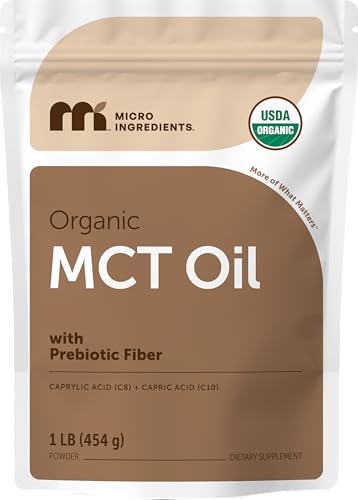
C8 means caprylic acid, while C10 means capric acid. A product may list both as a blend, or it may emphasize a high C8 proportion. Sports Research identifies only C8 and C10 and says C12 is excluded. Nutricost C8 gives the most specific breakdown in this comparison, listing 95% C8, 4% C10, and 1% C6. PureGood lists 60% C8 and 40% C10, while Micro Ingredients and Perfect Keto list 70% C8 and 30% C10.
A precise ratio is helpful when you have a defined formulation preference. If the listing only says “MCT powder,” do not assume a particular C8 or C10 balance. Nature’s Way identifies both acids and supplies total MCT per serving, but its supplied listing does not state the percentage split. That is a documentation difference, not proof that one unspecified formula has a particular composition.
Check total MCT per serving
Fatty-acid percentages and total MCT grams answer different questions. Other listings give a scoop weight rather than the amount of MCT inside the scoop. Sandhu’s, for example, describes a 10-gram scoop but does not state how much of that scoop is MCT.
When comparing containers, servings, and scoops, use the Supplement Facts panel if available. A larger container does not automatically mean more MCT per serving, and a higher scoop weight may reflect fiber or another carrier. This guide uses the supplied public listing data and does not fill in missing quantities.
Decide whether added fiber fits your routine
Several selected products pair MCT powder with prebiotic fiber. PureGood, Micro Ingredients, It’s Just!, and Sandhu’s use prebiotic fiber or acacia fiber. Garden of Life adds both prebiotic fiber and probiotics, including a stated 1.5 billion CFU amount. These additions may appeal to someone seeking a combination formula, but they also make the product less like a single-ingredient MCT powder.
BulkSupplements.com presents a comparatively simple unflavored MCT powder. Always compare the complete label with your dietary needs, especially when fiber, oat bran, collagen, dairy ingredients, or tree nuts matter.
Unflavored powders are designed for coffee, tea, smoothies, shakes, oatmeal, or recipes. Sports Research, Nature’s Way, Perfect Keto, and BulkSupplements.com all describe multiple mixing uses. PureGood specifically describes hot and cold beverages and a creamy texture. These descriptions establish intended use, not a guarantee of a particular mixing result.
Serving instructions are another practical distinction. Nature’s Way gives a one-level-scoop direction. Sandhu’s provides one 10-gram scoop in six to eight ounces of water or a smoothie. Micro Ingredients includes a scoop for repeatable portions. If you prefer to measure by weight, look for a listing that states grams per serving rather than relying only on scoop volume.
Review source and quality documentation
Organic certification, dietary certifications, and manufacturing claims should be treated as separate label features. Nature’s Way, Micro Ingredients, Garden of Life, Sports Research, and PureGood identify organic positioning in their listings. Garden of Life lists USDA Organic, NSF Certified Gluten-Free, vegan, paleo, and keto certifications. PureGood lists USDA Organic, non-GMO, kosher, vegan, and gluten-free claims.
Quality documentation also varies. Sports Research, PureGood, It’s Just!, Sandhu’s, Nutricost C8, Garden of Life, and BulkSupplements.com state third-party testing or named facility controls in the supplied evidence. Other products may have additional documentation outside the supplied listing, but it should not be assumed here. For a supplement, compare the actual package panel and manufacturer documentation before relying on a claim.
Consider dietary exclusions and allergens
The selected listings mention gluten-free, dairy-free, soy-free, vegan, non-GMO, and no-palm-oil formulations in different combinations. Sports Research states no dairy, palm oil, or added sugars. PureGood states no dairy or soy and includes kosher positioning. Garden of Life identifies vegan and gluten-free certification details. These claims are product-specific, so do not transfer them from one brand to another.
Flavor is equally individual. Most selected products are unflavored, while the broader candidate pool includes flavored MCT blends. The selected Perfect Keto listing describes an unflavored powder intended for coffee and recipes. An unflavored product may be more flexible for mixing, but the supplied evidence does not establish that every person will perceive it identically.
Final Recommendation
PureGood Organic MCT Oil Powder with Prebiotic Fiber ranks first overall in this specification-based comparison under the published weighted criteria.
Sports Research Organic Coconut MCT Oil Powder is the first overall specification-based choice among the products returned here. It has a clear C8-and-C10 profile, organic coconut sourcing, no C12, no palm oil, broad dietary claims, and stated third-party testing. PureGood is a close fit for shoppers who want prebiotic fiber, a resealable one-pound pouch, and especially detailed certification and testing information.
Nature’s Way is a practical pick when a stated 6-gram MCT serving and one-scoop directions matter more than a disclosed percentage split. Micro Ingredients and It’s Just! provide larger formats with prebiotic fiber, while Sandhu’s offers especially clear liquid-mixing instructions. Nutricost C8 is the targeted option for a predominantly C8 profile. Garden of Life adds probiotics, Perfect Keto focuses on coffee-creamer use, and BulkSupplements.com keeps the presentation simple with a listed 10-gram serving.
These top mct oil powder supplements should not be treated as interchangeable. Compare the exact Supplement Facts panel, serving size, carrier ingredients, dietary claims, and directions for the product you are considering. The best mct oil powder supplements for one routine may not be the best fit for a routine that avoids added fiber or requires a particular fatty-acid ratio.
Frequently Asked Questions
What should I look for in the best mct oil powder supplements?
Look for a clearly stated MCT source, C8 and C10 information, total MCT grams per serving, and a complete ingredient list. Also check whether the powder contains prebiotic fiber, probiotics, oat bran, or other additions. Dietary certifications and third-party testing claims can help you compare documentation, but they should be verified on the current package or manufacturer materials.
Is a higher C8 percentage automatically better?
No. A higher C8 percentage is a formulation distinction, not a universal quality verdict. Nutricost C8 lists 95% C8, while other selected products use C8-and-C10 blends such as 60/40 or 70/30. Choose based on the composition you want and the rest of the label rather than assuming one ratio suits every routine.
Can MCT oil powder be added to coffee?
Yes, the selected listings for Sports Research, Nature’s Way, Perfect Keto, PureGood, and BulkSupplements.com describe use in coffee or other beverages. Follow the product’s serving directions and mixing guidance. A powder may also be intended for smoothies, shakes, oatmeal, or recipes, depending on the specific listing.
Do all MCT powders contain only MCT oil?
No. Some products include carrier or complementary ingredients. Garden of Life lists prebiotic fiber and probiotics, while Micro Ingredients, PureGood, It’s Just!, and Sandhu’s list prebiotic or acacia fiber. Perfect Keto’s supplied description mentions an oat bran mix. Read the full ingredient panel if you want a simpler formula or need to avoid a particular ingredient.