Buying Guide
The best quiet pedestal fans are not defined by one number alone. A low stated noise level matters for sleep, calls, and focused work, but airflow, oscillation, height, and controls determine whether a quiet fan is useful in the room where it will live. The products above were selected from public listing features and specifications. This is not a hands-on test, and the published noise and airflow figures should be treated as listing claims rather than independent measurements.
Start with the room and seating height
A fan should move air across the part of the room you occupy. For a bed or low sofa, a model with a low setting or a tilting head can aim air more effectively than a tall fixed placement. The AIRMATE spans 12 to 37 inches, while the Becvtoz offers preset heights of 15, 20, 30, and 38 inches and can also serve as a desk fan. Those formats suit nightstands, desks, and low seating.
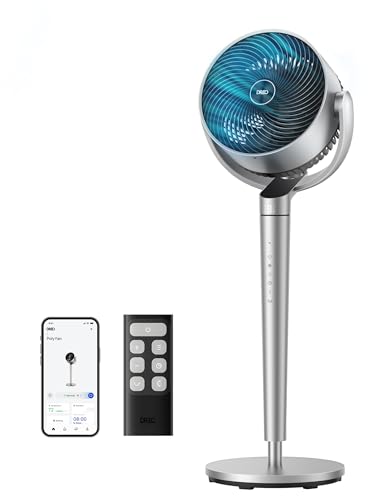
For higher beds, standing desks, or larger seating areas, the DREO TurboPoly Fan 704S adjusts from 37.5 to 43 inches, the Uthfy reaches 46 inches, and the KEGIAN spans 38 to 46 inches. These ranges provide more placement flexibility, although a taller fan can occupy more visual and physical space. Check the listed dimensions and base footprint before choosing a location.
Compare quietness carefully
The lowest supplied figures are 20dB, documented for the Levoit at its lowest setting, the DREO TurboPoly Fan 551, the DREO TurboPoly Fan 502, the KEGIAN, and the Becvtoz. The DREO TurboPoly Fan 704S also lists 20dB operation. Uthfy and AIRMATE list 25dB, while Rowenta lists 35dB(A) and includes a Silent Night mode.
These figures are not necessarily measured under identical conditions. A model may be quiet at its lowest speed but produce more sound at Turbo or maximum airflow. If sleep is the priority, look for both a low noise specification and a sleep mode, timer, or enough speed steps to make a gentle setting practical. The Levoit has five speeds plus Turbo, the KEGIAN has 16 speeds, and the DREO TurboPoly Fan 551 has nine speeds and three modes.
Match airflow to the job
Published airflow figures can help separate personal fans from room circulators, but they should not be compared as if every manufacturer used the same test method. Rowenta lists up to 2,436 cubic feet per minute, the DREO TurboPoly Fan 704S lists 1,400 CFM, and the DREO TurboPoly Fan 551 lists 1,150 CFM. Levoit lists up to 1,024 CFM, while the DREO TurboPoly Fan 508S lists 1,000 CFM and AIRMATE lists 960 CFM.
For a bedroom, you may prefer a lower setting and more precise direction rather than maximum output. For a living room or a stuffy space, stronger circulation and a longer stated air reach may be more relevant. The DREO TurboPoly Fan 704S lists reach up to 110 feet, while the DREO TurboPoly Fan 551 and DREO TurboPoly Fan 508S list up to 96 and 100 feet respectively.
Look at oscillation coverage
Standard horizontal oscillation can work well when the fan serves one seating area. The Levoit specifies 90° horizontal movement, AIRMATE specifies 80°, and Rowenta describes oscillating airflow without a supplied angle in the listing points. Wider movement can help share air across a room, but it may be less useful if you want a fixed stream.
Two-axis movement is more versatile when documented. The DREO TurboPoly Fan 704S provides 150° horizontal and 120° vertical oscillation. The DREO TurboPoly Fan 551 and Uthfy provide 120° horizontal movement with 100° or 120° vertical movement, while KEGIAN provides 120° on both axes. The Becvtoz offers selectable horizontal angles up to 180° and two vertical tilt options. Consider whether you need automatic movement on both axes or simply a tilting head.
Decide how much control you need
A remote is useful when the fan is beside a bed or across a room. All of the selected models list remote control, either explicitly or as part of their supplied features. Timers range from eight hours on several DREO models to 12 hours on KEGIAN, Uthfy, and AIRMATE. Choose a longer timer if the fan will run overnight or through a work session.
Smart models add app, Wi-Fi, voice, or temperature-responsive features. The DREO TurboPoly Fan 704S and DREO TurboPoly Fan 508S document app and voice control, while the KEGIAN listing describes ECO operation and a remote. These features can simplify schedules and automatic adjustments, but a basic remote and panel may be preferable if you want fewer setup steps.
Consider cleaning and storage
Dust accumulation is a normal maintenance concern for any fan. Levoit documents a detachable grille and blades, DREO describes detachable components on several models, Uthfy describes simple disassembly, and KEGIAN lists a removable front grille. These details are more useful than a general claim that a fan is easy to clean because they identify access points.
Storage also matters. The Becvtoz pole detaches and the unit converts between desk and standing formats. Lighter or more compact designs may be easier to move, but the supplied evidence does not establish a universal portability winner. Compare dimensions, listed weight, height range, and base size against your storage area.
Final Recommendation
DREO TurboPoly Fan 704S ranks first overall in this specification-based comparison under the published weighted criteria.
The DREO TurboPoly Fan 704S is the first overall specification-based choice among these best quiet pedestal fans. It combines documented airflow, broad oscillation, 20dB operation, smart controls, height adjustment, and a 12-hour timer. The DREO TurboPoly Fan 551 is a strong alternative when low noise and powerful circulation matter more than smart features, while Levoit is a practical bedroom pick with a clear 20dB lowest-setting claim and detachable cleaning parts.
Among the top quiet pedestal fans, KEGIAN stands out for 16 speeds and motorized two-axis movement. AIRMATE is better suited to lower placements, and Becvtoz is adaptable when a desk mode or compact storage matters. Rowenta remains notable for its large 16-inch head and substantial stated airflow figure, though its listed 35dB(A) operation is higher than the 20dB options. Treat all published figures as specification evidence, then prioritize the combination that fits your room, sleep habits, and preferred controls.
Frequently Asked Questions
What features matter most in the best quiet pedestal fans?
Start with a published low-noise figure, but also check whether it applies only to the lowest setting. Then compare speed steps, sleep mode, timer length, airflow information, and oscillation. A fan with 20dB operation may still need suitable direction and speed control to work well in your room.
Is a DC motor necessary for a quiet pedestal fan?
No single supplied specification proves that a motor will be quiet in every setting. Compare the actual published noise figure and the available low-speed controls rather than relying on motor type alone.
Are smart controls worth choosing?
Smart controls are useful if you want app scheduling, voice commands, temperature-responsive modes, or remote adjustment from bed. The DREO TurboPoly Fan 704S and DREO TurboPoly Fan 508S document these capabilities. If you only need speed, oscillation, and a timer, a remote-controlled model may be simpler.
How wide should a pedestal fan oscillate?
That depends on the area you want to serve. A narrower 80° or 90° range can suit one desk or bed, while 120° or wider two-axis movement can distribute air across more positions. The Becvtoz lists selectable horizontal angles up to 180°, and several DREO models document simultaneous horizontal and vertical oscillation.
What should I check before placing the fan in a bedroom?
Check the lowest height, base dimensions, timer, remote, display-light behavior, and stated noise level. Also confirm how the grille and blades come off for cleaning. A low setting, sleep mode, long timer, and accessible cleaning design can be more useful at night than maximum airflow alone.