Buying Guide
The best quiet tower fans are not defined by a single specification. A low published noise figure matters, but so do airflow range, room movement, and nighttime controls. This comparison uses listing data only, so the rankings reflect documented features rather than independent measurements or customer opinions.
Look for a stated decibel figure and check the condition it describes. Several selected models publish low-speed figures, including the PELONIS 40-Inch Bladeless Tower Fan at 22 dB, the Antarctic Star T36 at 22 dB on low, the Pelonis 42-Inch Tower Fan at 23 dB, and the Pureborne and MORENTO models at 25 dB. These figures help compare products on paper, but they do not establish that every speed will be equally quiet. The DREO 28 ft/s model, Levoit, and VAGKRI listings describe quiet or near-silent operation without giving a comparable exact number.
For a bedroom, prioritize Sleep mode, a timer, and a way to dim or turn off the display. Antarctic Star includes screen auto-off, the DREO Smart Tower Fan with 26 ft/s airflow lists display auto-off, and Levoit combines Sleep mode with a 12-hour timer. A fan can be quiet mechanically yet inconvenient if its display remains bright or its speed cannot be reduced gradually.
Match airflow to the room
Airflow claims help compare published capability, but they should not be treated as a guarantee of room-temperature reduction. The DREO Tower Fan 519 lists 1397 CFM, the Pelonis 42-Inch Tower Fan lists 1391 CFM, the PELONIS 40-Inch model lists 1200 CFM, and Pureborne lists 1100 CFM. These figures may appeal to users who want more air movement in a larger living area.
If you mainly need a personal breeze beside a bed or desk, a shorter tower may be easier to position. MORENTO is listed at 36 inches, while Levoit is listed at 36.2 inches with a 6.5-inch width. Compact dimensions can matter as much as airflow when the fan must fit beside furniture or in a narrow corner.
Check oscillation and directional adjustment
Oscillation spreads air beyond a single fixed position. Most selected fans document 90-degree oscillation, including the PELONIS 40-Inch, Pelonis 42-Inch, Pureborne, MORENTO, both selected DREO smart models, Levoit, and VAGKRI. VAGKRI is distinctive because it adds 135-degree vertical adjustment, which may help direct air toward people sitting at different heights.
A tall fan does not automatically provide better coverage. Compare oscillation with the available floor area and the location of your bed, desk, or sofa. A 42-inch model may project air from a higher outlet, while a shorter 36-inch model may be easier to place under shelves or beside low furniture. The right choice depends on where airflow needs to go, not only on height.
Decide how much control you need
Basic controls may be sufficient if you usually select one speed and leave the fan running. More adjustable models are useful when the room changes throughout the day. Antarctic Star offers six speeds and four modes; the selected DREO 36-inch model offers eight speeds and four modes; and the DREO Tower Fan 519 offers nine speeds and four modes.
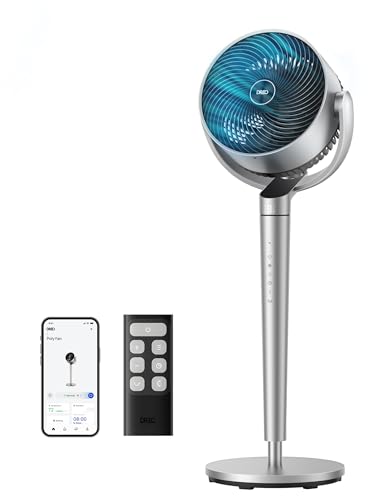
Smart control is useful when the fan is across the room or when you want scheduled operation. Pureborne, MORENTO, and the selected DREO smart models document app or voice integration alongside remote controls. Pureborne notes 2.4GHz Wi-Fi compatibility, so network requirements should be checked before purchase. Levoit and the PELONIS 40-Inch model emphasize conventional remote-based operation, which may suit shoppers who want fewer setup steps.
Consider cleaning and household safety
Bladeless construction is documented for several selected products, including the PELONIS 40-Inch, Pureborne, the DREO smart models, and VAGKRI. This design avoids exposed spinning blades, while Pureborne and MORENTO also list pinch-resistant or pinch-proof grille details. Antarctic Star documents a removable rear grille, the DREO eight-speed model lists a removable rear grille and impeller wheel, and Levoit lists a removable back grille.
These features can make routine maintenance more accessible, but they do not eliminate the need to follow manufacturer cleaning instructions. Families should review the specific safety information for the chosen model. The supplied listings mention ETL-related safety details for some products, but certification language is not identical across the selection.
Use timers and automatic modes thoughtfully
Timers are practical for bedtime, office sessions, or scheduled circulation. The selected products document timers ranging from eight hours on the DREO eight-speed model to 15 hours on the Pelonis 42-Inch and VAGKRI models. Sleep modes may reduce speed over time, while Auto or ECO modes can adjust airflow based on room temperature on models such as Levoit, Pureborne, MORENTO, and the selected DREO fans.
Treat automatic modes as convenience features rather than proof of energy savings in every situation. The evidence supports their presence and stated behavior, but not a universal reduction in electricity use. If power consumption is a priority, compare documented wattage where available and use the timer when continuous operation is unnecessary.
Final recommendation
Pureborne 42-Inch Smart Tower Fan ranks first overall in this specification-based comparison under the published weighted criteria.
Pureborne 42-Inch Smart Tower Fan is the first overall specification-based choice among these best quiet tower fans.
The PELONIS 40-Inch Bladeless Tower Fan is a strong alternative because it combines a stated 22 dB noise level, 1200 CFM airflow, six speeds, four modes, remote control, and 90-degree oscillation. Its bladeless construction and 33W specification add practical appeal for bedroom or office use.
The Antarctic Star T36 suits users who want detailed controls, screen auto-off, child lock, and a removable rear grille. Choose the Pelonis 42-Inch when higher listed airflow and a long timer matter more than compact placement. Pureborne and MORENTO are the most feature-rich smart-control options in this selection, while Levoit is a balanced choice for automatic temperature response.
For larger spaces, the DREO Tower Fan 519 offers the highest stated CFM in the selected group and nine speeds. The DREO eight-speed model supplies strong customization and cleaning access, and the DREO smart 26 ft/s model emphasizes bedroom automation. VAGKRI is the most directionally adjustable option. Taken together, these top quiet tower fans cover the main buying priorities without relying on customer sentiment or marketplace labels.
Frequently Asked Questions
What should I look for in the best quiet tower fans for a bedroom?
Start with a documented low-noise figure, then look for Sleep mode, a timer, and display shutoff. The PELONIS 40-Inch, Antarctic Star T36, Pureborne, and MORENTO each publish low-noise claims, while Antarctic Star and DREO document display-related nighttime controls. A remote can also help you change settings without getting out of bed.
Are bladeless tower fans easier to clean?
The selected listings describe bladeless designs as easier to clean or safer around children and pets, but cleaning access varies. The PELONIS 40-Inch emphasizes wiping the exterior, while Antarctic Star, Levoit, and the DREO eight-speed model document removable rear grilles. Follow the model’s instructions rather than assuming all internal parts are washable.
Is a 42-inch tower fan better than a 36-inch model?
Not automatically. A 42-inch fan may suit users seeking a taller format or higher listed airflow, as with the Pelonis 42-Inch and DREO Tower Fan 519. A 36-inch model such as Levoit, MORENTO, or the DREO eight-speed fan may fit more easily in a compact room. Compare airflow claims, width, oscillation, and placement together.
Do smart tower fans require Wi-Fi?
Smart features generally depend on compatible network or app setup. Pureborne specifically states compatibility with 2.4GHz Wi-Fi, and MORENTO and DREO document app or voice control. If you do not want connected setup, choose a model with a remote and onboard controls, such as the Pelonis 42-Inch or Antarctic Star T36.
Can a tower fan replace air conditioning?
The supplied evidence supports air circulation and personal cooling features, not replacement of air conditioning. Fans move air to improve comfort, and several listings describe pairing them with air conditioners. Use airflow, oscillation, and timer features to circulate air where needed, while treating room-temperature control as a separate function.
Methodology
This is a specification-based comparison, not a hands-on product test. Editorial scores use a weighted formula: quiet operation (25%), airflow capability (20%), control flexibility (20%), oscillation and room coverage (15%), nighttime features (10%), and safety and maintenance (10%). Scores use only the supplied feature and specification evidence. They do not use ratings, current listing information, purchase activity, marketplace badges, or exact price data. Claims about suitability are limited to documented product attributes and cautious editorial interpretation.