Buying Guide
The best ratchet tie-down straps are selected by matching the documented load information and physical configuration to the job. A strap that is convenient for a kayak or motorcycle may not be the right choice for industrial equipment. Start with the cargo, identify suitable anchor points, and then compare strap width, length, hook style, and stated working-load limit.
Check working load before break strength
Working load limit is the more useful figure for planning a tie-down application because it describes the stated load the strap is intended to handle in use. Break strength is a separate specification describing the point at which the strap may fail. Do not treat the two numbers as interchangeable. Cargo Control provides both figures, while STANLEY, FORTEM, and LISHINE also document working-load information. Several other listings provide only break strength or capacity, so buyers should avoid assuming an unstated working-load limit.
Choose the right strap width
One-inch straps are common in compact kits for motorcycles, kayaks, roof racks, boxes, and general vehicle cargo. FORTEM and Rhino USA use this format and add soft loops or coated hooks for versatile attachment. Two-inch straps provide a wider webbing format and appear in the Cargo Control, LISHINE, Bolvixor, and EVEREST selections. Width alone does not establish suitability; use the documented capacity and the requirements of the cargo and anchor system together.
Match length to the load
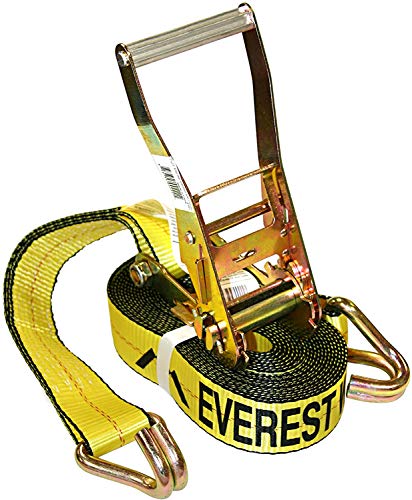
Fifteen or sixteen feet is a practical middle range for many vehicle and recreational applications. The STANLEY, Bolvixor, Cargo Control, Rhino USA, and Haccoplanet sets use lengths in that range. The EVEREST strap extends to 27 feet, making it suitable for large or awkward equipment when one long strap is useful. Rhino USA’s retractable model is 10 feet, while its self-retracting mechanism is intended to manage excess webbing rather than provide extra reach.
Compare hook and anchor designs
Hook shape determines whether a strap fits the available anchor. Standard S-hooks are used by STANLEY, FORTEM, Rhino USA, and Haccoplanet. Coatings are specifically described on several of those hooks and may help protect vehicle or cargo surfaces. Double J-hooks, used by EVEREST and LISHINE, are described for trailers and various anchor points. Haccoplanet adds safety clips, while Rhino USA includes keeper clips on its full-bend S-hooks. Confirm that the hook can seat fully in the vehicle, trailer, rack, or D-ring before loading.
Consider the ratchet and release
A padded or rubberized handle can provide a more controlled grip, but the listings do not establish how any handle feels in actual use. DEWALT describes an open handle and reinforced release pad; STANLEY specifies a padded handle and finger lever; FORTEM and Rhino USA describe rubber or padded grips. Quick-release levers are listed on multiple models. Retractable designs from Rhino USA are useful when loose strap length and storage are concerns, while traditional manual ratchets may offer a simpler mechanism.
Look for webbing and hardware protection
Outdoor transport exposes straps to weather and abrasion. Cargo Control documents UV-, water-, and abrasion-resistant polyester webbing. DEWALT, STANLEY, Bolvixor, and Haccoplanet also describe weather- or wear-focused materials. EVEREST adds an edge guard intended to minimize abrasion-related breakage. Coated or zinc-plated hardware is described across several choices and may help resist corrosion. These features support comparison, but they do not replace inspecting the strap for cuts, fraying, deformation, or damaged hardware before every use.
Decide between a kit and a single strap
A single long strap such as EVEREST can be useful when one continuous tie-down is needed, but most loads require multiple anchor points. Six-packs from Cargo Control and Bolvixor provide broader coverage. Four-packs from LISHINE, Haccoplanet, FORTEM, and Rhino USA balance coverage with simpler storage. Accessory-rich packages can reduce the need to buy soft loops separately, but included accessories should still be checked for compatibility and condition.
Final recommendation
DEWALT DXBC50002 Ratchet Straps ranks first overall in this specification-based comparison under the published weighted criteria.
DEWALT DXBC50002 Ratchet Straps is the first overall specification-based choice.
The final choice among the best ratchet tie-down straps depends on the documented features that match your intended use.
DEWALT DXBC50002 is the highest-ranked returned product under the published weighted criteria. Its documented capacity, 1.5-inch by 16-foot format, corrosion-resistant components, armored side caps, D-ring, and double J-hooks create a well-rounded profile for heavier cargo. Cargo Control is a strong alternative when a six-pack and explicit working-load documentation matter, while EVEREST fits users seeking a single long strap.
Among the top ratchet tie-down straps, STANLEY is a balanced two-pack with clear load figures and detailed handle features. LISHINE and Bolvixor suit wider multi-point applications, whereas FORTEM, Rhino USA, and Haccoplanet are better aligned with smaller vehicle and recreational cargo. Rhino USA’s retractable 2-inch model is the specialized pick for self-managing excess strap length.
Frequently Asked Questions
How should I compare the best ratchet tie-down straps for a motorcycle?
Begin with the motorcycle’s anchor points and the strap’s stated working load. One-inch sets such as FORTEM and Rhino USA include soft-loop or coated-hook features suited to vehicle and recreational applications. A strap should be positioned so the hook is fully seated and the webbing does not contact sharp edges. The listing evidence supports comparing these features, but it does not establish a particular motorcycle setup as universally suitable.
Are two-inch ratchet straps always better than one-inch straps?
No. Two-inch straps offer a wider format and are represented here by Cargo Control, LISHINE, Bolvixor, and EVEREST, but suitability depends on the documented load, anchor hardware, length, and cargo. One-inch straps can be more appropriate for motorcycles, kayaks, roof racks, and lighter general cargo when their stated limits fit the application.
What is the difference between a retractable and standard ratchet strap?
A standard strap uses a manual ratchet with separate loose webbing. A retractable model, such as the Rhino USA 2-inch option, uses a self-retracting mechanism to manage excess length. Retractable storage may help keep the strap neater, but its shorter 10-foot length can be less suitable for large or unusually shaped loads.
Should I use break strength or working load when choosing a strap?
Use the documented working-load limit when one is provided, and do not substitute break strength for it. Break strength indicates a different limit. Cargo Control, STANLEY, FORTEM, and LISHINE provide useful load details, while some listings do not state a working-load figure. When the necessary specification is missing, select a product with clearer documentation or consult the equipment requirements.