Buying Guide
Choosing the best trailer ratchet straps starts with the load and the trailer’s anchor points, not with a particular brand name. The products in this comparison use several documented designs: conventional loose-webbing ratchets, wheel straps, axle straps, E-track fittings, and retractable bolt-on assemblies. Those designs are not interchangeable in every application, so match the strap format to the way your cargo can be secured.
Start with the working load limit
Break strength describes the force at which a strap may fail, while the working load limit is the more useful figure for planning a tie-down system. Do not treat the two numbers as interchangeable. Trekassy lists a 3,333-pound safe working load and a 10,000-pound break strength, while the KJE tire set also documents a 3,333-pound working load limit with 10,000-pound break strength. These are strong specifications for vehicle-hauling kits, but the trailer, anchor points, hooks, and the complete tie-down arrangement also matter.
Lower-rated products can still be appropriate when the cargo and attachment system call for them. STANLEY lists a 1,100-pound safe working load and 3,300-pound break strength. CargoBuckle lists a 1,167-pound safe working load per strap and 3,500-pound break strength. Those figures make them better candidates for moderate loads than for automatically replacing a higher-capacity wheel or axle system. Always use the lowest relevant rating in the complete setup and follow applicable transport requirements.
Match width and length to the load
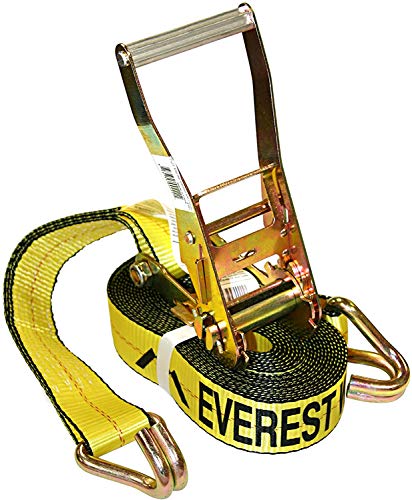
Two-inch webbing appears across many vehicle-focused choices, including the 20-foot LISHINE set, the 27-foot EVEREST strap, and the 10-foot KJE wheel straps. Wider webbing can be a useful specification for demanding trailer work, but length determines whether the strap can route around the load and reach the anchor without an improvised extension. The EVEREST strap provides the most reach in this group, while the LISHINE set offers four long straps for varied cargo positions.
Shorter straps can be easier to manage. CargoBuckle’s 6-foot retractable design and the 8-foot KJE kit may suit compact loads or fixed mounting positions. Retractable products generally store excess webbing inside their housings, but their compact lengths may not work around large tires, wide equipment, or distant anchor points. Measure the path from the cargo contact point to the trailer anchor before choosing.
Hook compatibility is a central part of trailer tie-down selection. Double J hooks, used by LISHINE and EVEREST, are intended for several trailer and cargo anchor arrangements. Flat hooks on the KJE wheel set are a different design and may be useful where the trailer has a suitable flat anchor area. S hooks, used on products such as Rhino USA and STANLEY, provide another common attachment format; coated versions may help reduce contact damage to cargo or vehicle surfaces.
Wheel and axle kits solve a different problem from general cargo straps. Trekassy includes tire straps and axle straps, and the KJE heavy-duty kit also includes axle straps. These formats can route through or around vehicle components rather than relying only on a body-mounted hook location. Confirm the manufacturer’s intended routing and keep webbing away from sharp edges, hot surfaces, and moving parts.
Consider E-track or permanent mounting
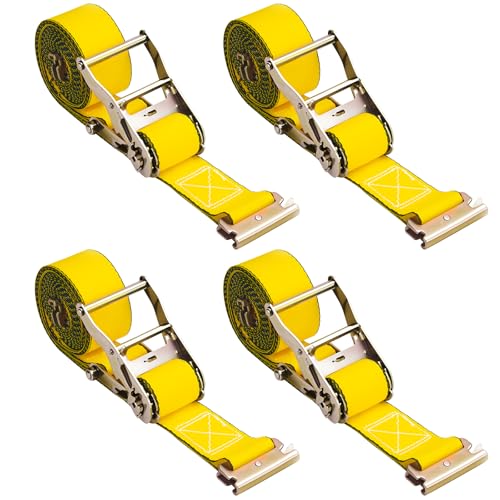
If your trailer, van, or box truck already has E-track, JOYANALL’s E-track format is the most directly matched option in this selection. Its spring fittings are designed to connect to the track, allowing installation and removal without changing the trailer’s anchor hardware. This is convenient only when the track is present and positioned appropriately.
Retractable bolt-on products are another installation category. CargoBuckle and Rhino USA provide retractable options, while several marine-oriented designs in the source pool use bolt-on mounting. A bolt-on ratchet can keep the assembly attached to the trailer and contain loose webbing, but it requires a suitable mounting location and, depending on the model, drilling or existing holes. Check clearance, fastener requirements, and whether the trailer structure can support the installation before buying.
Look for protection and storage details
Polyester webbing is specified throughout the selected products, with some listings adding UV, wear, water, or corrosion resistance. These descriptions are useful construction clues, not a substitute for inspecting straps before every trip. Replace webbing that is cut, abraded, frayed, chemically damaged, or otherwise compromised. Edge guards, protective sleeves, coated hooks, and yellow wheel-protection webbing can help address particular contact points, but they do not make a strap suitable for sharp edges without additional protection.
Storage features also vary. Trekassy and the KJE kits include carry bags, Rhino USA includes soft loops, and retractable designs contain excess webbing automatically. A manual strap can be perfectly practical if it is coiled and stored dry, while a retractable unit may be more convenient for frequent use. The best trailer ratchet straps are the ones whose capacity, geometry, attachment method, and storage format fit the actual routine.
Inspect and use straps consistently
Before loading, verify that the hooks are fully seated and that the webbing lies flat without twists. Keep the ratchet handle accessible, tension the strap without damaging the cargo, and secure loose ends. During a stop, inspect for shifting, abrasion, or loosening. Do not use a strap whose webbing or hardware shows damage, and do not exceed the documented working load limit.
Final Recommendation
Trekassy 2-Inch Car Tie Down Straps ranks first overall in this specification-based comparison under the published weighted criteria.
The final choice among the best trailer ratchet straps depends on the documented features that match your intended use.
Trekassy 2-Inch Car Tie Down Straps is the highest-scoring returned product and the first overall specification-based choice. Its combination of tire straps, axle straps, protective sleeves, 3,333-pound safe working load, and 10,000-pound break strength gives vehicle haulers a broad documented setup. For flat-hook wheel tie-downs, the KJE 4-Pack is a focused alternative. Choose LISHINE or EVEREST when extra length is the priority, JOYANALL when the trailer has E-track, and CargoBuckle or Rhino USA when retractable storage is more important. These are among the top trailer ratchet straps here because each aligns a distinct design with a specific trailer use rather than relying on one universal format.
Frequently Asked Questions
How do I choose the best trailer ratchet straps for a car?
Start with the vehicle’s weight, the strap’s working load limit, and the trailer’s anchor layout. Wheel or axle kits such as Trekassy and the KJE heavy-duty kit include vehicle-focused components. Check the complete system’s lowest rating and follow the strap manufacturer’s routing instructions.
Are 2-inch trailer ratchet straps always better?
Not automatically. Several selected products use 2-inch webbing, while STANLEY uses 1.5 inches and Rhino USA offers a 1.6-inch option. Width is only one specification; working load, length, hook compatibility, cargo contact, and trailer anchors must all match the job.
When should I choose retractable ratchet straps?
Choose a retractable design when containing excess webbing and simplifying storage are priorities. CargoBuckle and Rhino USA document self-retracting mechanisms. Confirm that the strap length and mounting method fit the trailer, because retractable units may have shorter webbing or require bolt-on installation.
Can I use an E-track strap without E-track?
Not as intended. JOYANALL’s selected product documents E-track spring fittings and connectors, so it is designed for a compatible track system. If the trailer lacks E-track, select a strap with hooks or mounting hardware that matches the existing anchor points.
What should I inspect before using trailer tie-down straps?
Look for cuts, fraying, abrasion, chemical damage, bent hooks, damaged ratchets, and missing safety clips. Make sure the webbing lies flat and the hooks are seated. Do not use a strap when its condition or rating is uncertain.