Buying Guide
The best ratcheting socket wrenches are not defined by piece count alone. A useful comparison starts with the drive system, the fastener sizes covered, the available access features, and how easily the kit can be stored and expanded. The products above range from compact 1/4-inch sets to 1/2-inch impact equipment and specialized long-reach ratchets.
Choose the drive size first
A 1/4-inch drive is generally the compact choice in this comparison. Egofine, TILIBOTE, and LLNDEI pair that format with small metric sockets, bits, extensions, or universal joints. These sets are suited to household repairs, bicycles, motorcycles, electronics-adjacent work, and smaller automotive fasteners. Their compact handles and accessories can be easier to control, but the supplied evidence does not position them as replacements for larger-drive equipment.
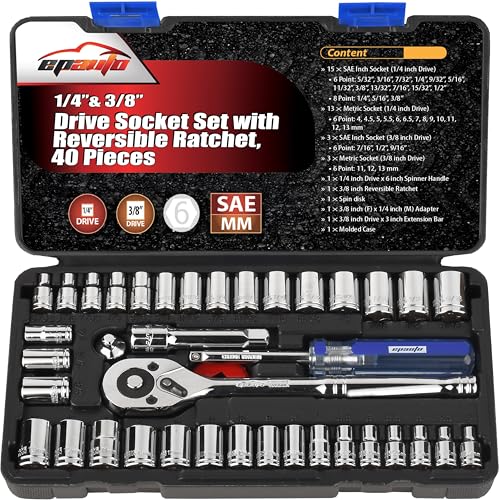
A 3/8-inch drive is a practical middle ground. EPAuto and WORKPRO combine 1/4- and 3/8-inch equipment, while HORUSDY focuses on a 3/8-inch impact set. This size offers a useful balance for general workshop and vehicle work. The Klein KNECT also uses a 3/8-inch drive, but its pass-through construction is the defining feature rather than a large conventional socket range.
For larger fastening work, the DEWALT set uses a 1/2-inch drive and is identified as impact-ready. That makes it a more focused choice than a compact household kit. Drive size should match the fasteners and tools you already own; adapters can add flexibility, but they do not turn every small ratchet into a heavy-duty system.
Match socket coverage to your fasteners
Mixed SAE and metric coverage reduces the need to maintain separate basic kits. EPAuto, WORKPRO, TILIBOTE, and HORUSDY document both measurement systems. HORUSDY goes further with deep and shallow sockets, while the smaller TILIBOTE kit adds SAE and metric sockets alongside bits.
Metric-only compact sets can still be the right choice when your work is predictable. LLNDEI documents shallow 4-14mm sockets, and Egofine lists 13 metric sockets from 4-14mm. These ranges are convenient for common smaller fasteners, but buyers should check whether larger sizes or SAE sockets are required before choosing a compact kit.
Socket geometry also matters. HORUSDY and LLNDEI document six-point designs. A six-point socket contacts the flat sides of a compatible fastener rather than relying on the corners, which is a useful design consideration when selecting a set. The listing evidence supports the design feature; it does not establish results for every fastener condition.
Consider access and ratchet movement
Tooth count and head design affect how a ratchet can be used in restricted spaces. The EPAuto and TILIBOTE ratchets list 72 teeth, while Klein KNECT lists 90 teeth and both Astro tools list 100 teeth. Higher tooth counts are associated with smaller documented swing requirements in some listings, but tooth count alone should not be treated as a complete measure of tool performance.
The Klein KNECT is particularly relevant for extended bolts and threaded rod because its pass-through head is designed around that use. The Astro 78318 and 783105 are different: they are long-reach, flex-head ratchets intended for compatible Nano-style stubby sockets. The 18-inch version favors maximum reach, while the 10.5-inch version offers a shorter format. Neither listing includes the compatible socket set, so these are specialty additions rather than complete starter kits.
A quick-release feature can make socket changes more convenient, but it is still worth checking the exact retention mechanism and drive size.
Evaluate construction and protection
Chrome-vanadium steel appears across several sets, including EPAuto, Egofine, and WORKPRO. HORUSDY and DEWALT provide more specific impact-related construction details, with HORUSDY listing heat-treated chrome-vanadium steel and DEWALT listing heat-treated CR-440 steel. These details are useful when the intended work involves impact tools, but they should be read alongside the product’s stated drive format and compatibility.
Surface treatments also vary. Polished chrome finishes are listed for EPAuto and Egofine, while HORUSDY documents a black phosphoric-acid treatment and LLNDEI lists a black phosphate finish. These are specification differences, not proof of identical long-term performance in every environment.
Do not overlook storage and accessories
A case is useful when a kit contains many small sockets and bits. EPAuto, TILIBOTE, Egofine, LLNDEI, HORUSDY, and WORKPRO all document storage solutions. Markings are another practical distinction: HORUSDY lists laser markings, WORKPRO lists laser graduations, and LLNDEI lists high-contrast permanent markings.
Accessories can change the usefulness of a compact kit. Extensions and universal joints appear in several selections, while TILIBOTE and Egofine add substantial bit coverage. The Klein KNECT includes adapters and a pass-through screwdriver, and HORUSDY includes a reducer and universal joint. Choose accessories that solve a real access or compatibility need rather than selecting solely by the highest piece count.
Final recommendation
HORUSDY 50-Piece 3/8-Inch Impact Socket Set ranks first overall in this specification-based comparison under the published weighted criteria.
The final choice among the best ratcheting socket wrenches depends on the documented features that match your intended use.
Klein Tools KNECT 65400KNECT is the highest-scoring returned product and the first overall specification-based choice. Its pass-through head, 90-tooth ratchet, impact-rated components, adapters, and 1/4-inch impact-driver compatibility give it the broadest access-oriented specification profile in this comparison. The top ratcheting socket wrenches still divide into different use cases: DEWALT is the focused 1/2-inch impact option, HORUSDY offers broad deep-and-shallow coverage, and EPAuto and WORKPRO provide balanced two-drive sets. For compact metric and bit work, Egofine, TILIBOTE, and LLNDEI are more appropriate. Astro’s two ratchets make sense when reach and Nano-style low-profile access matter most.
Frequently Asked Questions
What should I check before buying the best ratcheting socket wrenches?
Confirm the drive size, measurement system, socket range, and whether the ratchet or sockets are impact-rated when that matters. Also check whether extensions, adapters, and a case are included. A compact 1/4-inch kit may be convenient for small fasteners but is not automatically suitable for larger automotive work.
Is a 72-tooth or 90-tooth ratchet better?
Tooth count is one design specification, not a complete quality verdict. The EPAuto and TILIBOTE sets list 72-tooth ratchets, while Klein KNECT lists 90 teeth. Higher counts may support smaller movement between engagements, but the best choice also depends on head shape, drive size, handle access, and the sockets included.
Are pass-through socket sets useful for extended bolts?
They can be. Klein KNECT specifically documents a pass-through head for extended bolts and threaded rod. This design is different from a conventional closed socket arrangement and should be selected when that access problem is relevant. Confirm the compatible socket and adapter formats before purchase.
Do I need both SAE and metric sockets?
If you work on a mixture of household, automotive, or workshop equipment, dual-system coverage can reduce gaps. EPAuto, WORKPRO, HORUSDY, and TILIBOTE document SAE and metric sockets. If your tasks use only known metric fasteners, a compact metric set such as LLNDEI may avoid unnecessary pieces.
What are the Astro Nano ratchets for?
Astro Tools 78318 and 783105 are specialized 3/8-inch flex-head ratchets designed for compatible Nano-style or similarly designed stubby sockets. The 78318 has an 18-inch handle for extra reach, while the 783105 has a 10.5-inch handle. The listings do not identify those compatible sockets as included, so verify the complete setup before ordering.