Buying Guide
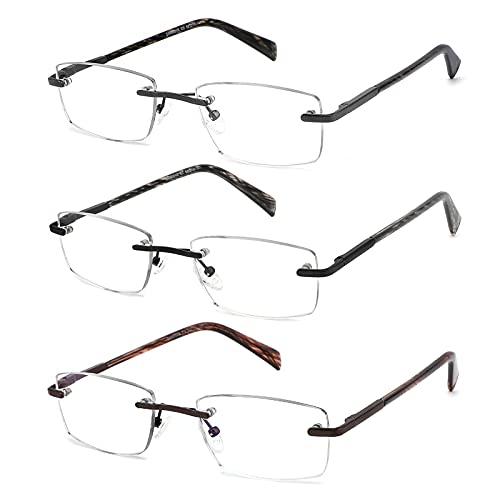
Choosing the best rimless reading glasses starts with separating the appearance of a frameless design from the features that make a reader practical. The products in this comparison are all listed as reading glasses with rimless or frameless construction, but their supporting specifications vary considerably. Some emphasize compact portability, some focus on screen-related coatings, and others document frame materials or progressive lenses.
Confirm the reading power
Ready-made readers are identified by a magnification strength such as 1.50, 2.0, 2.5, 2.75, or 3.00. The products do not all offer the same range. Visualites documents a product-line range from 1.00 to 4.00, while JJWELL lists powers from 1.0 to 4.0. Other selected entries are tied to a stated selection, such as TERAISE at 2.0X, LUFF at 2.75, or Viseng at 2.5.
Choose the strength that matches your established reading needs rather than assuming a higher number is better. SKYOAK is different because it uses progressive multifocal lenses rather than a single uniform reading zone. Its listing says the design is not zero-top, so shoppers should understand how the lens is intended to transition before choosing it.
Compare the rimless construction
Rimless readers can use different construction approaches. DOOViC, TERAISE, and several other products describe frameless styling, while one-piece construction appears in listings that were not selected for this final comparison. The practical point is to look for evidence about how the lenses, temples, nose pads, and hinges are assembled.
Visualites documents polished lens edges, adjustable nose pads, and silicone temple sleeves. DXYXYO provides physical dimensions and spring-loaded temples. prtcslwd lists titanium alloy, curved temples, silicone nose pads, and aluminum hinges. These details are more useful for comparing construction than a general claim that a product is lightweight.
Evaluate lenses for reading and screens
Lens features differ widely. Visualites lists optical-quality lenses with anti-reflective coating and polished edges. DXYXYO lists anti-glare, scratch-resistant, easy-clean, stain-resistant, impact-resistant, and shatter-resistant lens claims. DOOViC lists blue-light filtering, UV400, anti-glare, and scratch-resistant features. JJWELL lists high-definition acrylic lenses along with blue-light and UV400 claims.
Screen-related coatings can be relevant when readers are used with phones, tablets, or computers, but listing claims should not be treated as a substitute for an eye examination or a health outcome. LUFF documents a blue-light protection claim and an 8H nano-coating claim, while SKYOAK lists anti-blue-light and anti-scratch treatments. Compare the exact feature language and avoid assuming that two products with similar labels use identical lens technology.
Check weight, nose pads, and hinges
Comfort depends on more than a rimless silhouette. Visualites lists adjustable nose pads and silicone sleeves over the temple tips. TERAISE states an 18-gram weight and lists a one-piece silicone nose pad. LUFF lists a 16-gram design. Viseng documents soft silicone nose pads, curved temples, and flexible or memory-material construction. Spring hinges appear on DXYXYO, DOOViC, JJWELL, and the selected Viseng models.
If glasses tend to slide, nose-pad and temple details deserve close attention. If pressure is the main concern, compare the documented weight and flexibility. Do not infer an exact fit from a product label alone: DXYXYO is the only selected model here with a particularly detailed set of lens, bridge, and arm measurements, and Viseng also supplies useful approximate dimensions.
Consider materials and long-term handling
The selected products document several materials. Visualites uses flexible hypoallergenic TR90. TERAISE lists TR90, prtcslwd lists titanium alloy and aluminum hinges, LUFF lists aerospace alloy, and Viseng describes titanium-style or copper-titanium construction depending on the model. These descriptions can help narrow the design, but they do not establish independent laboratory durability.
Handling still matters with any rimless reader because the lens edges, nose pads, and temples remain exposed. Store the glasses in a supplied case when one is included. LUFF includes a case and cleaning tools, Visualites includes a tube case, and DXYXYO includes metal cases. SKYOAK lists protective bags and a cleaning cloth. Several other selected multi-pair products list storage bags or cloths, which can make rotation more convenient.
Match the package to your routine
A multi-pair package can support different reading locations. TERAISE lists three pairs and three storage bags; DOOViC lists three colors; JJWELL lists three colors and three pairs; and DXYXYO lists two pairs with cases. This is useful when one pair stays at a desk and another travels, but package size should not replace checking the correct power and fit.
For a single carefully specified pair, Visualites, LUFF, or prtcslwd may be more appropriate. For portability, DXYXYO’s mini dimensions and slim case are notable. For multifocal use, SKYOAK is the distinct option in this group. For a flexible metal design, the selected Viseng models provide spring hinges, silicone nose pads, or memory-material details.
Final recommendation
LUFF Rimless Reading Glasses ranks first overall in this specification-based comparison under the published weighted criteria.
LUFF Rimless Reading Glasses is the highest-scoring returned product and the first overall specification-based choice in this comparison.
The final choice among the best rimless reading glasses depends on the documented features that match your intended use.
Visualites 1 Rimless Reading Glasses combines anti-reflective lenses, polished edges, adjustable nose pads, silicone temple sleeves, and flexible TR90 material with a documented broad power range. LUFF is notable for its lightweight alloy construction and extensive accessory package, while SKYOAK is the option for shoppers specifically seeking progressive multifocal lenses.
Among the top rimless reading glasses in this comparison, DXYXYO stands out for compact dimensions and spring hinges, TERAISE for its 18-gram TR90 design and one-piece nose pad, and prtcslwd for titanium alloy with measured lens sizing. DOOViC and JJWELL are more screen-oriented choices based on their listed blue-light and UV-related features. The two Viseng models provide flexible temples, silicone nose pads, or useful measurements. Before choosing, verify the power, consider the intended reading distance, and use the fit and lens details rather than appearance alone.
Frequently Asked Questions
What makes the best rimless reading glasses different from ordinary readers?
A rimless reader removes most of the surrounding frame, but the important comparison points remain lens power, lens treatments, nose pads, temples, hinges, material, and measurements. Visualites documents adjustable nose pads and TR90 material, while DXYXYO provides compact dimensions and spring hinges. Those details help distinguish designs that may look similar in a listing photo.
Are rimless readers suitable for computer use?
Several selected products are explicitly marketed for computer or screen use, including DOOViC, JJWELL, LUFF, and SKYOAK. Their listings mention features such as blue-light filtering, anti-glare, or anti-blue-light coatings. These claims describe the listed lens features; they do not establish a medical benefit or guarantee comfort for every wearer. Computer users should also confirm that the reading power and viewing distance are appropriate.
Which selected model has progressive lenses?
SKYOAK is the selected progressive option. Its listing describes 3-in-1 multifocal lenses for reading, computer monitors, and nearby work, along with adjustable nose pads and nonslip temple tips. It also specifies that the progressive design is not zero-top, so the lens layout may differ from a conventional single-power reader.
Which selected products include storage accessories?
Visualites includes a tube case, LUFF includes a portable case and cleaning tools, and DXYXYO lists metal cases with its two-pair package. TERAISE lists storage bags, while SKYOAK lists protective bags and a microfiber cloth. Package contents can change, so check the current listing details before relying on a particular accessory.
How should I choose among different rimless shapes and materials?
Start with the power and intended viewing distance, then compare fit hardware and construction. prtcslwd documents a round titanium-alloy design, JJWELL uses a rectangular rimless style, and DXYXYO uses a mini format with stated dimensions. Flexible TR90 appears in Visualites and TERAISE, while LUFF documents an alloy frame. These specifications can narrow your choice, but a professional eye-care recommendation is appropriate when ready-made readers do not meet your needs.