Buying Guide
The best roll-up mattresses are easier to compare when you separate the sleeping surface from the storage format. The products here fall into two practical groups: foam camping pads and Japanese-style floor futons. Camping pads commonly emphasize memory foam, support foam, waterproof or water-resistant covers, non-slip bottoms, straps, and carrying bags. Futons more often use shredded memory foam or layered polyester and foam, quilted covers, handles, and floor-oriented dimensions.
Choose the right design
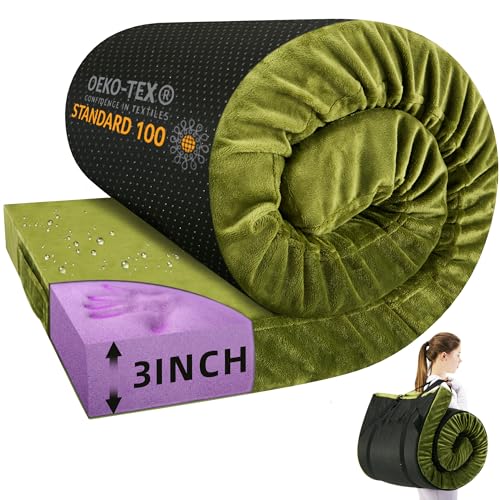
A camping pad is the more direct fit for a cot, tent, SUV, truck, or RV. The Easthome, Gaialoop, ORSEQFFG, BDEUS, and Hazli models all document outdoor or vehicle use. Their foam constructions are described in terms of memory foam, support foam, or dense foam, and several include covers intended to protect against moisture or dirt.
A Japanese floor futon is more naturally suited to a bedroom, living room, guest space, dormitory, or tatami-style setup. MAXYOYO, FISHDRU, DOWNSTORIA, SHOUREN, and Feisaibaoly describe these uses directly. They also provide twin-style footprints that are more suitable for floor sleeping than narrow cot sizes. A futon can still be used for camping when the listing says so, but its cover and storage system may be less outdoor-specific than a camping pad’s.
Compare thickness and foam construction
Thickness is a useful starting point, but it does not describe the complete feel. The selected camping pads are generally 3 or 4 inches thick. Easthome combines 3 inches of support foam with 1 inch of memory foam, while ORSEQFFG lists 2 inches of high-density support foam beneath 1 inch of memory foam. These descriptions make the intended balance easier to understand than a thickness number alone.
The 6-inch MAXYOYO futon is the thickest selected product, while Feisaibaoly lists a 3.5-inch, nine-layer design. FISHDRU lists a 2-inch height, so it may be easier to store but offers less stated material thickness than the thicker alternatives. The right choice depends on whether you want a compact occasional mat or a more substantial floor sleeping surface.
Check the sleeping dimensions
Measure the cot, vehicle, tent, or floor area before choosing. Cot-size products can be around 72 to 75 inches long and 24 to 25 inches wide. BDEUS lists a 75-by-25-inch cot size, while several other camping pads list 72-by-24-inch formats. These dimensions can fit a compact setup but leave less room to turn than a twin or queen.
Twin futons generally offer more usable width. DOWNSTORIA, SHOUREN, and Feisaibaoly list 39-by-80-inch twin dimensions. Hazli is the largest selected option, with an 80-by-60-inch queen footprint. That width is relevant for two-person use or anyone who dislikes a narrow sleeping surface, although the listed 28-pound weight makes it less convenient to carry than a cot pad.
Prioritize cover and base details
For outdoor use, look for the specific protection documented in the listing. Gaialoop and ORSEQFFG describe waterproof coatings on the cover, while BDEUS describes a water-resistant cover. Easthome lists a waterproof cover and non-slip bottom. A removable washable cover is also useful for camping, guest use, or floor placement because it can be cleaned separately from the foam.
A non-slip bottom may help keep a pad in place on a cot, vehicle surface, hardwood, or tent floor, but the supplied evidence does not quantify how well any product prevents movement. FISHDRU, DOWNSTORIA, Easthome, ORSEQFFG, and BDEUS explicitly document non-slip or grip-related bottom features. Products without that detail should not automatically be treated as unstable; the listing simply provides less evidence about the feature.
Plan for unpacking and storage
Many roll-up mattresses arrive compressed. Several listings instruct buyers to lay the mattress flat, use warmth or sunlight, and wait before expecting its full shape. Gaialoop’s camping mattress calls for a warm environment for 48 to 72 hours. ORSEQFFG gives similar vacuum-compression guidance, while Feisaibaoly warns that cold conditions can lengthen the recovery period substantially.
Storage hardware varies. Straps are supplied with many models, and some add a travel bag, dustproof cover, or carry handle. DOWNSTORIA lists both a handle and four Velcro straps. MAXYOYO includes a dustproof cover and straps. Consider where the mattress will live when not in use: a thicker foam or futon model may offer more cushioning but occupy more closet or vehicle space.
Certifications can help shoppers compare stated material standards, although they are not a substitute for comfort testing. Gaialoop, FISHDRU, Hazli, and other selected listings mention OEKO-TEX and/or CertiPUR certifications. Warranty terms also differ: Gaialoop lists two years, while Easthome and ORSEQFFG list one year. These details are specification information, not evidence of long-term performance.
Final Recommendation
Easthome 4-Inch Camping Mattress with Pillow ranks first overall in this specification-based comparison under the published weighted criteria.
The final choice among the best roll-up mattresses depends on the documented features that match your intended use.
Easthome 4-Inch Camping Mattress with Pillow is the highest-scoring returned product and the first overall specification-based choice. Its 4-inch dual-layer construction, built-in pillow, waterproof cover, non-slip bottom, carrying bag, and five size options create the most complete documented setup for camping and temporary guest use.
Among the top roll-up mattresses, Hazli is the clearest choice for a wide queen sleeping surface, while MAXYOYO 6-Inch Japanese Floor Mattress suits shoppers who prioritize thickness for floor sleeping. Gaialoop and ORSEQFFG offer strong camping-focused combinations of layered foam, washable covers, and outdoor protection. BDEUS is a practical roomier cot pad, and the selected futons are better suited to indoor floor sleeping, guests, dorms, and flexible low-profile use.
Before ordering, confirm the packed-storage location, the full expanded dimensions, the required recovery time, and whether the cover protection matches the surface and weather conditions you expect. The supplied listings establish intended uses and specifications, but they do not establish personal comfort, durability under a particular load, or performance in a specific climate.
Frequently Asked Questions
What should I look for in the best roll-up mattresses?
Start with the intended surface and size. For cots and tents, compare the pad’s length, width, thickness, foam layers, cover protection, non-slip bottom, straps, and carrying bag. For floor sleeping, also consider twin or queen dimensions, quilted construction, handles, and the space required for storage. A washable removable cover is useful when the mattress will be used outdoors or by multiple guests.
Are roll-up mattresses suitable for camping?
Several selected products are explicitly described for tent camping, car camping, RVs, cots, or road trips. Camping-focused models such as Easthome, Gaialoop, ORSEQFFG, and BDEUS document those uses. Check whether the cover is described as waterproof or merely water-resistant, and do not assume a product is suitable for backpacking unless the listing says so. ORSEQFFG specifically says it is not recommended for long-distance backpacking.
Are Japanese floor futons the same as camping pads?
They overlap but are not identical designs. A Japanese floor futon typically emphasizes floor, bedroom, guest-room, dormitory, or tatami use and may use shredded memory foam, polyester filling, quilting, or a foam support layer. A camping pad more often emphasizes a cot or vehicle fit, outdoor cover protection, a non-slip base, and a travel bag. Some futons, including the selected FISHDRU and Feisaibaoly models, also document tent or travel use.
How long do compressed mattresses need before use?
Follow the individual listing because the instructions vary. Several products call for roughly two to three days in a warm environment, while some mention sunlight. Feisaibaoly states that cold climates can extend full expansion from days to weeks. Keep the mattress flat during the stated recovery period and do not judge its final shape immediately after opening.
Which of the top roll-up mattresses is best for two people?
Hazli has the clearest documented two-person format because its queen size measures 80 by 60 inches and the listing describes shared use. Confirm the dimensions of your tent, RV, or floor area first. A twin futon or cot pad may be more portable, but its narrower width is generally a different setup from a queen-size shared sleeping surface.