Buying Guide
The best round fire pit covers should be chosen by matching the cover’s actual diameter and height to the fire pit, then checking how the fabric, seams, fasteners, and vents work together. A cover that is too small can leave the rim exposed, while an oversized cover may collect water or move more in wind. The products above are outdoor covers for round bowls, tables, and, in two cases, built-in fire pits; they are not fire-resistant covers intended to be installed over a hot appliance.
Start with diameter and height
Measure the outside diameter of the fire pit at its widest point. Then measure from the ground or supporting surface to the highest part that the cover needs to reach. Compare those measurements with the listed cover size rather than relying on a brand name or a general “universal” description.
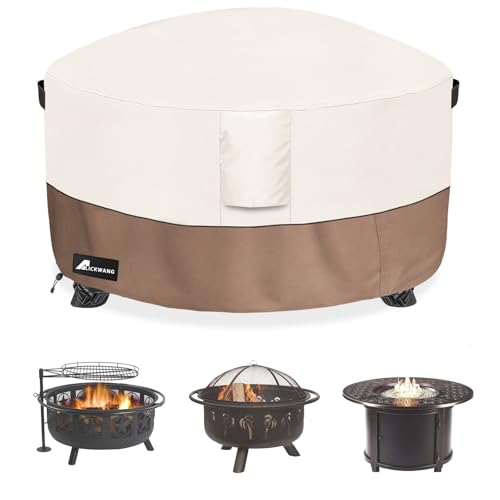
For a 30- to 36-inch pit, the selected QH.HOME 36-inch, Porch Shield, Alickwang, PATIOASIS, and Kipiea models provide several documented options. Their height targets differ: Porch Shield and Kipiea list 20-inch heights, while QH.HOME and Alickwang list 24 inches. That difference matters for a tall fire table, a raised rim, or a lid and burner assembly.
The QH.HOME 44-inch model is suited to a larger mid-range pit, and the two 48-inch selections cover larger bowls or tables. GuardKove and QH.HOME list 24-inch heights in this size class. For built-in installations, GoldenRaindrop targets 46- to 50-inch pits at about 9.8 inches high, while NEVERLAND covers 52- to 57-inch pits at 9 inches high. Those shorter profiles reflect the in-ground use described in their listings and may not suit a freestanding table.
Compare fabric and waterproof construction
Fabric denier is a useful comparison point, but it is not the only construction detail. The selected covers use 600D, 900D, or 1000D Oxford or polyester fabric. GuardKove documents 1000D fabric, while the QH.HOME 48-inch and 36-inch options document 900D material. Many of the other covers use 600D fabric, which can still be paired with coatings and seam treatments.
Look for the complete weather package: a waterproof backing or coating, sealed seams, and protection against sun and precipitation. GuardKove lists a PVC inner coating and heat-sealed seams. Both QH.HOME models describe vinyl or PVC layers and heat-sealed waterproof tape. Kipiea lists double-layer PU coating and sealed seams, while Porch Shield lists waterproof undercoating plus double-stitched and sealed seams. These details provide more useful comparison evidence than a general waterproof label alone.
The source descriptions also mention UV or fade resistance for most selected models. That can be helpful for exposed patios, but the claims use different wording and should not be treated as equivalent test results. Consider the amount of direct sun your fire pit receives and whether a darker or lighter cover is acceptable for your patio.
Check how the cover stays in place
Wind security depends on the shape of the pit, the fit, and the fastening system. Elastic hems and drawstrings provide adjustable tension around the base. Buckle straps add a more explicit connection to the fire pit or table. Alickwang lists four buckle straps, GuardKove lists two buckle straps plus a drawstring, and Porch Shield lists buckle straps with an elastic hem. GoldenRaindrop uses a lockable strap and a rolled-edge rope, while NEVERLAND lists an elastic hem cord.
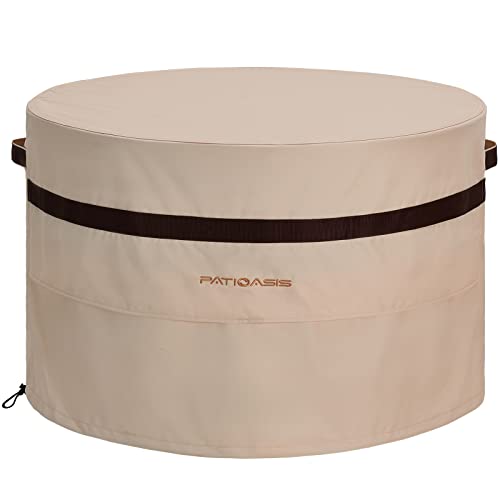
If your patio is exposed to gusts, prioritize a close-fitting size and a listed strap or buckle system. A drawstring alone may be adequate for some sheltered setups, but the supplied specifications do not establish how any particular cover will perform in a specific wind environment. Fasten the cover only after the fire pit surface has cooled; PATIOASIS expressly includes that instruction.
Consider ventilation and water management
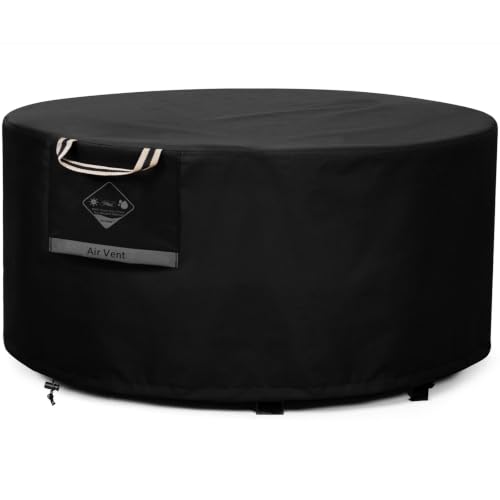
Vents can help air circulate and may reduce trapped moisture beneath the cover. GuardKove, QH.HOME 44-inch, QH.HOME 48-inch, Porch Shield, Alickwang, and PATIOASIS explicitly list vents or mesh ventilation.
Built-in covers require a different water-management approach. GoldenRaindrop and NEVERLAND both advise placing a support object in the center to prevent the top from sinking when rain or snow collects. That guidance is especially relevant when the cover is broad and relatively shallow. A support can help maintain the cover’s shape, but the supplied evidence does not establish a particular support material or performance result.
Look at removal and storage details
Handles can make a large, damp cover easier to remove and position. GuardKove, NEVERLAND, QH.HOME 44-inch, QH.HOME 48-inch, Porch Shield, and Alickwang list handles. Kipiea adds a storage bag, which may be useful when the cover is removed for use or seasonal storage. PATIOASIS also lists double handles, while its mesh vent is positioned as part of the ventilation design.
Before covering, allow the fire pit to cool completely and remove debris that could hold moisture against the surface. Follow the product’s care instructions when available. The source for Kipiea describes rinsing and wiping dry, but similar cleaning methods should not be assumed for every cover.
Final Recommendation
GuardKove 48-Inch 1000D Round Cover ranks first overall in this specification-based comparison under the published weighted criteria.
GuardKove is the highest-scoring returned product and the first overall specification-based choice among these best round fire pit covers. Its 1000D fabric, PVC backing, heat-sealed seams, vents, handles, drawstring, and two buckle straps make it the most complete large-cover package in this comparison. The QH.HOME 48-inch 900D model is a close alternative for a similar large size, while QH.HOME 44-inch is a sensible mid-large option.
For built-in fire pits, choose by installation dimensions rather than freestanding-cover conventions: GoldenRaindrop is aimed at 46- to 50-inch pits, and NEVERLAND reaches 57 inches. For smaller fire tables, Porch Shield is particularly well specified at 36 by 20 inches, and Alickwang offers four buckle straps at 36 by 24 inches. These top round fire pit covers are specification-based recommendations, so confirm diameter, height, rim shape, and clearance before ordering.
Frequently Asked Questions
Among the best round fire pit covers, what size cover should I buy for a round fire pit?
Measure both the outside diameter and the required height, then compare them with the listed cover dimensions. For example, the QH.HOME 44-inch cover is listed for pits up to 44 inches in diameter and 24 inches high, while Porch Shield targets up to 36 inches in diameter and 20 inches high. Do not assume that a cover with the same nominal diameter will fit every rim, burner, lid, or table profile.
Are these covers suitable for a hot fire pit?
No supplied listing supports covering a hot fire pit. Let the surface cool completely before installation. PATIOASIS specifically states that the fire pit surface should cool before covering, and that is a sensible precaution for the other fabric covers as well. The temperature claims in individual listings describe material-use conditions, not permission to cover an active or hot fire.
Which cover is best for an in-ground fire pit?
GoldenRaindrop and NEVERLAND are the clearest built-in options in this selection because their listings explicitly describe in-ground fire pits. GoldenRaindrop covers the 46- to 50-inch range, while NEVERLAND covers 52 to 57 inches. Both sources recommend a center support to help prevent sagging when rain or snow accumulates, so plan for that issue when selecting a broad, low-profile cover.
Do vents matter on a round fire pit cover?
Vents are a useful documented feature because they allow air circulation and may help with moisture beneath the cover. GuardKove, QH.HOME 44-inch, QH.HOME 48-inch, Porch Shield, Alickwang, and PATIOASIS list vents. However, the supplied evidence does not quantify how much condensation any cover prevents. A close fit, dry fire pit surface, and proper storage also remain important.
What keeps a round cover from blowing away?
A close fit combined with an elastic hem, drawstring, buckle, or strap can help secure a cover. Alickwang lists four buckles and an elastic hem; GuardKove lists two buckles and a drawstring; Porch Shield lists buckle straps and an elastic hem. These are design features rather than guarantees for a particular weather condition, so check the fit and use every supplied fastening point.