Buying Guide
This guide compares the best rubber kitchen rugs using documented rubber backing and floor grip, liquid and stain protection, cleaning convenience, standing comfort, size and layout flexibility, and construction durability.
What counts as a rubber kitchen rug?
When comparing the best rubber kitchen rugs, remember that the term can refer to a textile rug with a rubber backing or a cushioned kitchen mat whose underside is described as rubber, non-slip, non-skid, TPR, or a comparable grip material. The selected products include both constructions. Quqei and StepRite describe rubber-backed textile surfaces, while Nialnant identifies recycled rubber backing. Several cushioned PVC products, including Collive and WISELIFE, describe non-slip backing and dry-floor requirements.
The distinction matters because the surface and underside solve different problems. Woven chenille, microfiber, or polypropylene can absorb moisture and provide a softer textile feel. PVC foam is generally presented in these listings as water resistant, stain resistant, waterproof, or oil resistant, and it is usually cleaned by wiping. Neither design should be assumed to perform identically on every floor or in every wet condition.
Measure the area before choosing a size
Start by measuring the clear floor area in front of the sink, stove, island, or work counter. A 17-by-28- or 17-by-30-inch mat, such as WISELIFE or Quqei, suits a focused station. It may be easier to position when cabinets, appliances, or walkways limit available floor space.
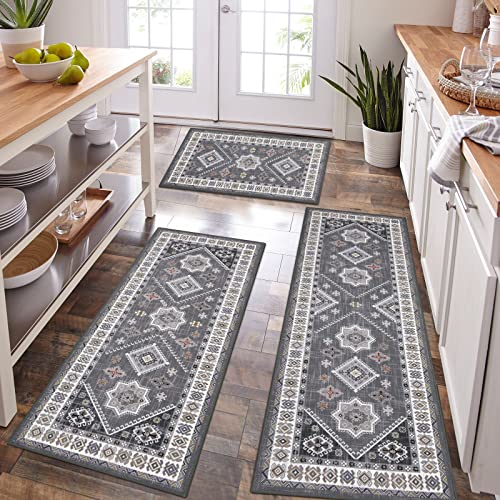
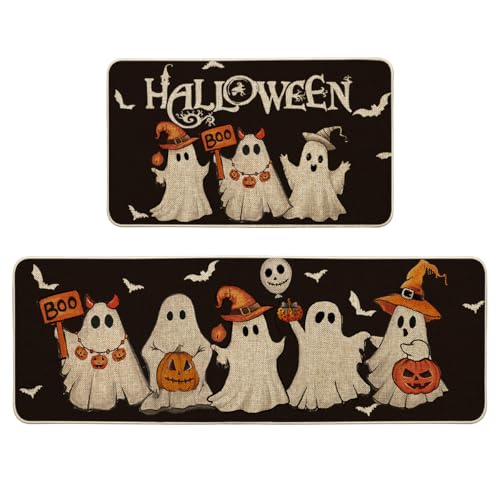
Two-piece sets provide more layout flexibility. Collive, HEBE, Nialnant, Voanos, and TranquilRelax list combinations with a shorter mat and a runner. These can be placed separately at two work areas or arranged along a longer counter. Before using a pair, check that cabinet doors, drawers, and appliances can open without catching an edge.
Three-piece sets offer the broadest arrangement options. HEBE RUGS lists approximately 32-, 48-, and 59-inch lengths. More pieces can be useful in a large kitchen, but they also create more edges to keep aligned and more surfaces to clean.
Choose textile or cushioned PVC construction
Textile rugs are worth considering when absorption and a softer surface are priorities. StepRite describes a chenille surface as water absorbent, and YDKGL describes soft chenille woven fabric with absorption. Quqei uses a high-density woven surface with absorbency and stain resistance. These designs may feel more like conventional area rugs and can help catch small splashes near a sink.
Cushioned PVC mats are better aligned with wipe-clean maintenance and liquid resistance claims. Collive, TranquilRelax, WISELIFE, and HEBE describe PVC surfaces with combinations of waterproof, water-resistant, oil-resistant, or stain-resistant properties. The evidence supports easier surface cleanup, but it does not justify assuming that liquid cannot reach the floor around the edges or seams.
Thickness also changes the feel and fit. WISELIFE lists approximately 0.5 inches, Collive lists 0.47 inches, and several other cushioned sets list 0.4 inches. TranquilRelax offers both 0.4-inch and 0.8-inch options. Thicker mats may provide more cushioning according to their product descriptions, but measure door clearance and watch for transitions between the rug and surrounding floor.
Check the backing and floor conditions
A non-slip or rubber backing is useful only when the rug is installed correctly. Multiple listings specify a flat, dry floor, and Voanos and WISELIFE specifically warn that moisture beneath the mat may cause slipping. Clean the floor before placement, remove debris, and avoid laying a rug over standing water. The backing should also lie flat rather than curling at the edges.
Rubber-backed textile rugs may need different care from PVC mats. Quqei recommends vacuuming, rinsing, or gentle low-speed machine washing followed by natural air drying. YDKGL similarly recommends gentle care and warns that high temperatures or intensive washing may deform the backing. Nialnant specifies gentle machine washing and air drying. Follow each listing’s care directions instead of applying a general washing routine.
Match care requirements to your kitchen
If frequent laundering is important, StepRite, Nialnant, Quqei, YDKGL, and the HEBE three-piece set provide explicit washing guidance. Air drying is commonly recommended. This can be convenient for textile rugs, but it also means the rug may need time away from the floor after cleaning.
For fast daily cleanup, PVC options such as Collive, TranquilRelax, WISELIFE, and HEBE emphasize wiping with a damp cloth or sponge. That approach is straightforward for oil splashes and food residue, although the supplied evidence does not establish how every printed surface will look after long-term use.
Consider comfort and trip edges
Standing comfort is most directly addressed by cushioned PVC and foam mats. Collive, TranquilRelax, WISELIFE, and HEBE describe cushioning or anti-fatigue support. These claims make them logical candidates for cooks who stand at one station for extended periods, but they are product-description claims rather than independent test results.
Low-profile textile rugs may be easier to place around doors and furniture. Nialnant lists a 0.25-inch slim profile, while Quqei lists 0.16 inches and Voanos lists 0.3 inches. A thinner rug may provide less padding, so choose based on whether clearance or cushioning is the bigger constraint. Beveled edges, documented on WISELIFE, may also be relevant when reducing abrupt transitions is a priority.
Final recommendation
StepRite Chenille Kitchen Rug ranks first overall in this specification-based comparison under the published weighted criteria.
The final choice among the best rubber kitchen rugs depends on the documented features that match your intended use.
StepRite Chenille Kitchen Rug is the highest-scoring returned product and the first overall specification-based choice. It brings together documented rubber backing, absorbent chenille, water resistance, reinforced edges, machine-wash guidance, and multiple available lengths. Among the top rubber kitchen rugs, it is the most balanced option for shoppers who want a textile feel without giving up practical kitchen features.
Choose Collive if waterproof and oil-proof PVC construction matters most, or TranquilRelax if comparing standard and extra-thick cushioning is useful. HEBE Anti-Fatigue is a strong two-piece alternative with reinforced edges, while WISELIFE suits a single compact station. For decorative textile coverage, Nialnant, Quqei, YDKGL, Voanos, and the HEBE three-piece set provide different combinations of rubber or non-skid backing, absorbency, sizes, and cleaning methods.
Frequently Asked Questions
Are the best rubber kitchen rugs waterproof?
Not necessarily. Some selected products describe PVC surfaces as waterproof or water resistant, including Collive and TranquilRelax. Textile options such as Quqei and StepRite emphasize absorbency instead. A rubber or non-slip backing helps separate the surface from the floor, but it does not mean every rug is sealed against all liquid. Keep the floor beneath the rug dry and follow the product’s placement instructions.
What size rubber kitchen rug is best for a sink?
Measure the open floor in front of the sink first. A compact 17-by-28- or 17-by-30-inch mat, such as WISELIFE or Quqei, can suit a single station. If the sink and stove are separated, a two-piece set such as HEBE Anti-Fatigue or Collive may provide more flexible placement. Confirm that cabinet doors and drawers clear the rug before buying.
Are cushioned mats better than washable fabric rugs?
They serve different priorities. Cushioned PVC mats such as Collive and HEBE emphasize standing support and wipe-clean, water-resistant surfaces. Fabric rugs such as StepRite and Nialnant emphasize absorbency and machine-wash care. Choose cushioning for extended standing and choose textile construction when a softer, absorbent surface or laundering is more important.
Can these rugs go on hardwood floors?
Several listings identify hardwood among compatible surfaces, including Quqei, StepRite, WISELIFE, and HEBE. The mats should be placed on a clean, flat, dry floor, and the backing should be checked regularly for debris or moisture. Compatibility claims come from the supplied product listings; flooring manufacturers may have their own care requirements.
How should a rubber-backed kitchen rug be cleaned?
Use the specific care instructions for the selected product. Woven options may allow vacuuming, rinsing, or gentle machine washing with air drying. PVC mats commonly call for wiping with a damp cloth or sponge. Avoid assuming that all rubber-backed rugs tolerate high heat, tumble drying, bleach, or intensive washing, since some listings warn that these conditions may deform the backing.