Buying Guide
The best women’s ruby stacking rings vary most in ruby type, stone coverage, width, and the way the band is intended to sit beside another ring. This comparison uses listing specifications and feature descriptions rather than hands-on testing. Treat the documented details as a way to screen designs, then confirm the current size, metal option, and finish before ordering.
Start with the ruby description
Ruby terminology matters. Several selected rings use created or lab-created ruby, while the Angara solitaire specifically documents a natural ruby. Created ruby is not the same sourcing category as natural ruby, so decide which description fits your preference before comparing appearance. The CYW ring supplies unusually specific information about its created stones, including 1.8 mm dimensions, a stone count range, and a total carat range. Other listings identify the ruby as created but provide less detail.
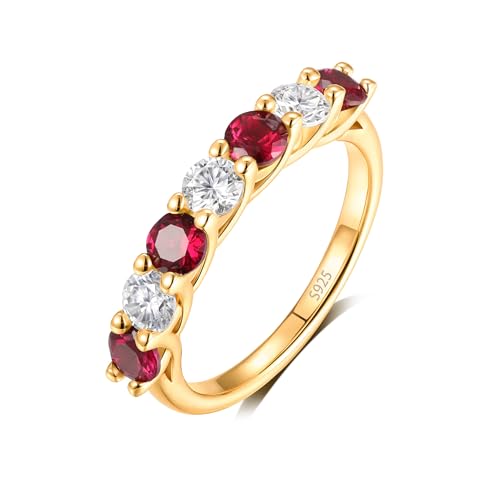
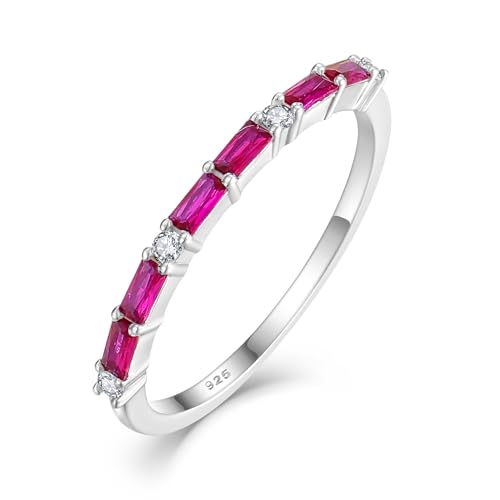
Some designs add cubic zirconia or moissanite. The DAYBYDAY, AIBAO, and RANDES bands combine ruby with cubic zirconia, creating a red-and-white arrangement. The Frbod and FWM bands use ruby with moissanite instead. These mixed-stone layouts can add contrast, but they will not look like a ruby-only band. The Angara ring takes the opposite approach: one square ruby is the visual focus rather than a repeated row of stones.
Choose half-eternity or full-eternity coverage
A half-eternity ring places stones across part of the upper band. This is documented for the FWM, AIBAO, STARCHENIE, and RANDES 3 mm designs. It can make the underside of the ring visually simpler and may give more flexibility when the ring sits beside a curved or detailed companion. The Wyyxl listing is different again because it describes two matching bands rather than one continuous ring.
A full-eternity design places stones around the band. The CYW, DAYBYDAY, and two selected RANDES designs document this format; Frbod also identifies its ring as an eternity band. Full coverage keeps the stone pattern visible as the ring turns, but it is important to pay attention to the supplied size information because a fully set band may be less straightforward to alter than a plain shank. That is a design consideration, not a claim about a particular seller’s service.
Compare width and visual scale
Band width changes how a stack reads. Frbod is wider at 4 mm. The Angara listing gives a 3 mm profile, and Wyyxl describes two 2.2 mm bands.
For a quiet layered arrangement, start by comparing the narrow bands with your existing ring’s width. A 1.5 mm or 2.2 mm design may sit comfortably beside a larger center ring without competing for attention. A 3 mm or 4 mm band creates a clearer border and may become one of the main visual elements. Width alone does not determine comfort, so also check the shape of the underside and whether the listing describes a tapered back or comfort-oriented construction.
All ten selected products document a sterling-silver option except Angara, which specifies 14K yellow gold. Many of the silver designs identify 925 sterling silver with rhodium plating or coating. Several also state hypoallergenic, nickel-free, lead-free, or sensitive-skin positioning. These are listing claims, so use them as comparison points and follow the care instructions supplied with the ring.
Finish affects coordination. Rhodium or white-gold color generally creates a cooler silver appearance, while the Angara ring’s yellow gold and the warm color treatment on the FWM design create a different direction. The CYW listing documents rhodium or yellow-gold-plated choices. If you are combining metals, decide whether the ruby color should be the unifying element or whether the metal colors should match your existing stack.
Confirm size and set contents
Check the exact size attached to the selected listing. Angara, FWM, DAYBYDAY, STARCHENIE, and other entries show a specific size in the supplied data, while Wyyxl describes sizes 4 through 10 and two included bands. Frbod lists sizes 5 through 11. The presence of a size range does not replace measuring your finger or checking the seller’s chart.
Also distinguish a single ring from a set. Wyyxl documents a unit count of two and two matching bands. The other selected entries describe one ring. This difference changes how you should plan the stack and how many separate pieces you will receive.
Final recommendation
Angara Square Ruby 14K Gold Stackable Ring ranks first overall in this specification-based comparison under the published weighted criteria.
The final choice among the best women’s ruby stacking rings depends on the documented features that match your intended use.
Angara’s 0.2 ct Square Ruby 14K Gold Stackable Ring is the highest-scoring returned product and the first overall specification-based choice. Its natural ruby, 14K yellow-gold shank, bezel setting, and 3 mm profile give it the clearest focal-point role among the selected designs.
For full coverage, CYW offers the most detailed documented ruby count and a full-eternity layout. Frbod is the clearest wider mixed-stone choice, while STARCHENIE suits a delicate arrangement. Wyyxl is useful when two coordinated bands are preferred. The RANDES 3 mm, DAYBYDAY, AIBAO, and RANDES 2.4 mm designs cover several round, mixed-stone, half-eternity, and full-eternity approaches. Together, these top women’s ruby stacking rings cover the main documented choices without treating one construction as right for every stack.
Frequently Asked Questions
Which of the best women’s ruby stacking rings uses a natural ruby?
The Angara square solitaire listing specifically identifies a natural ruby and gives a 0.2 ct weight. Most of the other selected designs describe their stones as created or lab-created ruby. Compare that distinction with the metal, cut, and setting before choosing.
Are full-eternity ruby rings suitable for stacking?
Yes, the selected CYW, DAYBYDAY, Frbod, and RANDES designs are described as eternity or full-eternity bands and can be worn with other rings. Their stones continue around the band, so confirm the fit carefully and consider how the complete stone coverage will sit next to the adjacent ring.
What width should I choose for a layered ring arrangement?
Use your existing ring as the reference point. STARCHENIE documents a 1.5 mm design, Wyyxl describes two 2.2 mm bands, several options list 2.4 or 3 mm, and Frbod lists a 4 mm band. Narrower bands tend to read more subtly, while wider bands create a more prominent border.
What is the difference between the mixed-stone options?
FWM and Frbod pair ruby with moissanite. DAYBYDAY, AIBAO, CYW, and selected RANDES designs pair ruby with cubic zirconia or describe those accent stones. Angara uses a single ruby. The choice is primarily about the documented stone combination and the visual contrast you want beside other rings.
Should I verify the ring size before selecting a band?
Yes. Listings vary between a single stated size and a range. Wyyxl documents sizes 4 through 10, Frbod lists sizes 5 through 11, and other entries show a particular size. Measure your finger and consult the applicable size chart, especially when combining multiple bands.