Buying Guide
Choosing the best women’s topaz stacking rings starts with separating the visual idea of a blue gemstone band from the specifications that determine how it will combine with other jewelry. This comparison uses public listing information rather than hands-on testing or customer-opinion summaries. The most useful details are the stone identity, the band width, the setting, the metal, and the available size information.
Decide between natural, created, and lab-grown stone descriptions
Topaz terminology is not uniform across these listings. Boston Bay Diamonds identifies seven genuine blue topaz gemstones, while LUSTRE AND LIGHT identifies a natural round London Blue Topaz. FAMIVES also describes its baguette as natural blue topaz. Those descriptions are materially different from the created blue topaz used by RANDES, DAYBYDAY, and CAIDIKA.
Created does not describe the same sourcing or material claim as natural. It is a useful distinction when comparing rings, but it should not be treated as a performance judgment. Danique Jewelry uses the wording lab-grown Swiss Blue Topaz hydroquartz and explains that it combines natural blue topaz with natural quartz. DECADENCE uses Swiss Blue Topaz language while also describing cubic-zirconia stones in the same band. If exact stone composition matters, read the individual listing details carefully rather than relying on color names alone.
Match the band profile to the rest of your stack
Band width is one of the clearest practical differences. CAIDIKA lists a 2 mm band, DAYBYDAY lists 2.2 mm round stones, and RANDES lists a 2.7 mm band. These dimensions point toward slimmer layering pieces. A narrow half-eternity band can sit beside a larger engagement or statement ring without becoming the only visible element, although the supplied data does not establish how any ring will feel on a particular hand.
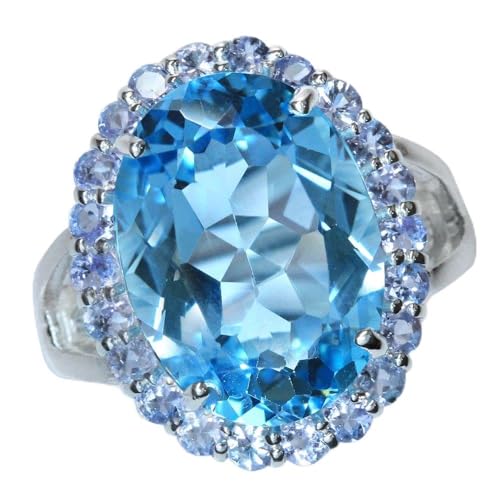
DECADENCE lists a 4 mm band, and RANDES documents a 5 mm double-row design in another candidate that was not selected here. Danique Jewelry gives an 8x10 mm stone size, making its oval bezel ring a more prominent accent than a tiny spacer band. A wider or larger design may be useful when the intention is to make the topaz the focal point, while a 2 mm to 2.7 mm profile is more appropriate when several rings need to share visual space.
Compare setting and cut details
Cut and setting create much of the difference between otherwise similar blue rings. The Boston Bay Diamonds band uses seven gemstones, giving it repeated stone detail across the top.
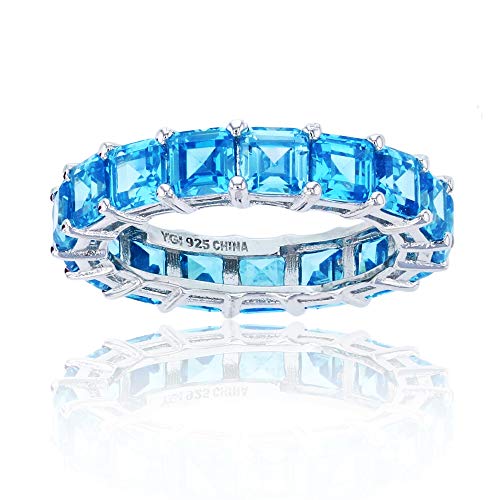
For a cleaner solitaire look, GEMISTRY documents a 6x4 east-west stone in a bezel setting. LUSTRE AND LIGHT uses a natural round stone in a bezel setting, and Danique Jewelry documents an oval bezel design. A bezel contains the stone with a surrounding metal edge, whereas the RANDES emerald-cut band uses prong terminology. These are design descriptions, not claims about durability or comfort beyond what the listings explicitly provide.
FAMIVES offers another shape-led option: a natural blue topaz baguette in an east-west horizontal orientation, paired with vintage filigree. Horizontal baguettes and east-west solitaires can add a linear accent beside round or oval rings. Because stacking is highly dependent on neighboring ring shapes, review the listed dimensions and profile before combining contrasting cuts.
Most selected rings use 925 sterling silver, including Boston Bay Diamonds, LUSTRE AND LIGHT, GEMISTRY, RANDES, DAYBYDAY, CAIDIKA, DECADENCE, and Danique Jewelry. Several listings also describe rhodium plating or another finish over the silver. Boston Bay Diamonds specifies a rhodium-plated .925 sterling silver band, LUSTRE AND LIGHT identifies sterling silver, and GEMISTRY specifies nickel- and lead-free 925 sterling silver.
The metal wording is less specific for FAMIVES, which describes white-gold-plated silver. Danique Jewelry lists sterling silver with gold or rose-gold vermeil options. Those finish choices can help coordinate a stack with other jewelry, but a plated or vermeil finish is not the same material description as a solid gold band. The listing for each ring should be the reference point for care and composition.
Sizing is especially important when multiple rings are worn together. Boston Bay Diamonds, GEMISTRY, CAIDIKA, and LUSTRE AND LIGHT show a single size in the supplied data. FAMIVES and RANDES also show specific individual sizes, so those entries should not be treated as universal size ranges.
DECADENCE lists sizes 5 through 10, and Danique Jewelry lists US sizes 5 through 10. Danique additionally recommends choosing one size up when stacking multiple rings. DAYBYDAY and the selected RANDES bands each show size 7. Always compare the listing’s size information with the intended finger and the neighboring bands. A ring that fits alone may need different planning when several bands share the same space.
Select a stack by visual role
A useful stack usually benefits from assigning each ring a role. A narrow created-topaz band such as CAIDIKA or DAYBYDAY can act as a delicate repeated layer. A natural solitaire from LUSTRE AND LIGHT or GEMISTRY can provide a single focal stone. Boston Bay Diamonds and DECADENCE add repeated-stone coverage, while Danique Jewelry supplies a larger oval accent.
For mixed shapes, place a linear design such as the FAMIVES baguette or GEMISTRY east-west solitaire beside round-stone bands. For a coordinated birthstone theme, compare the blue tones, stone sizes, and finishes rather than assuming every listing uses the same topaz type. The best women’s topaz stacking rings for one combination may not be the best match for another because band width and stone scale change the overall balance.
Read the listing for what it actually confirms
This is a specification-based comparison, so scores reflect documented details rather than an independent inspection. A listing may clearly state a band width but omit a full size range, or identify a topaz color without fully explaining whether the stone is natural or created. Treat those gaps as reasons to verify the product page before ordering. The most dependable comparison points here are explicit material terms, stated dimensions, named settings, and direct stacking descriptions.
Final Recommendation
GEMISTRY East-West Blue Topaz Bezel Ring ranks first overall in this specification-based comparison under the published weighted criteria.
Boston Bay Diamonds Natural Blue Topaz Stacking Ring is the first overall specification-based choice among the best women’s topaz stacking rings because it combines seven documented genuine blue topaz gemstones, .925 sterling silver, rhodium plating, and an explicit multi-ring stacking design. Its main limitation is the supplied size 6 listing.
For a natural solitaire foundation, LUSTRE AND LIGHT offers a round London Blue Topaz in a sterling silver bezel, while GEMISTRY is the more directional east-west alternative with a 6x4 stone. If a created-stone half-eternity band better fits the intended look, the RANDES emerald-cut design has the most detailed mixed-stone layout, and DAYBYDAY provides a slimmer low-profile option.
Among the top women’s topaz stacking rings, DECADENCE stands out for its 4 mm band, 17-stone layout, and sizes 5 through 10. Danique Jewelry is the choice to examine when an 8x10 mm oval and multiple vermeil finishes are more important than a narrow spacer profile. FAMIVES adds a natural baguette and vintage filigree for shoppers who want a more linear, decorative accent.
Frequently Asked Questions
What should I look for in the best women’s topaz stacking rings?
Start with the stone description, then compare band width, setting, metal, and size range. Natural, created, and lab-grown descriptions represent different material claims. A 2 mm to 2.7 mm band may suit a delicate layered arrangement, while a 4 mm band or 8x10 mm oval can serve as a more visible focal piece. Confirm the exact size and finish in the individual listing.
Is a bezel or prong setting better for a stack?
Neither setting is universally better. A bezel surrounds the stone with metal and appears in the LUSTRE AND LIGHT, GEMISTRY, and Danique Jewelry listings. RANDES documents a prong setting for its emerald-cut band. The choice is primarily visual and structural: compare the edge profile, stone shape, and how the ring will sit beside neighboring bands.
Which selected rings document natural blue topaz?
Boston Bay Diamonds identifies genuine blue topaz, LUSTRE AND LIGHT identifies natural London Blue Topaz, and FAMIVES describes natural blue topaz. GEMISTRY describes a blue topaz solitaire without using the same natural-stone wording. Other selected products explicitly use created or lab-grown terminology, so the descriptions should not be treated as interchangeable.
How should I plan sizing for multiple rings?
Use the stated US size range where available and compare it with the finger that will carry the stack. Danique Jewelry lists sizes 5 through 10 and recommends choosing one size up when stacking multiple rings. DECADENCE also lists sizes 5 through 10. For entries showing only one size, such as Boston Bay Diamonds or GEMISTRY, verify the available variant before relying on that ring for a stack.
Can different topaz cuts be worn together?
Yes, the selected listings document several shapes that can be visually combined: round, oval, baguette, emerald, and east-west solitaire designs. Pairing a linear FAMIVES or GEMISTRY ring with a round-stone band can create contrast, while similar round stones from DAYBYDAY and CAIDIKA produce a more uniform look. Compare stone scale and band width so one ring does not overwhelm the others.