Buying Guide
The best silicone donut pans are not all designed for the same batch size or portion. The selected products range from approximately 2-inch mini cavities to 4-inch large cavities, with six-, nine-, and 12-cavity layouts. Several sets include two or three pans, which can raise total output but also increase storage needs. Start by deciding what kind of donut you normally make, then compare the pan’s handling design, temperature range, and care instructions.
Choose the right donut size
Cavity dimensions have a direct effect on portions and recipe fit. Cupidove documents approximately 2-inch bite-size cavities, making it the specialist choice for small snacks, party trays, and recipes intended for mini donuts. Walfos lists 3-inch molds, while RICCLE and KASHME document 3.25-inch cavities. Webake lists 3.2-inch cavities, placing it in a similar standard-size range.
The large-donut category is represented by Vnray and Toeusog, both of which document 4-inch cavities. These pans are better suited to larger portions, but their six-cavity layouts produce fewer donuts per tray than the 9- or 12-cavity alternatives. Before buying, check whether your recipe is written for mini, standard, or large donuts. A cavity that is wider or deeper than expected can change how much batter you need and how many portions a batch produces.
Compare cavity count and total output
A single 12-cavity tray, such as Chicago Metallic, can produce a dozen ring-shaped treats in one bake. That can be more convenient than loading and unloading a six-cavity pan several times. Webake goes further with two nine-cavity pans and a documented combined capacity of 18 donuts. Anaeat also provides three six-cavity pans, which is useful when you want extra molds available for repeated batches.
A two-pan set is not automatically better than a single tray. Two trays need more shelf area, and flexible silicone can be harder to carry when filled. Conversely, multiple pans can be helpful when you are preparing several recipes, freezing molded treats, or baking for a gathering. Match total capacity to your oven rack space as well as your storage space.
Decide whether you need a reinforced frame
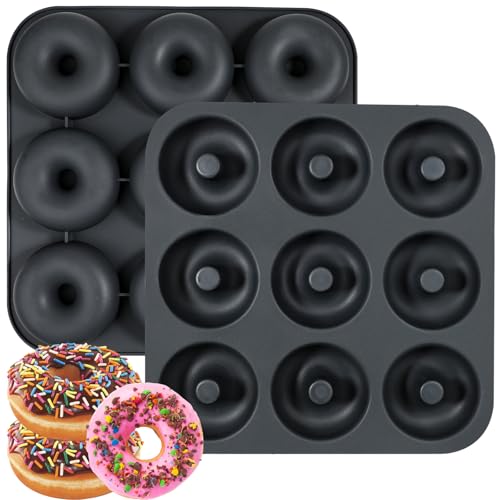
Flexible silicone is easy to fold and store, but a filled mold can be less rigid during movement. Chicago Metallic uses a wire-reinforced rim, while RICCLE, KASHME, Vnray, and Toeusog describe metal-reinforced frames. These designs are intended to hold the pan’s shape and make transfer from counter to oven easier.
Fully flexible products can still be practical. Wilton, Anaeat, Walfos, and Cupidove emphasize flexible construction, and their listings recommend or describe easy storage. Wilton specifically advises placing the pans on a level baking sheet before putting them in the oven. Anaeat and Walfos likewise provide flexible molds that can be stacked or folded. If you regularly fill pans away from the oven, a reinforced frame may be the more convenient design. If cabinet space is your main concern, a foldable mold may have the advantage.
Check heat and appliance compatibility
The selected listings show different stated temperature limits, so do not assume all silicone pans have the same rating. Walfos lists use from -40°F to 500°F. Vnray and Anaeat specify an upper limit of 446°F, while Cupidove lists 445°F. RICCLE and Toeusog list 450°F, and KASHME lists 446°F. Chicago Metallic lists 428°F. Wilton lists oven use up to 375°F.
Several products also document microwave, freezer, or refrigerator use. That matters if you plan to chill dough or mold frozen desserts, but the exact appliance guidance differs by product. Always follow the individual listing and your recipe’s requirements rather than relying on the word silicone alone. The best silicone donut pans for high-temperature recipes are the ones whose published limit clearly covers your intended use.
Review release and cleaning details
The listings commonly describe silicone as flexible and non-stick, but many still recommend lightly greasing the cavities. Anaeat says to grease lightly, fill carefully, cool the baked donuts, and press from the bottom for release. Walfos similarly mentions using a small amount of oil. Vnray and Toeusog also recommend oiling before filling. These instructions are useful reminders that release depends on the recipe and handling, not only on the material.
Dishwasher compatibility is documented for Chicago Metallic, RICCLE, KASHME, Webake, Wilton, Anaeat, Walfos, Vnray, Toeusog, and Cupidove. Some listings also provide hand-washing directions. If your kitchen routine favors quick cleanup, confirm that the exact model is dishwasher safe and follow any care notes. A smooth, flexible pan can be easy to rinse, but narrow or detailed cavities may still need attention after sticky batters.
Consider uses beyond donuts
Many selected pans are also described for bagels, biscuits, cakes, muffins, frozen desserts, or other ring-shaped treats. Chicago Metallic mentions donuts, bagels, and other round baked creations. RICCLE describes use as a bagel mold and freezer ice-ring mold. Webake identifies bagels, wreath ice cubes, and other creative treats, while Vnray and Toeusog mention bagel-style recipes.
These extra uses can make a pan more useful, but cavity size remains important. A mini pan such as Cupidove will not provide the same portion as a 4-inch Vnray or Toeusog mold. Think of versatility as compatibility with your recipes, not a promise that every recipe will fit equally well.
Final Recommendation
RICCLE 2-Pack Reinforced Silicone Donut Pans ranks first overall in this specification-based comparison under the published weighted criteria.
Chicago Metallic is the first overall specification-based choice among these best silicone donut pans because it combines 12 cups, a wire-reinforced rim, dishwasher compatibility, and a stated 428°F oven limit. It is a strong fit for bakers who want one full batch without using two trays.
RICCLE and KASHME are the leading alternatives for full-size donuts with reinforced frames. RICCLE stands out for its two-pan, 12-donut format and 3.25-inch cavities, while KASHME offers a similar two-tray capacity with clearly stated stackable storage. Webake is the capacity specialist with 18 documented 3.2-inch cavities across two pans.
For larger portions, Vnray and Toeusog both document 4-inch cavities and metal frames. Wilton is a straightforward option with clear care instructions, although its listed oven limit is lower. Anaeat and Walfos suit shoppers who prefer flexible multi-pan sets, while Cupidove is the focused choice for mini donuts. Together, these top silicone donut pans cover the main buying decisions: size, output, handling, heat range, cleanup, and storage.
Frequently Asked Questions
What size should I choose from the best silicone donut pans?
Choose based on the portion described by the listing and your recipe. Cupidove documents approximately 2-inch mini cavities. Walfos lists 3-inch molds, while RICCLE, KASHME, and Webake document cavities around 3.2 to 3.25 inches. Vnray and Toeusog list 4-inch cavities for larger donuts. If your recipe does not specify a pan size, a standard-size option is generally easier to match than a mini or large-format tray, but the supplied listings do not establish a universal standard.
Do silicone donut pans need to sit on a baking sheet?
A baking sheet can make a flexible pan easier to move, especially when it is filled with liquid batter. Wilton specifically instructs users to place its pans on a level baking sheet before moving them to the oven. Several other selected products use metal or wire-reinforced frames, including Chicago Metallic, RICCLE, KASHME, Vnray, and Toeusog. Those frames are designed to improve rigidity, but the supplied evidence does not establish that a baking sheet is unnecessary for every recipe or oven.
Are silicone donut pans dishwasher safe?
The selected listings for Chicago Metallic, RICCLE, KASHME, Webake, Wilton, Anaeat, Walfos, Vnray, Toeusog, and Cupidove state dishwasher compatibility. Care details still vary. Some listings also recommend hand washing or rinsing thoroughly. Check the instructions for the specific pan, especially when cleaning residue from small cavities or when the product description recommends mild detergent and warm water.
Which of the best silicone donut pans is suitable for large donuts?
Vnray and Toeusog both document 4-inch cavities and six-cavity layouts. Their metal frames are intended to make the pans easier to transfer, and both listings describe oven and freezer use. These are better matches for large portions than Cupidove’s approximately 2-inch mini cavities or the 3- to 3.25-inch formats documented for Walfos, Webake, RICCLE, and KASHME.
Can silicone donut pans be used for foods besides donuts?
Yes, several selected listings describe additional uses, but the exact suggestions differ. Chicago Metallic mentions bagels and other round baked creations. RICCLE and Webake also describe bagel or frozen-mold uses, while Vnray and Toeusog mention bagel-style recipes. Check each cavity’s dimensions and the product’s stated appliance compatibility before adapting a pan to another recipe.