Buying Guide
The best small bathroom vessel sinks are not chosen by outside dimensions alone. A basin can fit the countertop but still create problems if the faucet position, drain type, vanity depth, or surrounding clearance is wrong. The products above are ranked from public listing specifications, not hands-on testing. Use the measurements and installation notes as a planning checklist, then confirm the manufacturer’s current information before ordering.
Measure the usable countertop from front to back and side to side, leaving room for the faucet, backsplash, wall, and cleaning access. The QISHKA and J-FAMILY 11-inch round bowls are the most compact documented choices at 11 x 11 inches. They are useful when every inch matters, but their small diameter also gives less washing area than a longer oval or rectangular bowl.
The 14-inch class offers a different compromise. The QISHKA oval is 14 x 10 inches, while the J-FAMILY oval is 14.5 x 10 inches. Their narrow 10-inch dimension may suit a shallow counter better than a 16-inch rectangle. The J-FAMILY rectangular model is 14.5 x 10.6 inches, giving it a more angular appearance while remaining smaller than most 16-inch basins.
Larger options in this comparison generally measure about 16 x 12 or 16 x 13 inches. KARAMAG, Kichae, KES, DeerValley, and the larger KES oval can provide a more generous basin presence, but they require more countertop area. Remember that a vessel sink sits above the counter, so its overall height affects the finished rim height as well as the visual scale of the vanity.
Match the sink shape to the room
Round bowls are often the simplest choice for very tight layouts because they avoid projecting corners. The QISHKA and J-FAMILY 11-inch models both document round profiles. Oval bowls can preserve a softer appearance while using a relatively narrow front-to-back dimension; the QISHKA 14-inch oval, J-FAMILY 14.5-inch oval, and KES 16 x 13-inch oval document that design.
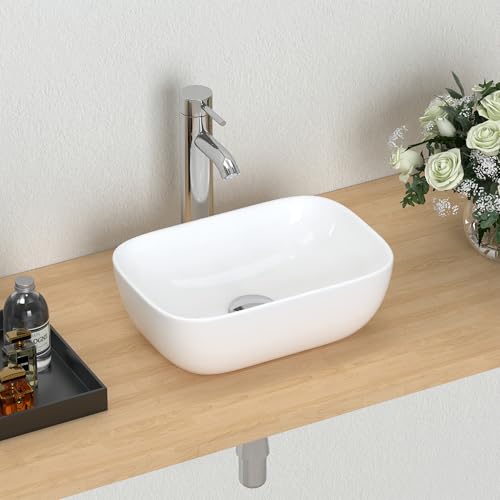
Rectangular sinks suit vanities with straight edges and contemporary styling. The J-FAMILY 14.5-inch rectangle is the smallest rectangular option selected. KARAMAG, Kichae, KES, and DeerValley use larger rectangular footprints around the 16-inch class. The DeerValley listing specifically describes softly rounded corners, which may be useful where a less sharply squared interior is preferred.
Check faucet and drain planning
Many vessel sinks in this group are sold as basins only. The faucet and drain are not included with the QISHKA, J-FAMILY, Kichae, KES, DeerValley, and larger KES models. Plan those parts separately, and verify whether the faucet will be mounted to the counter or wall.
Most selected products list a drain opening around 1.75 inches. The KES rectangular model lists a 1.81-inch opening, while the J-FAMILY rectangular model lists 45 mm. These figures are close in everyday terms but should not be treated as interchangeable without checking the drain specification. Non-overflow drains are important because most selected vessel basins do not document an overflow opening.
KARAMAG is the clearest exception for faucet planning: its listing documents a 1.38-inch faucet hole in the sink itself. That can be useful if the intended layout calls for a faucet hole through the basin, but it also makes the sink less flexible for a wall-mounted faucet arrangement. KES explicitly documents a no-faucet-hole format designed for counter- or wall-mounted vessel faucets.
Compare ceramic and porcelain details
Every selected product is described as ceramic or porcelain ceramic. Several listings mention high-temperature firing at 1380 degrees Celsius, including QISHKA and J-FAMILY. Others emphasize porcelain, vitreous china enamel, or high-grade ceramic. These statements provide useful construction evidence, but they are listing claims rather than independent laboratory results.
Surface details are also relevant in a compact bathroom. Smooth, glossy, or non-porous finishes are described for most of the selected sinks. QISHKA, J-FAMILY, Kichae, KES, and DeerValley state that their surfaces are easy to clean or resistant to stains and scratches. DeerValley adds softly rounded corners, and the larger KES oval specifically gives a 5.2-inch basin depth in connection with splash control. These features may make routine wipe-downs more convenient, but the listings do not establish a measured cleaning or splash performance result.
Account for included and excluded parts
A sink-only listing gives you more control over the faucet and drain but requires additional compatibility work. Before choosing, identify the drain type, faucet height, mounting position, and whether a pop-up assembly must be non-overflow. Also check the countertop cutout or mounting requirements described by the manufacturer.
Packaging is mentioned by several listings, but shipping protection is not the same as installation performance. Inspect any ceramic basin for cracks or chips before installation, as the product descriptions recommend. Do not permanently seal the sink until the position, drain fit, and faucet clearance have been checked.
Final Recommendation
QISHKA 11-Inch Round Ceramic Vessel Sink ranks first overall in this specification-based comparison under the published weighted criteria.
QISHKA’s 11-inch round ceramic vessel sink is the first overall specification-based choice among these best small bathroom vessel sinks because it combines the smallest documented footprint with a standard drain opening, top-mount installation, and detailed surface information. J-FAMILY’s matching 11-inch round model is a close alternative, while the QISHKA 14-inch oval is better suited to a narrow counter that can accommodate more length.
For a rectangular look, the J-FAMILY 14.5-inch model is the most compact selected option. KARAMAG is the one to examine when a built-in faucet hole is important. KES and DeerValley offer well-documented larger rectangular formats, and the larger KES oval is worth considering when its stated depth and splash-control design fit the room. Among the top small bathroom vessel sinks, the best final choice depends on measured clearance and fixture compatibility rather than appearance alone.
Frequently Asked Questions
What size is practical for the best small bathroom vessel sinks?
The selected models range from 11-inch round bowls to approximately 16-inch rectangular and oval basins. An 11-inch sink is the most space-conscious, while a 14-inch oval can provide more length without exceeding a 10-inch front-to-back dimension. Measure the countertop and faucet clearance before selecting a size.
Do these vessel sinks include faucets and drains?
Most do not. The QISHKA, J-FAMILY, Kichae, KES, and DeerValley listings identify the basin as separate from the faucet and drain. KARAMAG documents a faucet hole but does not include the faucet or sink drain. The drain opening and non-overflow requirement should be checked before buying compatible parts.
Are the selected sinks top-mount models?
Most selected products are described as above-counter or top-mount vessel sinks. KES specifically describes top-mount installation, and the QISHKA, J-FAMILY, KARAMAG, Kichae, and DeerValley listings also describe countertop placement. Installation hardware and countertop preparation can vary, so follow the product instructions.
Which shape works best on a narrow vanity?
A round bowl can be easiest to position when the counter is very tight. The QISHKA 14-inch oval and J-FAMILY 14.5-inch oval both list a 10-inch front-to-back dimension, which may suit a shallow vanity. Rectangular models can work well when the counter has straight edges, but their corners and faucet clearance should be planned carefully.
What should I verify before installation?
Confirm the sink’s length, width, height, drain opening, faucet-hole arrangement, overflow status, and included parts. Inspect the ceramic for transit damage before sealing it to the counter. Also verify the finished rim height and make sure the selected faucet reaches the basin without interfering with the backsplash or wall.