Buying Guide
Choosing among the best small tool bags starts with the loadout, not the brand name. A compact pouch for screwdrivers and meters has different priorities from a tote intended to hold a drill, hammer, and mixed hand tools. The products above cover several documented designs, so compare the opening, storage layout, material, and carrying method against the work you actually do.
Match the bag style to the job
A wide-mouth tote is generally the most flexible format for mixed tools. The DURATECH, WORKPRO, FASTECH, and AWP designs all document broad or quick-access openings. This style is useful when tools vary in shape or when you need to look into the main compartment rather than place every item in a dedicated loop. The DURATECH adds a built-in steel frame, while WORKPRO documents double-pull zippers and a 13-inch opening.
A more structured pouch can be better for small precision tools and parts. KLEIN TOOLS uses two compartments, and AASTT combines two compartments with mesh slots, deep pockets, a hammer loop, and an external nail apron. These layouts are more specialized than an open tote. They can help separate meters, leads, fasteners, and hand tools, but they may not be the best choice for large or irregular equipment.
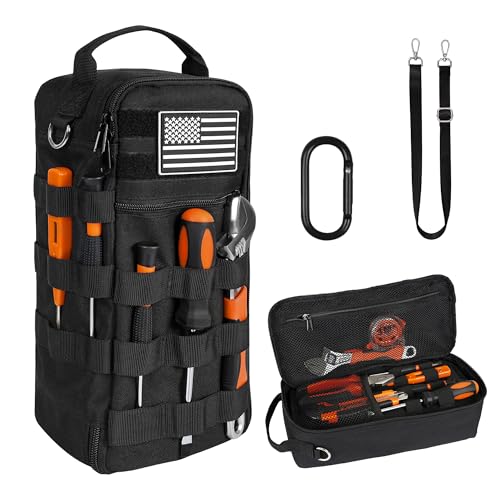
Chest and vertical formats address access in confined areas. Rexmore documents a three-point harness for ladder and tight-space work, while Trahzia uses a tall compartment, tool loops, side slots, and a hanging buckle. These designs may be particularly useful when setting down a bag is inconvenient. They also represent a more task-specific choice than a conventional carry tote.
Count useful storage, not just pockets
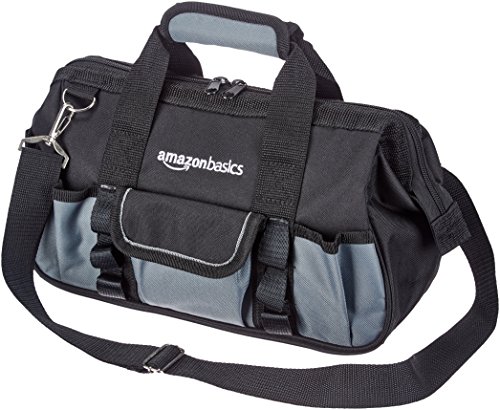
Pocket count matters only when the pockets suit your tools. Amazon Basics documents 16 total pockets, divided between internal and external storage. WORKPRO documents nine pockets, and FASTECH emphasizes eight external sorting pockets. Those arrangements can work well for users who carry many small hand tools and want quick separation.
Look for evidence of the pocket types as well as the number. Elastic slots may hold narrow tools, mesh can make contents easier to identify, and a dedicated tape strap or hammer loop may be more useful than several generic pockets. Trahzia documents all three types of trade-oriented storage, while AASTT specifically mentions a hammer loop, nail apron, and mesh slots. KLEIN TOOLS takes a simpler approach with two large compartments for separating groups of supplies.
Consider opening access and stability
A wide or framed opening helps a bag remain accessible while loading and retrieving tools. The DURATECH’s steel frame is designed to retain the bag’s shape, and its wide-mouth construction supports visibility into the main compartment. WORKPRO also documents a wide open mouth, while AWP uses a spring-loaded opening for quick access and closure.
A stable bottom is useful when the bag sits on a floor, bench, or uneven work surface. DURATECH includes a PE-board base and four non-slip feet. COREFLEX lists a hard bottom insert, and KLEIN TOOLS uses a reinforced gusseted bottom that helps it stand. Amazon Basics documents a wear-resistant PE base. These features do not make a bag waterproof by themselves, but they can reduce direct contact with a work surface and help the bag stay upright.
Read material claims carefully
The supplied listings identify several common constructions. Coated Oxford or polyester fabrics appear on DURATECH, FASTECH, Amazon Basics, and COREFLEX. AASTT uses 900D Oxford, while Rexmore and KLEIN TOOLS specify heavier 1680D material.
Water-resistant, waterproof-coated, and moisture-resistant are not interchangeable with a documented waterproof rating. FASTECH describes a waterproof coating, AASTT describes water resistance, and Rexmore describes protection from water splashes. Use those claims as guidance for light moisture exposure, but do not assume that any fabric bag is suitable for submersion or prolonged rain. Reinforced stitching, heavy-duty fabric, and a coated base are useful construction details, yet the listings do not provide independent durability testing.
Choose the carrying method
Handles work well for short transfers and quick grab-and-go use. Shoulder straps are more useful when the bag must remain hands-free, and several selected products document both options. Amazon Basics includes rugged handles and an adjustable strap. AASTT documents a shoulder strap and belt-loop compatibility. Trahzia lists a removable shoulder strap, while Rexmore uses a harness rather than a conventional tote strap.
Attachment systems can extend a compact bag’s usefulness, but they also add bulk. COREFLEX and Trahzia document MOLLE webbing, and KLEIN TOOLS lists D-rings for a shoulder strap or carabiner. If you already use a larger toolbox or backpack, a compact pouch may be more practical than a fully featured tote. If the bag will be carried alone, prioritize a comfortable handle, secure closure, and a layout that prevents small parts from shifting into the main compartment.
How to compare capacity
Nominal length is only one part of capacity. A 12-inch pouch can be tall and narrow, while a 13-inch tote can be wider and better suited to power tools. Check the listed length, width, and height together. AAWP’s 15-inch format uses a large main compartment, while the compact COREFLEX measures 12 x 7 x 7 inches and still documents multiple pockets and a hard bottom insert.
Also account for what the listing does not say. None of these bags should be assumed to include tools unless the listing explicitly says so; Trahzia specifically states that it is an empty bag. Stated capacity claims, such as DURATECH’s documented support figure, are more useful than guessing from photographs. Keep heavy equipment within the manufacturer’s described use and avoid treating a small organizer as a substitute for a dedicated power-tool case.
Final Recommendation
Rexmore Tactical Electrician and HVAC Tool Chest Bag ranks first overall in this specification-based comparison under the published weighted criteria.
DURATECH 13-Inch Wide-Open Tool Bag is the first overall specification-based choice among the best small tool bags because it combines a framed wide opening, nine compartments, a reinforced non-slip base, and documented support for a substantial tool load. Rexmore is the more specialized pick for ladder and confined-space work, while WORKPRO is a balanced pocketed tote for general trade or DIY use.
Choose AASTT when trade-specific loops and moisture-resistant fabric matter, FASTECH when external sorting pockets are the priority, or Amazon Basics for a straightforward 16-pocket organizer with two carrying methods. KLEIN TOOLS is a compact dual-compartment pouch, Trahzia favors vertical electrician storage, AWP keeps access simple, and COREFLEX adds MOLLE attachment points. These are the top small tool bags here based on documented specifications, not hands-on testing or customer sentiment.
Frequently Asked Questions
Start with the tools you carry most often. Check the opening dimensions, pocket types, overall dimensions, material, base design, and carrying method. A wide-mouth tote suits mixed tools, while a dual-compartment pouch or vertical organizer may work better for meters, screwdrivers, fasteners, and other smaller equipment.
Do not assume so. The listings use different descriptions, including water-resistant, waterproof coating, and protection from water splashes. Those are product-specific claims rather than a universal category standard. FASTECH documents a waterproof coating, AASTT documents water-resistant material, and Rexmore describes water-splash protection. None of those descriptions should be treated as proof of submersion resistance.
Neither format is universally better. A wide-mouth tote such as DURATECH or WORKPRO is easier to load with mixed or bulky tools. A pouch such as KLEIN TOOLS or AASTT can provide more separation for small tools and parts. Choose the format that matches your loadout and whether you need open access, compartmentalized storage, or hands-free carrying.
Which selected bag is suited to ladder work?
Rexmore is the clearest match because its listing documents a three-point harness, a padded strap, and use in ladder and confined-space work. Its pocket system is also designed around electrical and HVAC tools. This is a specification-based fit; the comparison does not represent a hands-on test of ladder stability.
The supplied product evidence describes bags and organizers, not included tool sets. Trahzia explicitly says it is an empty bag, and other listings describe storage features without listing tools in the package. Confirm the package contents before ordering if you need a complete tool kit rather than an empty organizer.