Buying Guide
Finding the best silk sewing thread for your work means balancing how the thread is built, how heavy it is, and how it behaves on your machine or in your hand. The picks in this guide cover everything from 3-ply decorative silk to vanishing 100 wt. filament silk, so you can match the thread to the technique rather than forcing a project onto a thread.
Fiber Construction: Filament vs. Spun Silk
Filament silk is made from long, continuous fibers, which gives it the smooth, glossy surface and fine diameter you see in Superior Threads Kimono Silk, YLI Silk Thread, and the Tire Silk #50 line. Spun silk, by contrast, is twisted from shorter fibers and tends to look softer and more matte, which is the profile Gütermann describes for its 101M spun silk thread. Filament silk is usually the better fit for invisible appliqué and fine quilting, while spun silk is favored when you want an elegant but understated seam.
Weight Range and Technique Fit
Silk thread weights vary widely, and weight drives technique fit. The Tire Silk #50 line is a 50 wt. thread that is documented for decorative quilting and general sewing, while the Kimono Silk and YLI 100 wt. products are ultra-fine options aimed at appliqué, English Paper Piecing, and detail quilting. Gütermann’s No.40 silk thread sits in a middle range and is documented specifically for hand-sewn eye buttonholes and decorative seams. When you are choosing the best silk sewing thread for a particular task, look at the stated weight first, then confirm a documented technique that matches your project.
Spool Size and Yardage
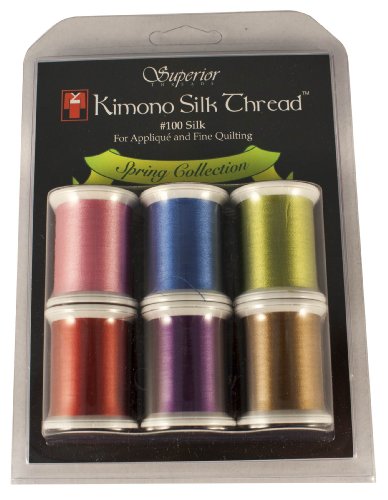
Spool formats in this category range from short 30 m reels designed for buttonhole work, such as the Gütermann No.40 reel, up to 1,090 yd mini cones like the Kimono Silk Mini Cone. Multi-spool sets such as the Kimono Silk Neutral 2 6-Pack and Spring Collection 6-Pack offer 1,320 yd of coordinated colors, which can be helpful for large quilts or binding runs. For studios and prolific quilters, larger cones reduce spool changes; for one-off garments or repairs, smaller spools keep inventory tight.
Color Range and Matching
Color availability varies sharply between products. YLI’s Silk Thread is documented as available in more than 50 colors, the Kimono Silk line is available in 80 colors, and the Gütermann No.40 silk comes in 100 colors for buttonhole and decorative work. By contrast, individual SKUs such as the Clover 064 maroon or Coats Seta Reale white represent a single color within a broader product family. If precise color matching matters, look at how many colors the brand documents for that specific line before choosing.
Machine Compatibility
Most silk threads in this guide are documented for both home and longarm sewing machines, including Tire Silk #50, Kimono Silk, and the Spring Collection set, which includes needle recommendations for both home and longarm machines. Fine filament silks such as the YLI 100 wt. thread may require tension adjustments on standard home machines because of their very fine diameter. Coarser silks such as the Gütermann No.40 thread are more often associated with hand-sewn buttonholes than with regular machine topstitching.
Finish and Handling
Several products document specific handling features. Clover’s 701CV series is marketed as not twisting or curling in use, which is useful for hand finishing. Superior Threads describes Kimono Silk as fine and lint-free, an important consideration for longarm quilters who want clean bobbin cases and tension assemblies. Silk fiber generally has natural flexibility that helps stitches sink into fabric, which is part of why so many of these threads are recommended for appliqué and fine detail work.
Final recommendation
YLI Silk Thread 100 wt White ranks first overall in this specification-based comparison under the published weighted criteria.
The final choice among the best silk sewing thread depends on the documented features that match your intended use.
Across construction, weight options, spool formats, and documented technique fit, the Superior Threads Kimono Silk Neutral 2 6-Pack stands out as a strong specification-based first overall choice for quilters and binders who want fine filament silk with multi-spool yardage in a single purchase. For quilters who prefer a sheen-rich 50 wt. silk, the Superior Threads Tire Silk #50 line offers documented 3-ply construction and smooth performance on home and longarm machines. If your work centers on hand-sewn buttonholes, the Gütermann No.40 silk thread provides a dedicated buttonhole silk format, and for appliqué that needs to disappear into fabric, the YLI Silk Thread 100 wt. line delivers ultra-fine filament silk with broad color support. Together these picks also represent the broader range of the top silk sewing thread options covered in this guide.
Frequently Asked Questions
What is the best silk sewing thread for quilting?
For quilting, 50 wt. filament silks such as the Superior Threads Tire Silk #50 line are widely documented for both home and longarm machines, while 100 wt. silk threads such as Superior Threads Kimono Silk and the YLI Silk Thread line are documented for invisible appliqué and detail quilting. The best silk sewing thread for your quilting project depends on whether you want sheen and visibility or near-invisible stitches.
Can I use silk sewing thread in a regular home sewing machine?
Yes. Several products in this guide, including Superior Threads Tire Silk #50, Superior Threads Kimono Silk, and the Spring Collection 6-Pack, are documented for home sewing machines. Very fine 100 wt. silks may require a smaller needle and tension adjustment, while heavier plied silks such as Gütermann No.40 are more commonly used for hand-sewn buttonholes than for everyday machine stitching.
What is the difference between filament silk and spun silk thread?
Filament silk is made from long continuous fibers, giving a smooth, glossy surface, which is the format documented for Superior Threads Kimono Silk, YLI Silk Thread, and Tire Silk #50. Spun silk is twisted from shorter fibers for a softer, more matte appearance, which is how Gütermann describes its 101M spun silk thread. Filament silk is typical for invisible appliqué and fine quilting, while spun silk is often chosen for elegant seams.
Silk thread is a strong option for hand sewing and buttonholes because of its flexibility and sheen. Clover silk thread spools such as the 701CV series are documented to resist twisting and curling in hand use, and Gütermann’s No.40 silk thread is specifically documented for hand-sewn eye buttonholes and decorative seams. If you regularly sew buttonholes, the best silk sewing thread choice will be a documented buttonhole silk in a color that matches your garment.
How do I choose between a single spool, a multi-pack, or a cone?
Single spools such as the Clover 701CV-401 50 wt. silk or the Coats Seta Reale white are well-suited to one-off projects or repairs. Multi-packs like the Kimono Silk Neutral 2 6-Pack and the Spring Collection 6-Pack provide coordinated colors and 1,320 yd of total length for larger quilts. Mini cones such as the 1,090 yd Kimono Silk Mini Cone suit studios and prolific quilters who want fewer spool changes and consistent color across many projects.