Buying Guide
Choosing among the best snowmobile drive belts starts with fitment, not a general brand reputation. A belt is a model-specific CVT component, so the correct part number, sled year, engine, clutch arrangement, and application should take priority over a broad compatibility statement. The products in this comparison were selected from listing evidence and scored against category-specific criteria: fitment clarity, construction, application specificity, heat and wear design, and part-number identification. This is not a hands-on test.
Confirm the part number first
Start with the belt number printed in the snowmobile manual, service information, or on the removed belt. The Polaris OEM 3211059 is a useful example of precise identification: its listing names the brand, manufacturer, model, and item part number, while also limiting the stated fitment to select Indy models. The Yamaha 8JP-17641-00-00 listing is similarly direct, with model-year coverage for SR Viper, Sidewinder, and SR Venture sleds.
Aftermarket listings may name several replacement numbers. The EZROAD 3211215 lists 3211215, 46G4387, 46C4387, and 46R4387, while the MOTOBULL 3211216 references 3211216, 3211122, and 3211115. These cross-references can help, but they do not eliminate the need to compare the exact sled configuration. A replacement number is useful only when it corresponds to the same belt application.
Match the belt to the sled’s application
Engine output and riding style influence the type of belt that makes sense, but the listing must support the application. Dayco describes the HPX5002 for high-horsepower snowmobiles, whereas the HP3011 is described for lower-horsepower sleds. Those are meaningful distinctions, but neither listing supplies a complete vehicle chart, so the model number should be checked against a separate fitment source before installation.
For mountain and deep-snow applications, the MOTOBULL listing specifically names Polaris RMK, SKS, Khaos, and related 800 and 850 models. Its compatibility information is more useful than a generic snowmobile label because it identifies model families and years. The EZROAD 3211215 likewise focuses on Polaris Indy, Switchback, Titan, Rush, and SKS applications. Use that detail as a starting point, then confirm the exact year, engine, track configuration, and clutch system.
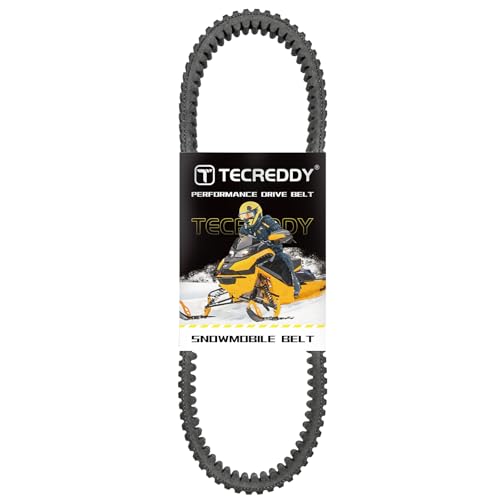
Ski-Doo coverage is also split by part number. The Ski-Doo OEM 417300571 is presented as a performance belt with mountain, trail, and fast-track positioning, but the supplied listing does not provide a complete model-year chart. The KARSEE 414860700 entry gives extensive coverage for Ski-Doo series including MX Z and Tundra models from 1996-2020. The Tecreddy 417300571 entry lists specified Free Ride, Renegade, Backcountry, and Expedition applications. Because these products reference different or overlapping numbers, verify the number rather than choosing by brand alone.
Compare construction details
Construction evidence helps distinguish listings that merely identify a belt from those that explain how it is built. Aramid tensile cords appear in the Ski-Doo OEM 417300571, Polaris OEM 3211059, KARSEE 414860700, MOTOBULL 3211216, and Tecreddy 417300571 listings. Several also describe reinforced elastomer undercords or neoprene layers. These details indicate the materials and layers supplied by the listing; they should not be treated as independent performance test results.
Tooth and surface design can also matter for identification. MOTOBULL documents dual nylon tooth coatings and a precise tooth profile. The Pro Parts Place candidate describes a cogged double-sided design, but it was not selected for this comparison because other candidates supplied stronger combined evidence. A belt with a distinctive tooth or notch pattern should be compared with the removed belt and the manufacturer’s specification before fitting.
The Ski-Doo OEM belt and Tecreddy belt both list Flexweave overcord construction. Their listings associate that layer with adhesion and crack resistance. The Dayco HP3011 instead identifies fiber-reinforced polychloroprene rubber and aramid cords. These are different construction descriptions, so do not assume that one material description is interchangeable with another belt number.
CVT belts operate in a heat-producing drive system, making thermal information useful when it is actually documented. Polaris states that the 3211059 is engineered for lower operating temperatures at high RPM and describes heat dissipation. MOTOBULL gives a stated range of -40°C to 140°C and describes a design intended to reduce overheating.
Heat claims remain listing claims, not measurements from this comparison. They should support comparison only after fitment is established. A belt with excellent thermal wording is still the wrong choice if its part number does not match the sled. Follow the manufacturer’s installation and break-in instructions where supplied, and inspect clutch alignment and belt condition as part of normal maintenance.
OEM and aftermarket choices
OEM entries generally make identification easier when the sled’s original part number is known. The Polaris 3211059, Yamaha 8JP-17641-00-00, and Ski-Doo 417300571 each use manufacturer-branded part identification. Their listings vary in how much construction and fitment information they provide, so OEM status alone does not replace checking the application.
Aftermarket products can offer extensive cross-reference lists or detailed material descriptions. KARSEE, EZROAD, MOTOBULL, and Tecreddy each document different combinations of model coverage, replacement numbers, cords, elastomer layers, or tooth designs. The trade-off is that a broad compatibility claim may require more careful verification. Compare the listed number, year, engine, and model family line by line rather than relying on a general description.
Final recommendation
Polaris OEM 3211059 Snowmobile Drive Belt ranks first overall in this specification-based comparison under the published weighted criteria.
The final choice among the best snowmobile drive belts depends on the documented features that match your intended use.
The Polaris OEM 3211059 is the first overall specification-based choice because it combines the clearest OEM identification with detailed aramid construction, controlled geometry, and stated thermal-performance information. Among the top snowmobile drive belts, it has the most specification-aligned balance of fitment documentation and technical detail in the supplied evidence.
Choose the Ski-Doo OEM 417300571 when that number matches your sled and you want the most fully described OEM construction. Yamaha owners should begin with the 8JP-17641-00-00 model-year chart. For aftermarket Polaris coverage, compare EZROAD 3211215 and MOTOBULL 3211216 against the exact sled configuration. For Ski-Doo applications, KARSEE 414860700 and Tecreddy 417300571 provide useful alternatives, but their broader lists make part-number verification essential. Dayco’s HPX5002 and HP3011 are more application-oriented choices, with the former aimed at high horsepower and the latter at lower-horsepower sleds.
Frequently Asked Questions
How do I choose among the best snowmobile drive belts?
Match the belt’s part number to the snowmobile’s year, engine, model, and clutch system first. Then compare documented construction, application, and heat-related details. A broad model list can be helpful, but it should be checked against the exact configuration rather than treated as universal fitment.
Are OEM belts always the right choice?
An OEM belt can simplify part-number matching, as shown by the Polaris 3211059 and Yamaha 8JP-17641-00-00 entries. However, the correct OEM number still depends on the sled. Aftermarket belts may be suitable when their replacement number and application match the original specification, but the supplied evidence should be checked carefully.
What do aramid cords contribute to a drive belt?
The supplied listings associate aramid cords with tensile strength, durability, dimensional stability, or reduced shrinkage. Those are manufacturer or seller descriptions, not independent test findings. Treat the material detail as one comparison point and confirm that the belt’s full part number fits the snowmobile.
Should mountain riders use a different belt design?
The answer depends on the sled and its specified belt. MOTOBULL documents Polaris RMK, SKS, and Khaos applications, while Ski-Doo listings identify mountain-oriented models and applications. Mountain use alone is not enough to select a belt; match the documented number and model-year coverage first.
Why is exact fitment more important than a broad compatibility list?
CVT belts must match the clutch system’s dimensions and operating requirements. A broad list can contain multiple engine sizes, years, or configurations. Checking the original part number and the complete application details reduces the chance of selecting a belt that is similar in appearance but not specified for the sled.