Buying Guide
The best solar outdoor in-ground lights are primarily pathway markers and landscape accents, not replacements for wired floodlights. The supplied listings focus on solar charging, automatic dusk-to-dawn operation, compact fixtures, and installation in soil or on selected surfaces. Start by deciding whether you need a flush disc, a small stake light, or a fixture that can also mount to a deck or stair.
Match the fixture to the surface
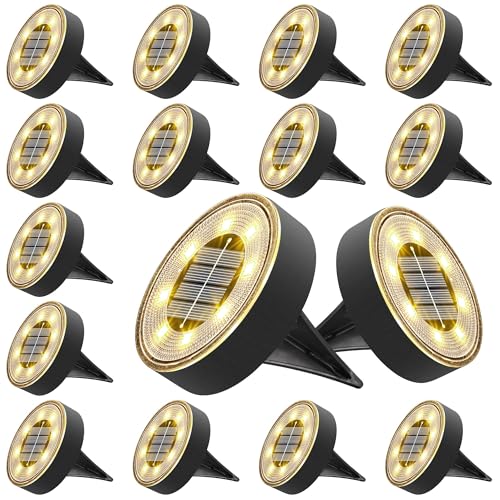
Flat discs are useful where the light will sit near a lawn edge, walkway border, or paver. The vighep model specifically documents a low-profile, mower-safe design, while inkgear lists a 0.6-inch-thick ultra-thin body for narrow paths and tight garden spaces. These forms can reduce interference with mowing and foot traffic, but the listings do not establish that every surface is safe for driving over or heavy loading.
Stake-based designs are more suitable for soil, planting beds, and lawn borders. LOTMOS, Joomer, bt farm, and INCX describe stakes or ground-plug installation. Soil condition matters: several listings advise loosening or moistening hard soil before pressing in the stake. Avoid forcing a stake into compacted ground, because the evidence does not support treating any included stake as indestructible.
Compare waterproof protection carefully
IP ratings are among the clearest specification differences. IP68 appears on the Peasur, LOTMOS, and Joomer listings, while IP65 appears on SenLuKit, INCX, SOLPEX, vighep, and inkgear. Greluna lists IP44. A higher rating can be useful in exposed landscapes, but placement still matters. SOLPEX specifically advises avoiding locations that easily flood, and solar fixtures need a panel position that receives usable daylight.
The listed construction materials also help with comparison. Peasur identifies 304 stainless steel and plastic, bt farm lists stainless steel and plastic, and inkgear identifies a 304 stainless-steel ring. Other products use ABS or engineering plastic. Material descriptions indicate the intended construction, but they do not prove a particular service life in every climate.
Consider light color and LED layout
Warm white is generally the more decorative choice in this group. Peasur, LOTMOS, Joomer, bt farm, inkgear, and Greluna list warm or 3000K output. Cold or cool white appears on vighep, INCX, and SOLPEX. SenLuKit lists warm white. Choose one color across a path when a uniform appearance matters.
LED counts are not directly equivalent to measured brightness. INCX lists 16 LEDs per fixture, SenLuKit lists eight top LEDs plus four side LEDs, and many other selected models list eight LEDs. These details describe the light arrangement, not a verified brightness test. A side-light layout may be useful where illumination around the fixture is wanted, while a flat disc can create a more discreet marker effect.
Evaluate runtime claims realistically
Solar runtime depends on daylight, panel exposure, season, shading, and cleanliness. LOTMOS lists 6–8 hours of charging and 10–14 hours of illumination. Peasur and bt farm list 8–10 hours, while Joomer lists 6–8 hours after a full charge. SOLPEX lists 4–6 hours of charging and 8–10 hours of illumination. These are manufacturer-provided claims, not independent measurements.
Position panels away from shade where possible and keep surfaces free of dirt and debris. A listed runtime should be treated as a reference rather than a guarantee for every installation or season.
Select the right pack size
Pack size should follow the length and visual rhythm of the area. vighep’s 24-light pack is suited to broad borders, while LOTMOS supplies 20 lights. INCX, bt farm, and Joomer each provide 16-light options. Twelve-light packs such as Peasur, SenLuKit, and Greluna can suit a typical path or patio perimeter. SOLPEX’s 10-light pack is useful when the installation is limited or when dual mounting is more important than maximum coverage.
Before buying, measure the route and decide whether fixtures will mark both sides or only one edge. A larger pack is not automatically better if the lights will be crowded together or placed where panels are shaded. Consistent spacing and matching color temperature can matter more to the finished appearance than adding extra fixtures.
Check mounting flexibility and upkeep
SOLPEX and SenLuKit offer the broadest documented placement flexibility. SOLPEX includes screws for decks, fences, stairs, or other surfaces in addition to stakes. SenLuKit states that its lights can be used with or without spikes, including on decks and stairs. Most other selected products are primarily soil-installed.
Solar fixtures generally require more attention to placement than wired lights. The supplied evidence supports automatic switching and no-wire installation, but it does not support claims of maintenance-free operation. Keep panels clear, inspect stakes after severe weather, and follow the included instructions for first charging and installation. Waterproof ratings should be treated as a specification aid rather than permission to submerge a fixture.
Final Recommendation
LOTMOS 20-Pack Solar Ground Lights ranks first overall in this specification-based comparison under the published weighted criteria.
LOTMOS 20-Pack Solar Ground Lights is the first overall specification-based choice in this comparison.
Peasur 12-Pack IP68 Solar Ground Lights is another strong general pick among the best solar outdoor in-ground lights. Its combination of IP68 protection, 304 stainless steel, 8 LEDs, automatic operation, and a stated 8–10-hour illumination claim makes it a practical option for exposed paths and garden borders.
Choose LOTMOS if you need a 20-light pack with an extended listed runtime window. Choose SenLuKit or SOLPEX when mounting flexibility matters. For very low-profile placement, inkgear and vighep are clear fits, while Greluna is the decorative choice for buyers who prefer Edison-style fixtures and 3000K warm white. These top solar outdoor in-ground lights are specification-based recommendations, so actual results will depend on sunlight, soil, placement, and weather.
Frequently Asked Questions
Are the best solar outdoor in-ground lights suitable for lawns?
Yes, several selected models document lawn use, including vighep, Peasur, LOTMOS, and bt farm. Low-profile designs such as vighep and inkgear may be more appropriate near mowing routes, but the supplied claims should not be treated as proof that every mower or lawn tool can safely pass over every fixture.
What IP rating should I look for in solar ground lights?
The selected products range from IP44 to IP68. IP68 is the highest listed protection level in this comparison and appears on Peasur, LOTMOS, and Joomer. However, placement, drainage, and panel exposure still matter. SOLPEX advises avoiding areas that easily flood.
Do these lights need wiring or an electrical outlet?
The selected listings describe solar charging and wireless installation. Most use a stake pushed into soil, while SenLuKit and SOLPEX document additional placement options. They still need daylight for charging and should be installed according to the supplied instructions.
Is warm white or cool white better for a pathway?
Warm white, including Greluna’s listed 3000K output, is generally suited to a decorative, softer appearance. Cool or cold white models such as vighep, INCX, and SOLPEX may suit buyers who want a crisper marker effect. The best choice depends on the surrounding landscape and the color consistency you want.
How many lights do I need for a walkway?
The answer depends on the path length, spacing, and whether you are lighting one or both sides. The selected packs range from six to 24 fixtures. Measure the route first, then choose a pack that allows even spacing without placing panels in shade.