Buying Guide
Choosing the best low-voltage outdoor in-ground lights starts with the system rather than the appearance alone. These fixtures are designed to sit in soil, gravel, concrete, decks, or other landscape surfaces and send light upward, so compatibility, sealing, installation depth, and light direction matter as much as wattage. The products compared here are selected from public listing specifications. They were not hands-on tested, and the comparison does not use customer sentiment.
Confirm the electrical setup
Most of the selected fixtures specify 12-24V AC/DC operation. That range appears on the SOROP, CLOUDY BAY, JESLED, SUNVIE, ZUCKEO, and LEDVIE listings, while the Gardencoin MR16 fixture specifies 12V AC/DC. Before buying, check the output of the transformer already installed in your landscape system. A fixture can be low voltage yet still be unsuitable for a particular transformer, connector arrangement, or cable run.
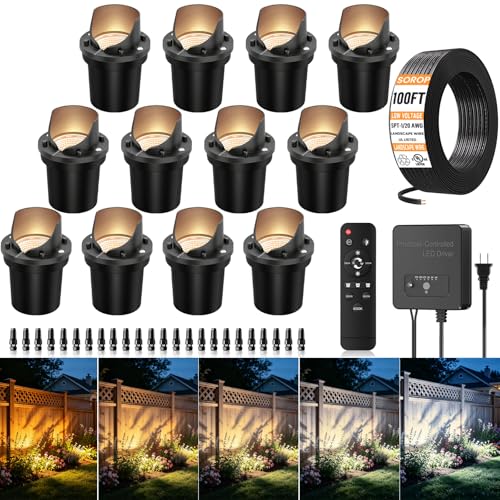
Several products are fixture-only packages. CLOUDY BAY, JESLED, SUNVIE, ZUCKEO, and LEDVIE state or imply that a transformer is excluded or required. The SOROP package is different because its listing includes a 144W transformer, 100 feet of UL-listed wire, and connectors. Even with a kit, calculate the total connected load and follow the maker’s installation directions. Do not connect these products directly to household line voltage.
Match the seal to the location
IP67 is the most common documented protection level in this selection. SOROP, CLOUDY BAY, LEONLITE, SUNVIE, ZUCKEO, LEDVIE, and JESLED all list IP67 protection or sealing details. In practical terms, that rating is relevant to dust and temporary water immersion under the applicable test conditions, but it does not remove the need for proper drainage, cable routing, and installation according to the instructions.
Gardencoin’s brass fixture lists IP65 instead. That can still suit many outdoor locations, but it is a different protection specification from IP67 and should be considered when the fixture will sit in a particularly wet or low-lying area. The same product documents a sealed O-ring and an operating temperature range from -40°F to 113°F, while the other listings provide different construction details rather than a common temperature range.
Choose fixed, tunable, or color-changing light
Color temperature changes the appearance of a landscape. The 2700K and 3000K choices in products such as Gardencoin, LEONLITE, and several SUNVIE models produce the warm-white style commonly used for trees, paths, patios, and architectural accents. LEDVIE lists daylight white, which may be preferable when a cooler appearance is wanted. Product descriptions should be checked carefully because “bright” is not a substitute for a documented lumen figure or color specification.
For adjustment, CLOUDY BAY lists five color temperatures from 2700K through 5000K. SOROP extends that concept to five settings from 2200K through 6500K and adds dimming, timer modes, a photocell, and a remote. SUNVIE’s RGBW set documents 16 colors, four modes, dimming, three brightness levels, and independent warm-white chips. These features make the fixtures adaptable, but they also introduce more controls and components than a simple fixed-color light.
Replaceable-bulb fixtures offer another type of flexibility. Gardencoin’s six-pack uses a replaceable 5W 2700K MR16 bulb, and its listing says alternative colorful bulbs can be used. The separate Gardencoin brass fixture also uses an adjustable GU5.3 socket compatible with standard MR16 bulbs, but that product is supplied without an MR16 bulb. A replaceable-bulb design can simplify future maintenance, while an integrated LED fixture avoids the need to select a separate bulb at installation.
Consider glare, top design, and mowing
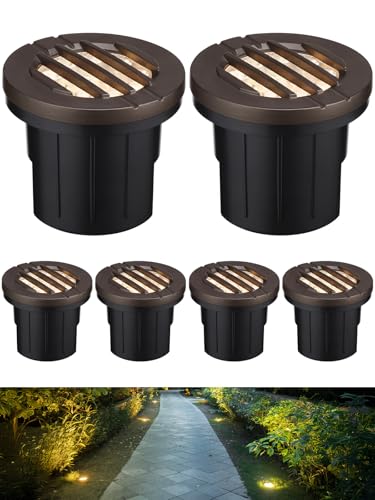
The top of an in-ground fixture affects both the visual effect and the way the landscape can be maintained. SUNVIE’s shielded model uses a shielded top and convex lens to focus the light and reduce dazzling. LEONLITE documents a flat vertical grille intended to improve drainage, optimize anti-glare performance, and reduce maintenance. SOROP and another SUNVIE model use grated tops that are described as helping prevent gravel, mulch, and leaves from entering the lens.
A nearly flat grated top can be useful beside a walkway or in lawn areas where mowing is part of routine maintenance. SOROP specifically describes its top as free to mow, while LEONLITE lists 12-24V operation that allows a lawnmower to cut directly over the lights. These statements are product-specific; they should not be generalized to every in-ground fixture. Confirm the manufacturer’s installation instructions and the final surface height before placing any light in a mowing path.
Evaluate construction and installation hardware
Common materials in this group include die-cast aluminum, stainless steel, tempered glass, PVC, and brass. CLOUDY BAY, LEONLITE, JESLED, and SOROP document aluminum construction. LEONLITE adds a stainless steel panel, while the SUNVIE stainless-steel-cover model uses a stainless steel cover and tempered soda-lime glass. The Gardencoin brass product uses a die-cast brass shade with a reinforced PVC body. Material choice may affect appearance, corrosion considerations, and how the fixture fits the surrounding hardscape, but the supplied data does not establish comparative real-world durability.
Connectors can reduce cutting or splicing work, but inclusion varies. SOROP lists 24 connectors for 12 lights, SUNVIE lists 16 connectors for its shielded set and 24 for its grated-top set, ZUCKEO lists 40 for 20 lights, and LEDVIE lists 24 for 12 lights. For the selected products, verify whether the connector type matches your cable and whether extra wire, junction protection, stakes, sleeves, or a transformer are needed.
Plan beam direction and placement
Well lights are useful for uplighting trees, walls, signs, fences, paths, decks, driveways, and patios. Products with a documented 90-degree beam include LEONLITE, ZUCKEO, LEDVIE, and JESLED. A broader beam can cover more of a nearby surface, while a shield, grille, or directional shade can help keep the light from being distracting. The evidence supplied here does not support a universal beam-distance recommendation, so placement should be based on the target, fixture dimensions, and the manufacturer’s guidance.
Measure the fixture opening and burial depth before digging. The selected products vary in size, from compact units around three inches across to taller fixtures such as the five-inch Gardencoin MR16 model. Ensure that water can drain away from the housing and that cable exits are protected as directed. Keep connections accessible enough for inspection while avoiding locations where standing water is likely.
Final Recommendation
SOROP 7W 5CCT Well Lights, 12-Pack Kit ranks first overall in this specification-based comparison under the published weighted criteria.
The final choice among the best low-voltage outdoor in-ground lights depends on the documented features that match your intended use.
SOROP 7W 5CCT Well Lights, 12-Pack Kit is the highest-scoring returned product and the first overall specification-based choice. Its included transformer, wire, connectors, five color temperatures, dimming, photocell, and timer modes create the most complete documented package in this comparison. For a fixture-only installation, CLOUDY BAY is a strong alternative because it combines IP67 protection, aluminum construction, and five color-temperature settings. LEONLITE is a focused warm-white option with documented high CRI90 and anti-glare detailing.
Among the top low-voltage outdoor in-ground lights, the right choice depends on the installation rather than a single universal feature. Choose Gardencoin when replaceable MR16 bulbs matter, JESLED when the listing’s pressure-resistance claim fits a driveway or traffic-prone location, and ZUCKEO when a large 20-light layout is useful. SUNVIE’s RGBW model is suited to decorative color effects, while LEDVIE provides a daylight-white alternative. In every case, confirm transformer compatibility, included hardware, drainage, and the planned mounting surface before installation.
Frequently Asked Questions
Many selected products list 12-24V AC/DC compatibility, including SOROP, CLOUDY BAY, LEONLITE, SUNVIE, JESLED, ZUCKEO, and LEDVIE. Gardencoin’s MR16 six-pack specifies 12V AC/DC. Check the exact fixture specification against your transformer output, total wattage capacity, cable length, and connector type. SOROP is the only selected package here that documents an included 144W transformer.
Not necessarily. Several fixture sets require a transformer but exclude it, including CLOUDY BAY and multiple SUNVIE models. SOROP includes a transformer, wire, and connectors as part of its documented kit. A transformer may also be needed when replacing an existing system if the current unit lacks enough capacity or does not provide the required output range.
What does IP67 mean for an outdoor well light?
IP67 is a documented ingress-protection rating used by many products in this comparison. It indicates protection against dust and temporary immersion under the relevant test conditions. It does not mean installation can ignore drainage, cable sealing, or the manufacturer’s instructions. Gardencoin’s brass fixture lists IP65 instead, so compare the stated rating with the planned location.
Should I choose warm white, daylight white, or color-changing lights?
Warm-white products in this group include 2700K and 3000K options, while LEDVIE lists daylight white. CLOUDY BAY and SOROP provide multiple color-temperature settings, and SUNVIE’s RGBW model adds colored modes plus independent warm-white chips. Fixed-color fixtures are simpler; tunable and RGBW models provide more adjustment but involve additional controls or settings.
Can an in-ground light be installed where a lawnmower passes?
Some selected listings specifically document mowing-related designs. SOROP describes its nearly flat grated top as free to mow, and LEONLITE states that its 12-24V lights can be cut over by a lawnmower. Treat those as product-specific claims, not a blanket rule. Follow the installation instructions, set the fixture correctly in relation to the surface, and avoid assuming that every well light has the same profile or pressure tolerance.