Buying Guide
Choosing among the best stainless steel toothbrush holders starts with the space and storage pattern you actually need. A single-person bathroom may need only one or two openings, while a shared bathroom may benefit from four to seven positions. The listings in this comparison include compact countertop caddies, open stands, a corner organizer, a detachable drip-tray design, and wall-mounted models. Because this is a specification-based review, the guidance below interprets documented features rather than claiming hands-on performance.
Match the holder to your bathroom layout
Measure the usable counter area before selecting a holder. Compact options such as the HBlife, Urbanstrive, and YANLIFY models are listed at roughly four to five inches across their longer dimension and are designed for toothbrushes, toothpaste, and small grooming items. The Joseph Joseph caddy is also positioned as a slim countertop organizer. These formats are suitable when the sink area has limited room, but the number and shape of compartments still matter.
A corner can be an underused part of a vanity. The MYITYARD holder documents an L-shaped corner design, making it a logical option for a small bathroom, apartment, or RV counter. Its three open compartments provide broader storage rather than a separate narrow hole for every brush. That may be preferable when you also want room for mouthwash, floss, or tongue-cleaning items.
If countertop space is the main constraint, the Ytuomzi holder uses adhesive wall mounting and a narrow profile. Its listing identifies smooth tile, glass, wood, marble, stainless steel, plastic, and metal surfaces as possible installation locations, while also specifying that no drilling is required. Check the surface condition and the dimensions of your brush heads before choosing a wall-mounted design.
Consider capacity and separation
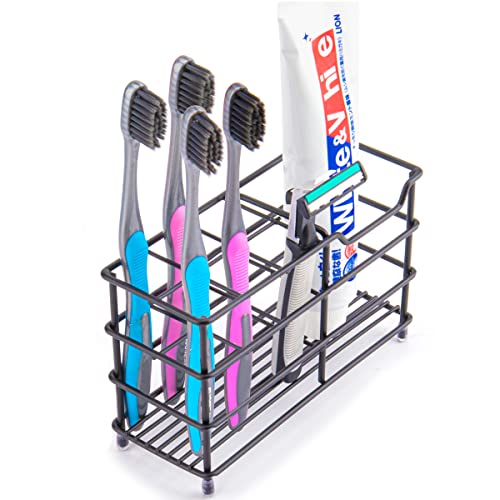
The best stainless steel toothbrush holders are not all organized the same way. The OXO, HBlife, Urbanstrive, and YANLIFY designs document four toothbrush positions plus a toothpaste position. That layout is easy to understand for a family or shared bathroom. Wbbog increases the documented capacity to seven slots, including six standard-sized toothbrushes and one toothpaste tube, so it is the most suitable selected option when slot count is the priority.
The Joseph Joseph holder has three compartments and is described as suitable for electric toothbrushes and toothpaste. This broader arrangement may be more flexible for larger handles or grooming tools, but it does not provide the same number of individual toothbrush positions as a five- or seven-slot design. The HapiRm takes another approach with five partitions for toothbrushes, toothpaste, mouthwash, and other items.
Look closely at the wording around fit. Ytuomzi gives a specific approximate width for compatible toothbrush heads and notes that some Sonicare heads may not fit. Other listings use general language such as “most” toothbrushes or describe standard-sized items. If you use an unusually wide electric brush, a large toothpaste tube, or specialty oral-care tools, compare the opening dimensions where supplied rather than assuming universal compatibility.
Prioritize airflow and water handling
Moisture management is a recurring design feature across these products. The OXO lists slots at the top and bottom for ventilation, while Joseph Joseph specifies ventilation for quick drying. Open-frame designs from MYITYARD and Chintu are described as promoting airflow and drainage. Wbbog and YANLIFY use angled openings or slots that the listings associate with drainage and airflow.
The HapiRm adds a removable diatomaceous-earth mat to its stainless steel organizer and describes the mat as absorbent. It also lists hollow construction for drainage. Chintu instead uses a removable drip tray, which gives you a distinct base component to remove and clean. These are different approaches: an absorbent mat manages water where it lands, while a tray collects water for removal. Neither description should be treated as a guarantee of drying speed in every bathroom.
A holder with ventilation still benefits from sensible placement. Avoid blocking openings against a wall or crowding the slots with items that prevent air movement. Empty or wipe removable components as needed, particularly if the holder sits beside a frequently used sink. Drainage features reduce standing-water concerns in the design, but they do not eliminate normal cleaning needs.
Evaluate stability and installation
Countertop holders generally rely on feet, pads, or a weighted base. Urbanstrive lists four rubber pads, HBlife describes stable feet, and MYITYARD lists four non-slip, scratch-resistant feet. OXO documents a stainless steel construction and a divider, while its listing emphasizes a wide opening rather than a specific foot design.
Chintu lists a silicone anti-slip pad, and Wbbog specifies four silicone grip pads. These features are relevant on smooth or wet counters, although the supplied evidence does not establish performance on every surface. Consider the holder’s footprint, the weight of the items you plan to store, and whether the counter is regularly exposed to splashing.
Wall-mounted Ytuomzi trades counter stability for adhesive installation. Its listing advises waiting after applying the adhesive before placing items on the holder. Follow that documented installation guidance and use a clean, smooth surface. A wall-mounted design can be useful in a narrow bathroom, but it is less convenient to relocate than a freestanding holder once attached.
Think about cleaning and long-term use
Stainless steel is useful here because many listings describe it as rust-resistant or suitable for humid bathroom environments. Several selected products specify 304 stainless steel, including OXO’s rust-resistant construction, HapiRm, Urbanstrive, and Ytuomzi. Material grade is only one consideration: seams, trays, dividers, and enclosed areas also affect how accessible the holder is for cleaning.
Joseph Joseph explicitly dismantles for cleaning, OXO has a removable divider, HapiRm has a removable mat, and Chintu has a removable drip tray. Those documented removable parts make these designs especially interesting if you prefer access to the base and interior. Open designs such as MYITYARD can also allow airflow and visibility around stored items.
A coated finish may change maintenance expectations. Joseph Joseph lists a fingerprint-resistant coating, while Chintu is described with a matte black finish and stainless steel construction. These can suit different bathroom styles, but the supplied evidence does not establish that one finish resists every stain or scratch. Use the cleaning instructions provided with the product and avoid assuming that a rust-resistant finish is maintenance-free.
Final Recommendation
HapiRm 5-Partition Stainless Steel Organizer ranks first overall in this specification-based comparison under the published weighted criteria.
The OXO Good Grips Stainless Steel Toothbrush Holder is the first overall specification-based choice among the best stainless steel toothbrush holders. Its combination of four-brush capacity, upright toothpaste storage, ventilation, a wide angled opening, and removable divider gives it the most balanced documented feature set for a shared bathroom.
Choose the Joseph Joseph EasyStore if cleaning access and a compact footprint matter most. Select HapiRm when five partitions, a removable absorbent mat, and multiple moisture-handling features fit your counter. Wbbog is the capacity choice for households that need seven documented slots, while MYITYARD is the space-conscious pick for a corner. For wall storage, Ytuomzi offers the clearest no-drill format, provided the adhesive surface and toothbrush-head dimensions are suitable.
These top stainless steel toothbrush holders differ more in layout and water management than in basic material. Before buying, confirm the available footprint, count your toothbrushes and toothpaste tubes, and check whether you prefer removable cleaning parts, open ventilation, or wall mounting. That process is more reliable than choosing solely by appearance, especially because listing dimensions and slot descriptions vary across the category.
Frequently Asked Questions
What should I look for in the best stainless steel toothbrush holders?
Start with stainless steel construction, then check the number and shape of openings, drainage or ventilation, base stability, and cleaning access. A family may need four or more separated toothbrush positions, while one user may prefer a compact three-compartment caddy. Also compare the holder’s listed dimensions with the counter or wall area available.
Are countertop or wall-mounted holders better for a small bathroom?
A wall-mounted design can free counter space, and the Ytuomzi model documents adhesive installation without drilling. A countertop option is easier to move and does not depend on wall-surface suitability. Consider whether you have a smooth installation surface and whether you want a permanent location before choosing between the two formats.
Which selected holder has the most documented storage capacity?
The Wbbog holder lists seven slots: six for standard-sized toothbrushes and one for a toothpaste tube. The OXO, HBlife, Urbanstrive, and YANLIFY holders each document four toothbrush positions plus one toothpaste position. The best choice depends on both capacity and whether the openings fit your specific brushes.
Do stainless steel toothbrush holders need drainage?
Drainage and ventilation can help water leave the holder and allow air to circulate. Selected designs use open frames, slots, raised bases, removable trays, or an absorbent mat. These features do not remove the need for routine cleaning, and the supplied listings do not guarantee identical drying results in every bathroom.
Which holder is easiest to clean based on the listing data?
Joseph Joseph explicitly states that its caddy dismantles for cleaning. OXO has a removable divider, HapiRm has a removable mat, and Chintu has a removable drip tray. These features provide access to specific components, but regular care still depends on how much water and residue the holder encounters.