Buying Guide
Choosing among the best iron pot lid holders starts with the storage position, not the material name alone. The listings in this comparison include iron, steel, coated metal, and mixed metal-and-plastic designs. They fall into three useful groups: countertop rests for active cooking, horizontal organizers for cabinets or shelves, and vertical racks mounted to doors or walls. A good match should support your lid shapes, fit the available space, and provide a practical way to manage moisture.
Choose the right holder type
A countertop rest is the simplest option when you need somewhere to place a lid while stirring. Poeland adds a removable drip tray, while NiHome and CHANNICORNER combine a lid support with utensil-resting space. These designs avoid drilling and usually require no assembly. They are convenient beside the stove, but they occupy counter area and generally hold fewer pieces than a cabinet rack.
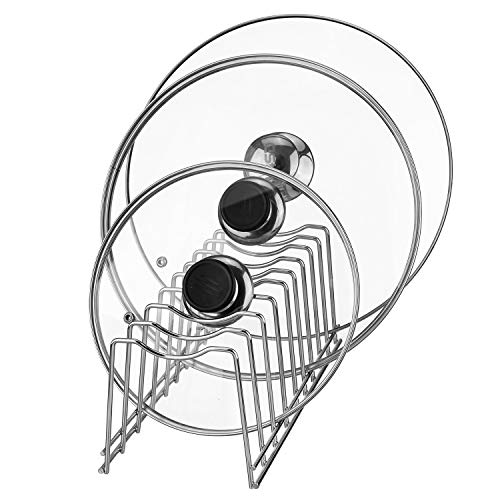
Horizontal organizers such as Housolution, ROOHUA, MUDEELA, PanPanPal, and Mustorn use dividers or compartments to separate lids and cookware. This arrangement can make stacked cabinet storage easier to access because each item has a distinct slot. Expandable models commonly reach roughly 22 to 23 inches in length, so measure the shelf, cabinet, or counter before ordering. Also check the vertical clearance required by handles and the depth available behind a cabinet door.
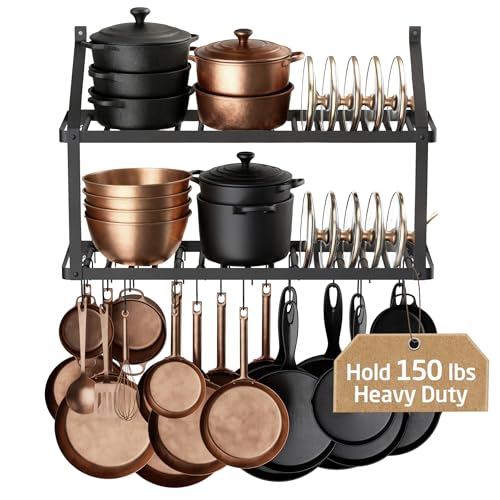
Vertical models such as ORDORA use wall or cabinet-door space. They are useful when shelf space is limited, but installation introduces new checks. Confirm that the door can close with the lids loaded, that the surface is suitable for adhesive, and that screw mounting will not interfere with plumbing, wiring, or cabinet construction. The listing for ORDORA includes both adhesive hooks and screws, giving more than one mounting route.
Compare support and stability
Lid support depends on how the holder contacts the lid. U-shaped grooves can cradle a lid edge or handle, while fixed slots separate pieces and help keep them upright. Housolution, ROOHUA, MUDEELA, and PanPanPal document U-shaped or deep-groove support. lonpute instead uses fixed slot widths, which may be preferable when your lids and boards have predictable thicknesses.
Stability comes from the base, feet, frame, or mounting hardware. Housolution lists silicone pads, ROOHUA uses a coated iron frame, and NiHome describes added bottom bars and silicone feet. CHANNICORNER uses a weighted base and four non-slip pads. These details are useful evidence, but they do not replace checking whether a large lid will extend beyond the holder or shift the center of gravity. For wall-mounted products, the surface and installation method are just as important as the rack itself.
Match capacity to your cookware
Count the lids you actually need to store and note their diameters, handle styles, and thicknesses. A one-layer stand may be enough for one active cooking station. A fixed multi-slot rack such as lonpute is better when you want predictable separation for lids, plates, or baking sheets. Expandable racks provide more flexibility: Housolution lists 14 dividers, while MUDEELA and PanPanPal list 10 and Mustorn lists nine stainless steel dividers.
Two-piece designs can be useful if cookware is spread across a kitchen. Housolution and ROOHUA document configurations that can operate as one rack or as two separate pieces. Mustorn supplies two organizers, which may allow storage in separate cabinets. Remember that more compartments do not automatically mean a better fit. Divider spacing, cabinet depth, and handles can limit usable capacity.
Consider surface protection and moisture
Metal construction can provide a firm frame, but coated or padded contact points may be preferable for painted, enamel, or nonstick cookware. ROOHUA describes rubber coating, Mustorn describes a smooth ABS base, and ORDORA lists a powder-coated steel surface. NiHome specifically advises careful handling of enamel cookware, an important limitation to note.
For lids placed immediately after cooking, drainage and cleanup matter. Poeland has a removable drip tray, and CHANNICORNER describes a ripple surface for drainage. Stainless steel designs such as lonpute are listed as wipe-clean, while washable stands can be rinsed when appropriate. Whatever the design, dry components fully after washing, especially where water can collect around seams, trays, or coated metal.
Plan installation and clearance
Countertop products need only a level surface, but cabinet and wall racks require more preparation. Measure width, depth, and height with the lid handles attached. Adhesive systems generally need a clean, smooth surface and may require a waiting period before loading; the supplied evidence for ORDORA and related mounted designs emphasizes surface or installation considerations. Screw-mounted racks offer a more permanent approach but require suitable hardware placement.
The best iron pot lid holders are not necessarily the largest. Select the smallest layout that accommodates your cookware with room to lift each lid out. For expandable racks, measure both the collapsed and extended dimensions. For vertical racks, open and close the door several times before final installation to verify that the rack and lids will not collide with shelves or adjacent cabinetry.
Final recommendation
Housolution Pot and Pan Lid Organizer ranks first overall in this specification-based comparison under the published weighted criteria.
Housolution Pot and Pan Lid Organizer is the highest-scoring returned product and the first overall specification-based choice among these best iron pot lid holders. Its heavy-duty iron construction, 14 adjustable dividers, expandable length, and two configuration methods make it the most adaptable option for a substantial cookware collection. ROOHUA is a close alternative when rubber-coated iron and a two-piece setup are priorities. For countertop cooking, Poeland stands out for its removable drip tray, while NiHome and CHANNICORNER offer compact utensil-and-lid resting. Among the top iron pot lid holders, ORDORA is the clearest choice for vertical cabinet-door or wall storage, provided the mounting surface and door clearance are suitable.
Frequently Asked Questions
What should I measure before buying the best iron pot lid holders?
Measure the available width, depth, and height, then measure the lids with their handles attached. For cabinet-door or wall racks, check the door swing and the space needed for the lid to project outward. Expandable products should be measured at both their shortest and longest settings. Also compare fixed slot widths with the thickness of your lids, boards, or bakeware.
Are countertop or cabinet lid holders better for small kitchens?
It depends on which space is less constrained. A compact countertop stand such as NiHome or CHANNICORNER is convenient and needs no mounting, but it uses work-surface area. A vertical ORDORA rack can reclaim horizontal space, while a shorter expandable rack may fit inside a cabinet. Installation and clearance are the deciding factors rather than kitchen size alone.
No. Protection details vary. ROOHUA lists rubber coating, Mustorn lists an ABS base, and ORDORA lists powder-coated steel. NiHome advises careful handling of enamel cookware. If your lids have delicate finishes, look for coated, padded, or smooth contact areas and place the lid gently. The supplied listings do not establish that any holder is suitable for every cookware finish.
Which design is best for wet lids during cooking?
A countertop stand with drainage features is the most direct match. Poeland documents a removable drip tray, and CHANNICORNER describes a ripple surface intended to aid drainage. These designs keep a wet lid near the cooking area, but the tray or stand should still be cleaned and dried according to its material. Cabinet organizers are better for dry storage after cooking.
Can one rack hold both pot lids and cutting boards?
Several selected products document multi-use storage. Housolution, MUDEELA, PanPanPal, and lonpute list combinations that include lids, cutting boards, baking sheets, plates, or bakeware. Check slot spacing and total item height before mixing categories. A rack designed around narrow lids may not provide enough room for thick boards or handled pans.