Buying Guide
The best steel planters are not defined by appearance alone. The useful differences in this group are the steel finish, the way excess water leaves the container, whether the interior can be adjusted, and how the planter meets the ground. Start by matching the shape and planting depth to the plants and location, then check assembly and finish details.
Choose the steel finish
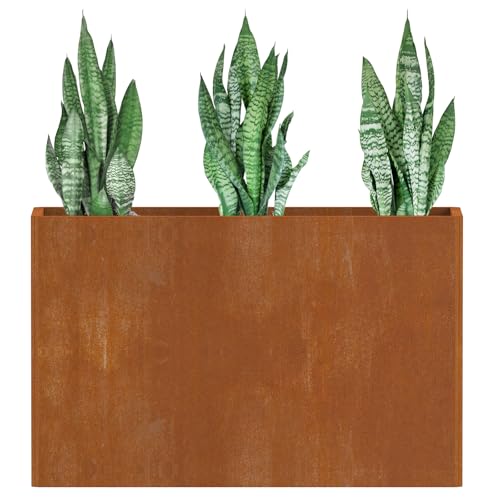
Most selected products use corten or weathering steel, which the listings describe as developing a rust-like protective patina. That makes the surface part of the design rather than a separate coating. Pre-rusted products such as the BHCORTEN 36 x 15 x 24-Inch Tall Planter and the GZLVSOW 14 x 14 x 30-Inch Tall Planter arrive with a weathered appearance. This can suit buyers who want the visual effect immediately, but the listings warn that pre-rusted products may release rust particles during installation.
Raw or unrusted products take a different approach. The Foresland 36 x 11 x 30-Inch Corten-Style Planter and CYC 34-Inch Corten Planter with Grow Bag are supplied without the developed patina. Their listings say a finish-development step is required, but this avoids loose rust powder at delivery. Consider where the planter will be assembled and whether staining is a concern before choosing between pre-rusted and raw steel.
Match dimensions to the planting plan
Measure the available area in three directions, not just the planter length. Tall models such as the Foresland 36 x 11 x 30-Inch Corten-Style Planter and GZLVSOW 14 x 14 x 30-Inch Tall Planter provide vertical emphasis while using relatively modest floor space. They can work near entrances or along patios, but their height may make the planting container more visually dominant.
Long, low-to-medium boxes create a different effect. The Watbick 48 x 10 x 16-Inch Long Corten Planter is the longest option in this selection and is intended for linear placement. The GZGNEEVL 32 x 16 x 16-Inch Corten Planter has a wider rectangular footprint, while the BHCORTEN 26-Inch Square Corten Planter uses equal dimensions for a centered display. Use the available width and the intended plant arrangement as the main decision points.
Check drainage details carefully
Drainage is one of the most important specification differences. Several listings provide specific hole counts: the BHCORTEN 36 x 15 x 24-Inch Tall Planter lists four holes, the Ganeekiron 32 x 12 x 24-Inch Corten Planter lists four in the shelf and four in the bottom, and the Gabviem 36-Inch Corten Planter with Legs lists six. These details make it easier to compare water-management provisions.
Some designs add more control. The Watbick 48 x 10 x 16-Inch Long Corten Planter includes plugs for using some, all, or none of its two drainage holes. Foresland’s 36 x 11 x 30-inch model lists silicone plugs and non-woven bags. By contrast, the CYC 34-Inch Corten Planter with Grow Bag does not specify drainage holes in the supplied evidence, so it should be selected for its assembly and stability features rather than assumed drainage performance.
Decide whether a shelf is useful
A removable or adjustable shelf can reduce the amount of soil needed for shorter plants and create a shallower planting zone. It is documented on the WIZWERK 36-Inch Corten Planter with Wheels, both tall Ganeekiron and BHCORTEN models, the GZLVSOW tall planter, and Foresland’s tall model. These products are better suited to mixed arrangements where plant heights or root depths may vary.
A shelf is not necessary for every setup. A simple box such as the GZGNEEVL 32 x 16 x 16-Inch Corten Planter may be preferable when the goal is a single open soil area. The BHCORTEN 26-Inch Square Corten Planter also uses a straightforward open-box format. Check the listing’s interior configuration rather than inferring it from the outside height.
Consider elevation, wheels, and stability
Ground clearance can help a planter fit a patio or deck arrangement. The Gabviem model uses four legs, the Watbick model uses six legs with one-inch elevation, and the WIZWERK model adds wheels with two lockable casters. These features serve different purposes: legs create clearance, while wheels support repositioning.
The WIZWERK planter is the most useful when sunlight, seasonal décor, or cleaning requires movement. Lockable wheels can hold it in place after repositioning, but a fixed planter may be more appropriate for a permanently installed display. The CYC model uses water bags and a grow bag as stability-related accessories, while Foresland’s tall model lists adjustable feet for uneven ground. These are specification features, not guarantees of performance on every surface.
Review assembly and installation needs
Most of the selected boxes require assembly. The BHCORTEN 36 x 15 x 24-Inch Tall Planter, Ganeekiron model, and GZLVSOW tall planter list panels, hardware, or simple assembly instructions. The Gabviem planter specifically describes tool-free assembly. The CYC planter uses self-locking buckles and no screws, making it the most distinctive option for quick setup based on the supplied evidence.
Raw steel models require one additional consideration: the finish-development process. Pre-rusted planters may need outdoor installation because of rust particles, while raw models avoid that initial mess but require the buyer to apply or use the supplied finishing approach. Review the assembly instructions and prepare a suitable work area before adding soil.
Final Recommendation
WIZWERK 36-Inch Corten Planter with Wheels ranks first overall in this specification-based comparison under the published weighted criteria.
The final choice among the best steel planters depends on the documented features that match your intended use.
WIZWERK 36-Inch Corten Planter with Wheels is the highest-scoring returned product and the first overall specification-based choice. Its combination of lockable wheels, a removable shelf, drainage, internal airflow space, and a tall rectangular format gives it the broadest documented utility in this comparison. For the top steel planters by a specific use, choose the Foresland 36 x 11 x 30-Inch Corten-Style Planter for adjustable feet and divider flexibility, the Watbick 48 x 10 x 16-Inch Long Corten Planter for a long border, or the BHCORTEN 26-Inch Square Corten Planter for a square focal display. Buyers who want a pre-rusted finish should compare the BHCORTEN and GZLVSOW options, while those who prioritize simpler setup can consider the Gabviem or CYC designs.
Frequently Asked Questions
Are these steel planters suitable for outdoor use?
The selected listings describe their corten, weathering, or rust-resistant steel planters for patios, gardens, yards, decks, porches, balconies, entrances, or commercial spaces. Outdoor suitability still depends on the specific site, drainage arrangement, surface, and installation instructions. Raw and pre-rusted finishes also require different handling during setup.
Which of the best steel planters has the most planting flexibility?
The WIZWERK 36-Inch Corten Planter with Wheels, Foresland 36 x 11 x 30-Inch Corten-Style Planter, and Ganeekiron 32 x 12 x 24-Inch Corten Planter document removable or adjustable shelves. These features allow a shallower arrangement for shorter plants or a deeper space after removal, subject to the available interior dimensions.
Do steel planters need drainage holes?
Drainage provisions help manage excess water, but the supplied products differ in hole counts and controls. Some list multiple holes, while the Watbick model adds removable plugs. The CYC listing does not specify drainage holes, so buyers should confirm the intended water-management setup before purchase.
Should I choose a pre-rusted or raw steel planter?
Choose pre-rusted steel if you want a developed weathered appearance at delivery and can manage possible rust particles during installation. Choose a raw model if a cleaner delivery matters and you are prepared to follow the finish-development instructions. The Foresland and CYC listings specifically describe an unrusted starting condition.
Are wheeled steel planters better than planters with legs?
Neither design is universally better. The WIZWERK planter’s wheels support repositioning, including locking two casters after movement. Legged models such as the Gabviem and Watbick planters provide elevation and clearance without making mobility their main feature. Choose based on whether movement or ground clearance matters more for your location.