Buying Guide
The best sterling silver body piercing barbells are not chosen by appearance alone. Gauge, wearable length, bar shape, end style, and closure construction all influence whether a listing is worth considering for a particular placement. The products above cover several documented formats, but they are not interchangeable. A 6mm cartilage barbell, a 12mm navel barbell, and a 38mm industrial barbell serve very different purposes.
This guide interprets the supplied listing information only. It does not report hands-on testing, independent material verification, or customer opinion. Treat every dimension as a starting point for comparison and confirm the requirements of your own piercing before selecting jewelry.
Match the bar shape to the piercing
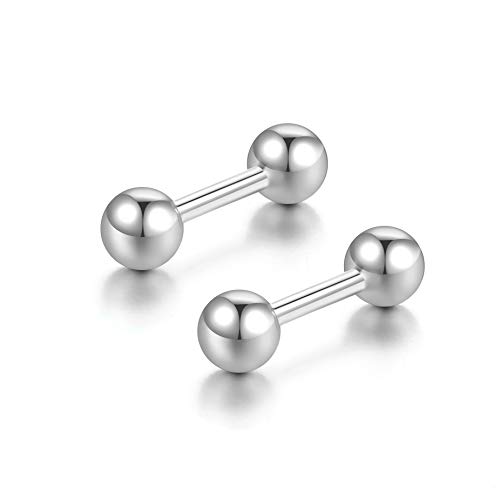
Straight barbells have a linear profile and are represented here by the 14G, 14mm PiercingPoint design. Its listing names tongue and ear use, so it is the clearest straight-bar comparison in the group. Curved barbells follow a different contour. OUFER documents a 16G, 8mm curved barbell for rook, eyebrow, lip, labret, daith, and medusa placements, while the shorter PiercingPoint 16G, 6mm model focuses on eyebrow and tragus use.
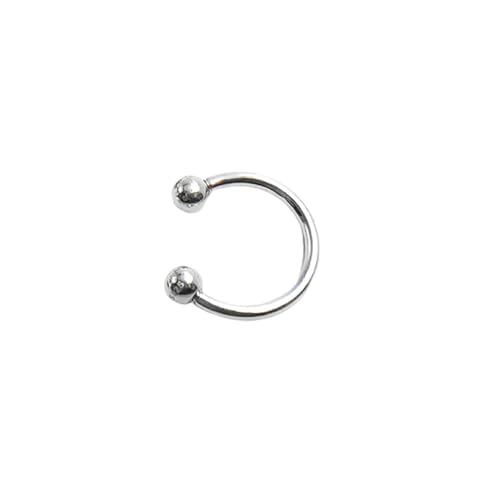
Circular barbells, sometimes described as horseshoe designs, form an open ring shape with ball ends. Cykdohy documents a 16G format with 6mm, 8mm, and 10mm length choices and an internally threaded removable ball. The Generic 16G model provides a simpler 10mm circular configuration. These designs should be evaluated by the diameter or length terminology supplied in the listing, not by appearance alone.
Industrial barbells are more specialized. Zynova lists an 18G, 38mm bar with chain detailing and describes it as a double-piercing industrial design. That longer measurement reflects the format’s purpose and should not be compared directly with a small rook or cartilage barbell.
Check gauge and wearable length together
Gauge describes thickness, while length describes the bar dimension. Both need to match the intended piercing. A longer bar is not automatically better; it may leave more visible space than desired, while a short bar may create pressure if the anatomy needs more room.
The small ear-focused options use thinner gauges. SILBERTALE lists its minimalist cartilage barbell at approximately 18G and 6mm, while its curved daith and rook model is approximately 18G and 8mm. Cykdohy and the Generic circular barbell use 16G. These differences matter when comparing products that may look similar in listing photographs.
Avoid treating phrases such as “standard size” or “fits most” as a substitute for a measurement. The most specification-aligned listings provide both gauge and length, and FIASASO goes further by listing decorative ball dimensions. Use those details to compare against the measurements of the piercing rather than assuming a universal fit.
Understand threading and closure details
Threading affects how the ends attach and how the jewelry is handled. Several selected products explicitly document internal threading. FIASASO, PiercingPoint’s straight and curved barbells, SILBERTALE’s 6mm bar, Cykdohy, and the Generic circular model all provide internal-threading or screw-ball information in their listings. That detail is more useful than a vague statement that the jewelry is easy to wear.
A clicker and an internally threaded barbell are different mechanisms, so compare the closure type with your handling preferences and the placement’s shape. Zynova documents secure end balls but does not provide the same level of threading detail; that is a specification gap to note.
Review material and finish claims carefully
Every selected product is presented as sterling silver or S925 sterling silver in the supplied evidence. Some listings add useful details: DJCIW says the piece is solid S925 rather than plated or coated, OUFER describes nickel- and lead-free 925 sterling silver, and SILBERTALE identifies nickel-free and lead-free construction. FIASASO describes a high-polish surface and hypoallergenic material, while Cykdohy describes a smooth surface and similar skin-conscious claims.
These are listing claims, not independent laboratory findings. If material sensitivity is a concern, focus on the exact composition and exclusions supplied by the manufacturer, and seek professional guidance when needed. Plating is also worth noticing. The SILBERTALE cartilage and curved models mention platinum plating, while the DJCIW listing specifically emphasizes solid silver. The distinction can be relevant to shoppers comparing construction descriptions.
Select ornamentation according to the intended look
Minimalist options include the SILBERTALE 6mm double-ball barbell and the simple Generic circular barbell. Zynova adds chain detailing, CZ accents, butterfly, and moon motifs to an industrial bar.
Ornamentation can affect how much visual space the jewelry occupies and may introduce dangling or projecting elements. The listings document design features, but they do not establish how those features behave during sleep, exercise, or clothing contact. Compare the design with the activities and clothing around the piercing rather than assuming a decorative piece will be equally suitable for every situation.
Final recommendation
FIASASO 14G CZ Navel Barbell, 12mm ranks first overall in this specification-based comparison under the published weighted criteria.
FIASASO 14G CZ Navel Barbell, 12mm is the first overall specification-based choice among these best sterling silver body piercing barbells because it combines detailed sizing, internal threading, 925 sterling silver, and a clearly documented navel-oriented design. DJCIW is the closest alternative for readers prioritizing an explicit solid-S925 claim and a butterfly dangle.
For curved placements, OUFER offers the clearest combination of 16G, 8mm sizing and multiple named uses, while the shorter PiercingPoint model is more focused on compact eyebrow or tragus applications. Cykdohy is the most flexible circular comparison because the listing provides several lengths. SILBERTALE’s two smaller options are useful for readers comparing minimalist cartilage, daith, or rook styles.
The top sterling silver body piercing barbells should be selected by documented fit details rather than by the decorative finish alone. Before ordering, compare gauge, length or diameter, bar shape, closure, and the listing’s material description with the requirements of the intended piercing. If the listing leaves a key dimension unclear, treat that uncertainty as a reason to verify the specification first.
Frequently Asked Questions
What should I compare first when choosing the best sterling silver body piercing barbells?
Start with the piercing location, then compare shape, gauge, and length. A navel barbell such as FIASASO or DJCIW uses a different 14G, 12mm configuration from the 18G, 6mm SILBERTALE cartilage barbell. Closure and end dimensions should be checked next.
Is 14G thicker than 16G or 18G?
Yes. In the supplied listings, 14G is shown as 1.6mm, 16G as 1.2mm, and 18G as approximately 0.9mm or 1.0mm. The SILBERTALE listings use approximately 18G, OUFER and Cykdohy use 16G, and the navel options from FIASASO and DJCIW use 14G. Confirm the exact measurement terminology before comparing models.
What is the difference between a straight, curved, and circular barbell?
A straight bar follows a linear path, as seen in the 14mm PiercingPoint design. A curved bar follows a bow-like contour, as shown by OUFER and the 6mm PiercingPoint model. A circular barbell forms an open horseshoe shape, as documented by Cykdohy and the Generic 10mm model. The correct shape depends on the piercing and the jewelry specification.
Are all sterling silver claims equivalent?
No. The listings use several descriptions, including 925 sterling silver, S925, solid S925, nickel-free, lead-free, and hypoallergenic. DJCIW explicitly describes solid S925 silver, while OUFER and SILBERTALE provide nickel- and lead-free claims. These statements come from public product listings and should not be treated as independent material certification.
Which selected design is most specialized?
Zynova is the most specialized because its listing describes an 18G, 38mm industrial barbell for a double-piercing industrial configuration. Its chain, CZ, butterfly, and moon details distinguish it from the smaller straight, curved, circular, and navel barbells. Industrial jewelry should be compared with industrial requirements rather than with ordinary single-piercing bars.