Buying Guide
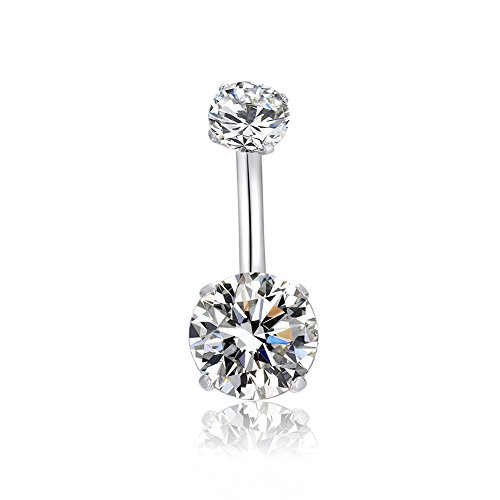
The best diamond body piercing barbells are selected by matching the documented construction to the piercing location and your required dimensions. In these listings, “diamond” generally refers to cubic zirconia, clear crystal, or rhinestone accents rather than a documented natural diamond. That distinction matters when comparing appearance, setting detail, and the amount of material information provided.
Start with the piercing location
Straight barbells and curved barbells serve different design purposes. AVYRING and Lcolyoli provide straight-barbell formats, with the former explicitly listing tongue and nipple uses and the latter describing general body-piercing applications. Curved options appear throughout the navel and eyebrow selections. Satix and D.Bella are focused on curved navel jewelry, while the Dyknasz and Briana Williams sets describe curved uses for eyebrow, rook, cartilage, and related placements.
A product title may mention several locations, but the important question is whether the actual shape supports that use. A straight 14mm bar is a different starting point from a reverse-curved 10mm navel bar. Treat the seller’s stated applications as documented scope rather than a substitute for professional fitting.
Check gauge before style
Gauge describes bar thickness. The selected products use either 14G, listed as 1.6mm in several records, or 16G, listed as 1.2mm. AVYRING, HQLA, Uzgtvy, Lcolyoli’s straight set, Satix, D.Bella, and FIASASO use 14G specifications. The Dyknasz sets and Briana Williams use 16G.
Do not assume that a visually similar barbell can replace another gauge. A mismatch can affect fit and may make the jewelry unsuitable for a particular piercing. Confirm the gauge of the existing jewelry or ask a qualified piercer before selecting from these products.
Compare wearable length and inner fit
Length is just as important as gauge. Satix and D.Bella list 10mm lengths, HQLA lists 10mm, and Uzgtvy lists a 10mm bar. FIASASO lists 12mm, while Lcolyoli’s straight set lists 14mm. AVYRING is the most adjustable on paper because its listing gives 12mm, 14mm, 16mm, and 18mm choices. The Dyknasz mixed-length set offers 6mm, 8mm, and 10mm options, while Briana Williams lists 8mm.
These numbers describe the product specification, not a universal fit recommendation. Anatomy, piercing angle, tissue thickness, and healing status can change the appropriate length. A short bar may sit more closely, while a longer bar may leave additional room, but the supplied evidence does not establish how any individual piece will fit.
Material documentation varies. Satix and AVYRING identify G23 or Grade 23 titanium, with Satix specifying Ti-6Al-4V-ELI ASTM F-136 and AVYRING describing G23 titanium. These are the clearest titanium records in the comparison.
Several products identify 316L surgical stainless steel, including HQLA, FIASASO, Lcolyoli, Dyknasz, and Briana Williams. FIASASO adds a 14K gold-plated surface over its stainless-steel base. Uzgtvy describes steel and copper, while the D.Bella listing simply says surgical steel. Compare the exact wording instead of treating every silver- or gold-toned finish as the same material.
Look closely at the stone setting
The most detailed stone specifications come from HQLA, FIASASO, HQLA’s 5mm and 8mm zirconia layout, and the 3mm CZ details listed by several Dyknasz and Briana Williams products.
For a smaller accent, look for a listed 3mm top, such as those in the Dyknasz and Briana Williams records. For a more pronounced navel layout, HQLA and FIASASO document larger stone dimensions. The word “diamond” in a title should not be read as proof of a mined or lab-created diamond when the evidence specifically names CZ or crystal.
Choose the closure and shape
Satix documents a clicker format, which distinguishes it from the externally threaded designs listed by Lcolyoli and Dyknasz. FIASASO specifies internal threading. Other listings describe screw-off ends without always identifying the threading orientation. Closure style affects how the jewelry is handled, so give priority to records that state the construction clearly.
Curved and reverse-curved formats are represented by Satix, D.Bella, Uzgtvy, Dyknasz, and Briana Williams. Straight formats are represented by AVYRING and Lcolyoli. Select the shape that corresponds to the intended placement rather than choosing only by stone appearance.
Decide between one piece and a set
Single-piece options such as Satix, HQLA, D.Bella, and FIASASO make the specific design easier to identify. Sets such as AVYRING, Uzgtvy, Dyknasz, and Briana Williams offer several documented looks or sizes. A set can provide styling variety, but it may also include non-CZ tops, different shapes, or mixed materials such as the acrylic option in the Dyknasz 16-piece record.
Read the unit count and style breakdown carefully. “Pieces,” “pairs,” and “styles” are not interchangeable. AVYRING lists two pieces, Briana Williams lists six, and Uzgtvy lists seven pieces in eight styles. Those details help clarify what the package contains before you compare designs.
Final Recommendation
AVYRING Titanium Tongue and Nipple Barbells ranks first overall in this specification-based comparison under the published weighted criteria.
Satix Clear Crystal Reverse Curved Barbell is the first overall specification-based choice among these best diamond body piercing barbells because its Grade 23 titanium, 14G and 10mm dimensions, reverse-curved shape, clicker format, and CZ detail are all clearly documented. AVYRING follows for users who need a straight barbell and want multiple length choices in G23 titanium.
HQLA is a strong fit for a clear, graduated navel design because its 5mm and 8mm stone sizes are explicit. FIASASO is the most detailed gold-plated option, with internal threading and two listed zirconia sizes. The Dyknasz selections and Briana Williams are useful when a curved 16G format or multiple styles matter, while D.Bella keeps the navel design compact and simple. These are the top diamond body piercing barbells here based on supplied specifications, not hands-on testing.
Before choosing, verify the piercing location, gauge, wearable length, and closure with a qualified piercer. Material wording also deserves attention: Grade 23 titanium, 316L steel, plated steel, and unspecified surgical steel are different records and should be evaluated separately.
Frequently Asked Questions
Are these best diamond body piercing barbells made with real diamonds?
The selected listings document cubic zirconia, simulated diamonds, clear crystal, or rhinestone accents. The supplied evidence does not establish that any selected product uses a natural or lab-created diamond. Treat “diamond” as a style description unless the material listing says otherwise.
What gauge should I choose for a body piercing barbell?
The comparison includes 14G and 16G products. The right gauge depends on the piercing and existing jewelry, so match the documented gauge to your current fit or ask a qualified piercer. Do not choose solely from the CZ design.
Are curved barbells different from straight barbells?
Yes. Curved and reverse-curved products are represented by Satix, D.Bella, Uzgtvy, Dyknasz, and Briana Williams, while AVYRING and Lcolyoli list straight barbells. The shape should correspond to the intended piercing location and jewelry configuration.
Which selected product offers more than one length?
AVYRING lists 12mm, 14mm, 16mm, and 18mm choices. Dyknasz’s mixed-length curved set lists 6mm, 8mm, and 10mm. These are product dimensions, not a guarantee of fit for a particular anatomy.
What should I verify before wearing a new barbell?
Verify the gauge, wearable length, shape, metal, stone setting, and closure. Also confirm that the listing’s stated use matches your piercing. A qualified piercer can help assess fit and whether the jewelry is appropriate for the piercing’s current condition.