Buying Guide
The best sturdy sheet music stands should be judged by documented construction and fit rather than by a product title alone. A rehearsal stand for loose pages has different needs from an orchestral stand holding thick scores, a tablet, or a clip-on light. The listings in this comparison provide useful signals including tripod design, leg spread, tray depth, stated load capacity, height range, angle adjustment, folding behavior, and included accessories.
A wide tripod or braced tripod is the clearest stability-oriented design in this group. The On-Stage SM7711B specifies a 19-inch footprint and a one-piece steel tripod base. The On-Stage SM7122BB uses a braced tripod with non-slip feet, while the CAHAYA models describe widened or wider leg spreads. These details explain how each stand is intended to remain planted.
A broad footprint can occupy more floor space. Measure the area beside your chair, instrument, or pedalboard before choosing a large orchestral design. Non-slip feet are useful on smooth surfaces, but the supplied evidence does not establish performance on every floor type. Place any stand on a level, stable surface and check that the legs are fully extended.
Match the tray to your music
Tray depth and width matter when you use bound scores, folders, or several pages. The On-Stage SM7711B has a 20-inch aluminum bookplate with a 2-inch lip and is documented to support multiple sheets, books, clamp-on lights, and other accessories. The CAHAYA dual-use models specify 2-inch-deep trays. By contrast, the Amazon Basics portable stand lists a 2.2-pound maximum capacity, making it more appropriate for lighter materials.
Spring arms, clips, and lips help keep pages in position, but they do not make every stand suitable for a laptop or projector. Several listings mention those devices, yet the most useful comparison point is the stated load guidance. If your setup includes electronics or a thick binder, favor a model with a documented capacity and a tray dimension that fits the item without overhang.
Check seated and standing adjustment
Height ranges vary considerably. The compact On-Stage SM7122BB adjusts from 26 to 40 inches, while Vekkia reaches 32 to 56 inches and Tialero reaches 33 to 57 inches. The Amazon Basics folding model spans about 31 to 55 inches. A broad range can accommodate different players and positions, but the correct height depends on whether the music should sit near eye level, above a keyboard, or beside a seated instrument.
Angle adjustment is equally important. Several selected models document 180-degree tray movement, while the On-Stage SM7711B describes automatic angle locks. Knob-based systems can offer precise positioning, but automatic or self-locking mechanisms may reduce the number of controls you need to operate. Treat these as design differences rather than proof of real-world ease, since this guide is not a hands-on test.
Decide how much portability you need
Folding bases, removable bookplates, carrying bags, and tri-fold panels all address transport. The Amazon Basics folding stand detaches its bookplate and folds its tripod base. The CAHAYA tri-fold model folds its panel and includes a bag. The On-Stage SM7122BB folds flat, making it appealing for lessons or frequent load-in and load-out.
Portability can involve trade-offs. More folding joints and removable parts may mean more assembly steps, while a broad orchestral base may take more room in a vehicle. If the stand will remain in a practice room, prioritize tray size and stability. If it will travel weekly, compare the folded design, bag inclusion, and whether the bookplate must be removed.
Some of the best sturdy sheet music stands include more than a tray and tripod. Tialero includes a rechargeable dual-head light and phone holder. Halostand includes a desktop stand, rechargeable light, bag, and sheet-music clip. CAHAYA’s dual-use models add tabletop supports, folders, or clips. These extras can simplify a practice setup, but they should not replace checking the core stand specifications.
A light is most relevant for dim rooms or performances without convenient illumination. A desktop conversion is useful for a piano, desk, or compact practice area. If you already own those accessories, a simpler stand may be easier to store. An included accessory does not automatically confirm compatibility with every instrument, device, or score format.
Final recommendation
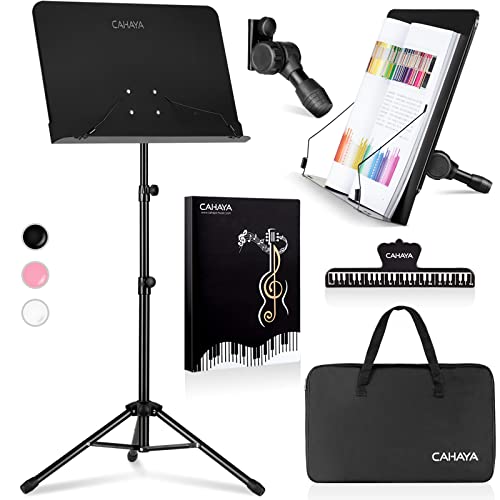
CAHAYA Dual-Use Sheet Music Stand ranks first overall in this specification-based comparison under the published weighted criteria.
CAHAYA Dual-Use Sheet Music Stand is the first overall specification-based choice in this comparison.
It is one of the best sturdy sheet music stands choices when stability, a deep bookplate, and documented load support are priorities. Its 0.9 mm steel construction, widened tripod base, 12-pound capacity, 180-degree tilt, and desktop conversion create a broad specification profile. The extra components may require more storage, but they add flexibility for musicians who alternate between floor and tabletop practice.
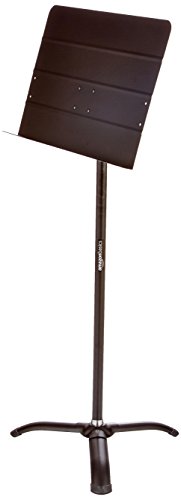
The On-Stage SM7711B Orchestra Music Stand is the better fit for buyers who want a substantial orchestral-style bookplate and automatic locks. Its 19-inch steel footprint, 20-inch aluminum tray, 8-pound capacity, and accessory support make it appropriate for multiple pages and larger scores. The CAHAYA Tri-Fold Panel Music Stand offers a useful balance of folding transport, a 10-pound stated capacity, and a 31- to 56-inch range.
For a portable stand with lighting, consider Tialero. Vekkia is a practical choice when a broad height range, 180-degree tray tilt, and carrying bag are important. The On-Stage SM7122BB is the compact option for lower setups, while the Amazon Basics folding model emphasizes detachable storage. Halostand is suited to shoppers who want a bundled desktop stand, light, folder, clip, and carrying bag. These are among the top sturdy sheet music stands for different use cases, but the final choice should reflect tray load, floor space, and transport frequency.
Frequently Asked Questions
What should I look for in the best sturdy sheet music stands?
Look for a stable tripod or braced base, non-slip feet, a tray sized for your music, a height range that suits your playing position, and a clear load specification when you use heavy books or accessories. Folding hardware and a carrying bag matter if the stand travels regularly.
A folding design can still document useful stability features. The selected folding models include widened or braced tripod bases, non-slip feet, metal construction, or stated load capacities. However, the supplied listing data does not establish performance under every stage condition. Inspect the leg spread, tray support, locking method, and maximum load before choosing one for a demanding setup.
Is a deep tray important for bound scores?
A deep tray can help accommodate thicker books and folders. The CAHAYA dual-use models and the On-Stage SM7711B specify 2-inch tray depth or lip support. A shallow tray may be adequate for loose pages, but buyers should compare the listed depth with the thickness of their score and the placement of any spring arms or clips.
Do I need a music stand with a light?
A built-in or included light is useful when your rehearsal or performance space may be dim. Tialero and Halostand include rechargeable lighting. If you normally play in a well-lit room, a simpler stand may reduce accessories and storage needs. Check whether the light is part of the package and whether its placement suits your sheet layout.
Can a floor music stand work on a desk?
Only when the product specifically documents tabletop or desktop conversion. The CAHAYA dual-use models and Halostand include separate desktop support, while other stands are designed primarily for floor use. Do not assume that removing a tripod creates a stable desktop stand unless the listing supplies a dedicated support component and instructions.