Buying Guide
The best tiered pants hangers are space-management tools, but their designs differ substantially. Some use clips to suspend skirts and trousers from adjustable points. Others use open-ended or coated rods, and several use swing arms that bring individual garments forward. The right choice depends on the clothes being stored, the closet rod layout, and how often garments are removed.
Start with the number of tiers
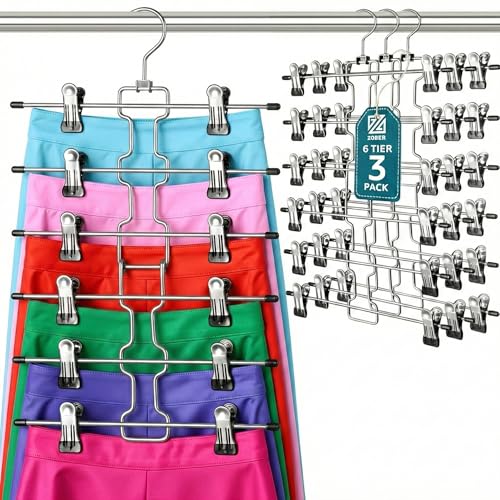
Tier count is the clearest capacity specification. Five-tier products such as Cycleacc, feasteery, and DOIOWN are moderate choices for a compact wardrobe. Six-tier designs from ZOBER, Damita, SHUKEEKA, Fayleeko, and Lumigens provide more positions without moving to the tallest documented format. Besslly lists nine layers, making it the capacity-focused option in this comparison.
Capacity claims should be read as organizational guidance rather than a guarantee for every garment. Thick jeans, heavy work trousers, and bulky fabrics occupy more room than lightweight pants. A heavily loaded rack may also need more clearance between tiers. Before buying, measure the available vertical space and check whether the hanger will sit comfortably on the closet rod.
Choose clips or open rods
Clip-based hangers are useful when the garment needs to be held from the waistband or upper edge. ZOBER and Damita document adjustable clips, allowing the position to be changed for different clothing widths. Lumigens describes 12 clips per hanger, which can be useful for combining pants with skirts, scarves, or smaller items. SHUKEEKA also lists adjustable clips and rubber protection.
Clips introduce trade-offs. They may take more time to open and reposition than an open-ended rod, and the correct grip position matters for delicate or heavily structured fabrics. Look for rubber-coated or padded contact points when available. The listings for ZOBER, Damita, Lumigens, and SHUKEEKA all describe some form of rubber protection or grip.
Open rods are more suitable for garments that can slide onto the hanger from the side. Fayleeko documents an open-ended design, while Cycleacc uses EVA foam-covered rods and FeeraHozer describes silicone-coated rods. DOIOWN uses a velvet-covered structure. These surfaces are intended to help retain garments, but the supplied evidence does not establish how each material performs across every fabric type.
Consider access before maximum capacity
A high-capacity hanger is less convenient if retrieving one item means disturbing several others. Swing-arm designs address that issue directly. Cycleacc lists four individually swinging arms with movement up to 300 degrees, and feasteery describes individually swinging arms plus a 360-degree rotating hook. These models are strong candidates for people who select different pairs frequently.
A swivel hook can improve orientation even when the tiers themselves do not swing. Besslly, Damita, Lumigens, and DOIOWN document rotating hooks. Open-ended designs can also simplify placement and removal, as described for Fayleeko. Clip-based formats remain practical when garments need firm positioning, but they generally require more direct handling at each clip.
Metal is common in this category. Besslly uses stainless steel and ABS plastic, Cycleacc specifies stainless steel, and FeeraHozer describes high-grade stainless steel. Several clip designs identify anti-rust or chrome-plated metal. These specifications support a preference for a metal frame, but they do not independently prove a particular product’s long-term durability.
Protection details matter because exposed edges can catch fabric. Besslly, ZOBER, and Lumigens document rubber tips or protective coverings. FeeraHozer lists safety caps, while Cycleacc identifies a smooth surface. If the hanger will hold delicate materials, prioritize a documented coating, cap, rubber tip, velvet surface, or padded rod rather than assuming every metal edge is equally protected.
Fixed multi-tier designs are straightforward when the organizer will stay in one closet position. Fayleeko describes a collapsible structure, and SHUKEEKA describes a foldable design. Those features may help when storage needs change or when the hanger is not used continuously. Besslly also documents connector hooks, and its rack can be used in two orientations.
Two-way designs deserve attention in small closets. Besslly, Fayleeko, Cycleacc, and FeeraHozer document horizontal or vertical use. Vertical use can concentrate garments along the rod, whereas horizontal use may make selection and drying more convenient. Confirm the available clearance in both directions before relying on this feature.
Match the set size to the closet
A single Damita hanger can be appropriate when only one section needs reorganizing. Two-packs from Besslly, Cycleacc, Fayleeko, and Lumigens can divide storage between seasons or clothing types. Three-packs from feasteery, ZOBER, and SHUKEEKA are better suited to several closet zones. FeeraHozer’s four-pack is the broadest set among the selected products.
Set size should not replace a capacity check. Several smaller hangers may distribute weight more evenly than one crowded rack, but they also occupy multiple hook positions. Compare the number of garments, closet rod length, and vertical clearance together.
Final recommendation
Besslly 9-Layer Pants Hangers ranks first overall in this specification-based comparison under the published weighted criteria.
Besslly 9-Layer Pants Hangers is the first overall specification-based choice among these best tiered pants hangers because it documents the highest tier count, a stated load capacity, non-slip rods, connector hooks, and two-way use. For easier individual access, Cycleacc is the more focused swing-arm alternative, while ZOBER is a strong clip-based option for mixed clothing sizes.
FeeraHozer is a practical choice for heavy-denim organization and larger multi-closet projects. Fayleeko suits shoppers who want open-ended access and a collapsible structure. Damita adds a documented finger-friendly clip design, and DOIOWN offers a velvet-covered alternative. The top tiered pants hangers are not identical, so prioritize capacity, access, garment contact, and closet orientation in that order for your situation.
Frequently Asked Questions
What should I look for in the best tiered pants hangers?
Start with the number of tiers and the available vertical clearance. Then check whether the design uses clips, open-ended rods, or swing arms. Documented non-slip surfaces, protective tips, coated rods, swivel hooks, and metal construction can help distinguish products with otherwise similar capacity. Also consider whether you need horizontal and vertical positioning or a foldable structure.
Are swing-arm pants hangers easier to use than clip hangers?
They can be, particularly when you frequently select garments from the middle of a rack. Cycleacc documents four arms that swing individually, and feasteery also describes individually swinging arms. Clip hangers may be preferable when you want adjustable attachment points or need to hold skirts and other items from their edges. The better design depends on how garments are placed and removed.
Do tiered pants hangers work vertically and horizontally?
Some do, but not all. Besslly, Fayleeko, Cycleacc, and FeeraHozer document horizontal and vertical use. Vertical positioning can concentrate more garments along the rod, while horizontal placement may simplify access. Always check the closet’s rod length, side clearance, and vertical height before switching orientation.
Are clips or coated rods better for pants?
Clips provide an adjustable grip and can work well for pants, skirts, and mixed garments. Coated rods, velvet, silicone, and EVA foam are alternatives intended to reduce slipping without clipping the fabric. The supplied listings do not provide comparative testing, so choose based on the garment construction and whether you prefer waistband clips or side-loading access.
How many tiers do I need?
Five or six tiers cover many standard organization needs, while nine tiers are aimed at denser storage. Count the garments you want on each hanger, then allow room for thicker fabrics and comfortable retrieval. Besslly documents nine layers; ZOBER, Damita, SHUKEEKA, Fayleeko, and Lumigens document six; Cycleacc, feasteery, and DOIOWN document five.