Buying Guide
The best titanium body piercing studs are not interchangeable simply because they share a titanium label. Gauge, post length, fastening method, top construction, and placement all affect whether a listing matches the jewelry you need. This comparison uses the supplied product pages as specification evidence. It does not confirm fit, finish, comfort, or performance through hands-on testing.
Start with the material wording
Look for a specific material designation rather than relying only on a title that says “titanium.” The selected listings use terms including ASTM F136, G23, F136, solid titanium, and implant-grade titanium. FINE4U, limerencia, BodyAce, and NONTAI provide ASTM F136 references. YACHY, LOLIAS, Gotumo, and OUFER use G23 or comparable titanium wording in their supplied evidence.
Material wording still requires careful reading. NONTAI identifies the bar as solid ASTM F136 titanium but describes the top as 316L surgical steel with a PVD finish over implant-grade titanium. These distinctions matter when the top and post do not use identical material descriptions.
Match gauge and post length
Gauge describes post thickness, while post length describes how far the bar extends through the piercing. The selected products cover 16G, 18G, and several available thicknesses. A 16G option appears in FINE4U, LOLIAS, Gotumo, BodyAce, and OUFER’s opal design. YACHY, limerencia, and the two OUFER decorative studs use 18G specifications. NONTAI lists 16G, 18G, and 20G availability.
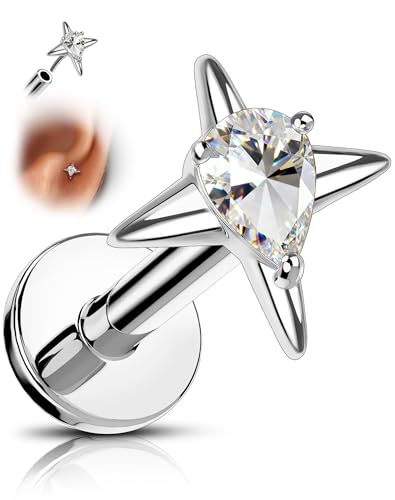
Post choices vary just as much. FINE4U provides 6mm and 8mm posts; LOLIAS lists 6mm, 8mm, and 10mm; and YACHY and limerencia include 6mm and 8mm options. Gotumo lists 6mm, 7mm, and 8mm bars. The single-length OUFER star, OUFER pear, and OUFER opal listings are more straightforward, with 6mm specified for the selected versions.
Use these numbers as compatibility checkpoints, not as a universal fit recommendation. Piercing placement, anatomy, swelling, and the existing channel can change the appropriate selection. If you are uncertain, compare the listing’s gauge and length with guidance from a qualified professional before inserting jewelry.
Choose the fastening style
The two main fastening patterns in this selection are internally threaded screw-on and threadless push-in. Internally threaded jewelry places the threading inside the post and uses a top that screws into it. BodyAce, YACHY, LOLIAS, Gotumo, and FINE4U document this style. YACHY also lists a guide pin, while LOLIAS describes an internally threaded design intended to help align the top.
Threadless jewelry uses a press-fit pin rather than a screw-on top. limerencia, OUFER’s opal, star, and pear designs, and NONTAI use threadless language. This can reduce the need to handle tiny screw threads, but the supplied listings still require attention to the insertion method. NONTAI mentions available gauge choices, while the OUFER and limerencia listings provide their own push-in descriptions.
A flat back is another separate feature. It describes the backing profile rather than the way the top attaches. Many of the selected products combine a flat back with either screw-on or threadless fastening. Check both features independently when comparing listings.
Consider the top design and finish
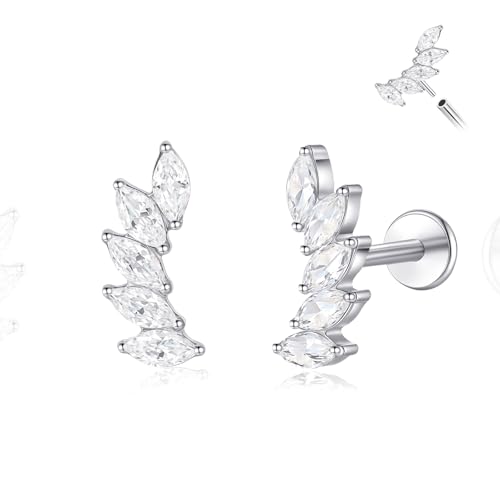
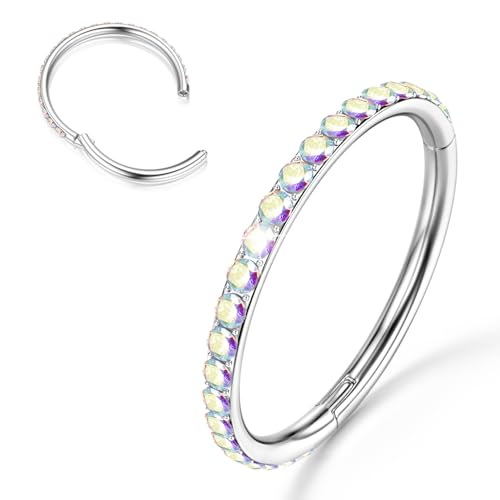
The top determines the visible style. FINE4U uses a kite-shaped CZ, YACHY documents three leaf styles, LOLIAS lists a flower top, and BodyAce specifies a leaf design with green CZ color. The smaller decorative options include OUFER’s four-point star, OUFER’s pear CZ in a starburst frame, and NONTAI’s tiny starburst set. The OUFER opal design uses a 3mm opal top.
Finish descriptions also vary. YACHY lists a gold Luna Laurel version, BodyAce lists gold and silver color information, and OUFER’s pear design identifies silver in the selected listing while noting gold or silver tone availability. FINE4U’s selected color is Clear plus Moss Agate CZ. Treat color and plating as appearance specifications rather than evidence of a different base metal.
Package structure can affect how you plan a purchase. FINE4U is sold as one complete stud with two posts. BodyAce includes one bar and one piercing taper. YACHY lists three tops and three bars, while LOLIAS lists three posts and one forward-helix top. Gotumo’s selected configuration has seven units, and NONTAI lists three studs.
The pair format is explicit for limerencia, while OUFER’s opal listing specifies two pieces. The OUFER star and pear entries are single-stud formats. Confirm whether you need one piece, a pair, replacement-compatible components, or several complete studs before selecting a package.
Use placement claims carefully
The listings mention locations such as helix, tragus, conch, cartilage, lobe, labret, lip, nose, Monroe, Medusa, rook, and daith. Those terms show the intended range documented by each seller, but they do not establish that every listed size will fit every placement. A product with several location claims may still offer only one post length in the chosen configuration.
For example, the Gotumo set documents ear, nose, lip, and cartilage uses, while the OUFER star listing is more focused on tragus, helix, lobe, Monroe, and cartilage. Choose based on the specific placement and the supplied gauge and length details rather than on the number of locations in a title.
Final Recommendation
FINE4U ASTM F136 Kite Stone Titanium Stud ranks first overall in this specification-based comparison under the published weighted criteria.
The final choice among the best titanium body piercing studs depends on the documented features that match your intended use.
FINE4U ASTM F136 Kite Stone Titanium Stud is the first overall specification-based choice because it combines ASTM F136 titanium, nickel-free construction, 16G sizing, two post lengths, internally threaded fastening, and a defined decorative top. Among the top titanium body piercing studs, it offers a particularly clear balance of material documentation and fit flexibility.
Choose YACHY if multiple leaf tops and two post lengths are more useful than a single-stud format. LOLIAS is the better fit-focused alternative when 10mm is among the lengths you need. Gotumo is notable for interchangeable bar and CZ sizes, while limerencia is the clearest pair option. For a smaller visual accent, the OUFER star and pear designs document compact 18G, 6mm formats. The BodyAce leaf, OUFER opal, and NONTAI starburst sets round out the list with distinct top styles and package formats.
Before choosing, verify the gauge, post length, attachment system, and whether the listed material applies to both the post and the decorative top. The product pages provide useful specifications, but they do not replace placement-specific professional guidance.
Frequently Asked Questions
What are the best titanium body piercing studs for comparing material specifications?
FINE4U, limerencia, BodyAce, and NONTAI explicitly reference ASTM F136 in the supplied evidence. Several other selected products identify G23 or implant-grade titanium. Read the complete material description because a listing may describe the post and top differently.
Is 16G or 18G better for a titanium body piercing stud?
Neither gauge is universally better. The selected products show both sizes, and NONTAI lists 16G, 18G, and 20G options. Match the stud to the gauge of the piercing and confirm the post length for the intended placement.
What is the difference between internally threaded and threadless studs?
Internally threaded studs use a top that screws into the post, as documented by BodyAce, YACHY, LOLIAS, Gotumo, and FINE4U. Threadless studs use a push-in pin, as documented by limerencia and the selected OUFER designs. Both formats require correct sizing and careful handling.
Do flat-back studs work for every piercing location?
A flat back is documented across many placements in the selected listings, including cartilage, helix, tragus, conch, lobe, labret, and lip. However, a flat-back design does not guarantee that one gauge or length suits every location. Compare the product’s exact size with your placement requirements.
Are the top and post always made from the same material?
No. Most selected listings describe titanium construction for the jewelry, but NONTAI specifically describes an ASTM F136 titanium bar and a top involving surgical steel with a PVD finish. Check the full material statement when solid titanium throughout is important to you.