Buying Guide
The best tow-behind lawn tractor attachments extend a riding mower into a complete yard cleanup system. Across the comparison above, the listings split into three design families: spring tine dethatchers for thatch and moss removal, landscape rakes for heavier debris like pine needles and straw, and tow-behind lawn sweepers for collecting leaves and clippings. Choosing among them comes down to matching the working width, frame, and hitch to your property size and towing machine.
Match Working Width to Lawn Size
Working width is the single biggest productivity lever in a pull-behind attachment. A 40 in path is comfortable for many suburban lawns, while a 48 in unit, like the Agri-Fab 45-0295 or the AugFir 48 in dethatcher, covers more ground per pass. For very large lawns, pastures, or fields, a 60 in dethatcher, such as the YITAMOTOR 60 in model or the Garvee 60 in unit, reduces the number of passes substantially.
Frame, Materials, and Tine or Brush Design
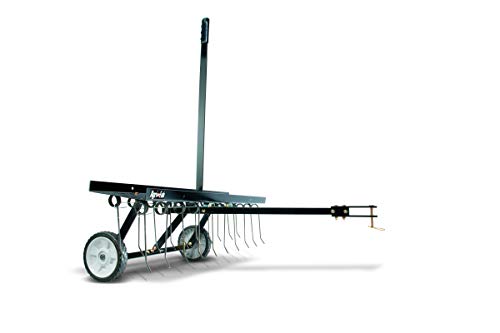
A durable frame and reliable tines or brushes determine how long a tow-behind tool holds up. Several listings specify all-steel or carbon-steel frames with powder-coated or welded finishes, and heat-treated spring tines that flex on contact. The Agri-Fab 45-0295 lists 24 replaceable heat-treated spring tines, while the YITAMOTOR 60 in dethatcher describes 24 individually replaceable spring steel tines on a powder-coated frame.
Hitch Compatibility With Your Tractor
A universal pin-style hitch is the most common connection across the comparison, supported by dethatchers like the BlumeTrec 40 in, the Suchtale 40 in, and the LAKEROD 40 in. The AugFir 48 in dethatcher adds an adjustable hitch that can be raised or lowered to match different tractor drawbar heights.
Adjustability and Operating Controls
Lift handles and adjustable tine or brush heights make daily work easier. The Agri-Fab 45-0295 uses a cantilever transport handle for raising and lowering the tines, while the BlumenTrec 40 in and Garvee 60 in dethatchers describe a similar lift handle pattern.
Capacity, Weight Trays, and Debris Handling
Weight trays and hopper bags change how deeply tines dig in and how long you can work before stopping. The AugFir 48 in dethatcher lists a 150 lb ballast tray, the BlumeTrec 40 in lists 100 lb, and several 40 in dethatchers, including the LAKEROD 40 in, the FTOPBTB 40 in, and the Suchtale 40 in, list a 70 lb tray.
Wheels, Tires, and Terrain
Wheel and tire design influences how steadily a tow-behind unit tracks across the lawn. The Agri-Fab 45-0295 and Agri-Fab 45-0294 both use 7 in semi-pneumatic tires, while the Garvee 60 in dethatcher uses inflatable tires for varied terrain. Larger pneumatic or inflatable tires tend to roll more smoothly over uneven ground, while flat-free wheels reduce the risk of downtime from punctures.
Final Recommendation
Agri-Fab 48 in Tow Behind Lawn Dethatcher (45-0295) ranks first overall in this specification-based comparison under the published weighted criteria.
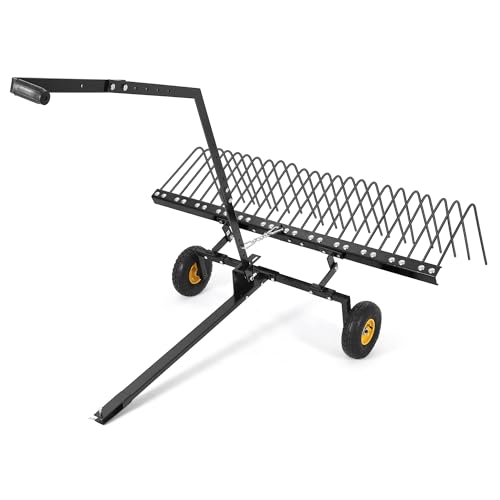
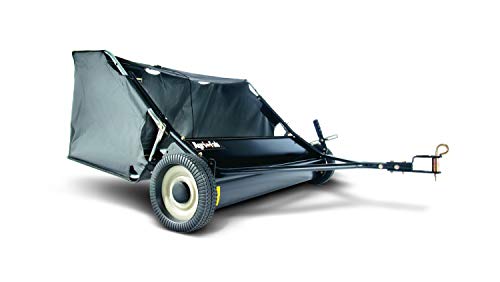
The Agri-Fab 48 in Tow Behind Lawn Dethatcher (45-0295) is the first overall specification-based choice among the best tow-behind lawn tractor attachments, combining a 48 in working width, 24 replaceable heat-treated spring tines, a 70 lb weight tray, 7 in flat-free wheels, and a universal hitch backed by a 3-year limited warranty. For acreage owners who need to clear more space per pass, the YITAMOTOR 60 in Tow Behind Pine Needles Rake broadens coverage further with 24 spring steel tines and a powder-coated frame. For a matched leaf and debris system, the Agri-Fab 42 in Tow-Behind Lawn Sweeper pairs a 42 in sweep with a 12 cu ft hopper and a dump rope, giving the top tow-behind lawn tractor attachments list a balanced dethatcher-rake-sweeper workflow for 2026.
Frequently Asked Questions
What is the difference between a tow-behind dethatcher and a landscape rake?
A tow-behind dethatcher uses spring tines to lift thatch, dead grass, and moss from the soil surface, while a landscape rake uses stiffer tines or teeth to gather heavier debris like pine needles, straw, and leaves. Both pull behind a lawn tractor, but dethatchers focus on soil-level cleanup and rakes handle surface debris.
How do I match a tow-behind attachment to my lawn tractor?
Check the hitch type on your tractor first, since most riding mowers use a pin-style hitch that fits the dethatchers and sweepers above.
Should I choose a 40 in, 48 in, or 60 in working width?
A 40 in width, like the LAKEROD 40 in or Suchtale 40 in dethatcher, suits small to medium lawns, while a 48 in width, such as the Agri-Fab 45-0295 or AugFir 48 in, covers larger properties in fewer passes. A 60 in width, like the YITAMOTOR 60 in or Garvee 60 in, is best for open acreage and very large lawns where pass count matters most.
How are the best tow-behind lawn tractor attachments scored in this guide?
Each attachment is scored on working width, frame and materials, tine or brush design, hitch compatibility, adjustability and controls, and capacity or ballast. The criteria are weighted to reflect the practical differences between dethatchers, landscape rakes, and tow-behind sweepers, and every score is drawn from the listed product specifications rather than from user feedback.
Do tow-behind lawn sweepers work on wet leaves?
They tend to perform best on dry leaves and clippings, and may be less effective on heavy, wet leaves that cling to the turf.