Buying Guide
The best navy airplane model kits differ most in subject, scale, and the amount of construction detail documented in the listing. This comparison uses those specifications rather than hands-on testing or customer sentiment. A kit can be a good fit because it offers a particular aircraft, a compact display footprint, alternate parts, or a more involved presentation—not because one format is universally superior.
Start with the aircraft subject
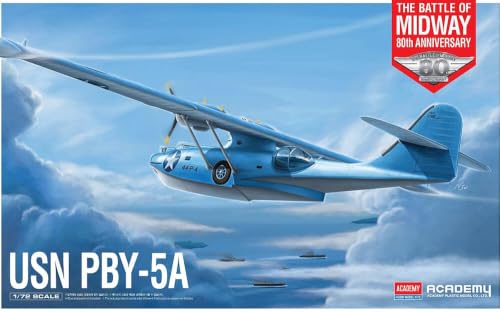
Choose the aircraft first, then compare scale and features. The Academy TBM-3 represents a naval bomber with an open-or-closed bomb bay. The Academy F6F-current listing information offers a choice between two Hellcat versions. The Academy PBY-5A Catalina provides a patrol-seaplane profile, while the Hasegawa S-3A Viking covers a later patrol-aircraft subject. Jet-focused builders can consider the Academy F-4J, Academy F-14A, or Hobby Boss Seahawk FGA.6.
A varied collection may benefit from mixing roles rather than buying several similar fighters. The T-34B Mentor is a training aircraft, the TBM-3 is a bomber, and the Catalina is a seaplane. These documented differences help create a more representative naval aviation display.
Match scale to your display area
Scale is one of the clearest practical buying decisions. The Academy F-14A is 1/144 and lists an assembled length and width of roughly 5.2 and 5.3 inches, so it suits a smaller shelf. The 1/72 kits occupy a middle position, although the Catalina is much wider than a typical single-engine aircraft; its listed assembled width is about 17.3 inches.
The 1/48 kits provide more room for cockpit, panel, rivet, and landing-gear details. The TBM-3, F6F is not 1/48, T-34B, F-4J, and Tamiya Corsair show why the scale is popular for display modeling. The Revell F4U-1A moves to 1/32, creating a larger presentation with more visible surface area. Measure the intended shelf before choosing a large-winged subject.
Configuration features can change the final appearance. The TBM-3 bomb bay can be assembled open or closed. The Academy F6F includes an optional part for either the -3 or -5 version. The Revell F4U-1A has foldable wings, while the Academy F-4J includes varied armament and three pilot figures. The Academy F-14A includes several missile types, including AIM-54, AIM-7, and AIM-9.
These options do not necessarily make one kit easier. They do make the finished model more adaptable to a preferred display. Read the listing carefully to distinguish a genuine alternate part or positionable feature from a general marketing description.
Look for evidence of surface and interior detail
Surface detail is specifically documented for several kits. The Academy F-4J lists fully engraved panel lines and rivet details, and the T-34B lists reproduced panel lines and rivets. The PBY-5A also lists precise panel-line molds. For interior work, the F-4J lists cockpit and landing-gear detail, the TBM-3 identifies Accurate Miniatures injection parts, and the Revell Corsair lists a detailed cockpit and engine.
When a listing does not mention a cockpit, engine, or landing gear, do not assume that feature is included or unusually detailed. The Hasegawa Viking, for example, has direct evidence for an accurate scale model, instructions, and decals, but the supplied data does not describe its cockpit or gear. That makes it easier to compare honestly with kits having more complete specifications.
Plan for paint, glue, and finishing supplies
Many of the plastic kits here are unpainted or state that paint and glue are not included. This applies explicitly to the Academy TBM-3, Academy F6F-current listing information, Academy T-34B, Academy F-14A, Academy PBY-5A, and Revell F4U-1A. The Tamiya listing calls its product a static display model but does not document included paint or adhesive.
The Hobby Boss Seahawk and Hasegawa Viking list decals or painting guidance, which can help with finishing decisions, but those items should not be confused with included paints. Check the package contents and your existing tools before starting. A kit that requires separate materials may still be appropriate; it simply needs a more complete preparation plan.
Consider build style and display priorities
A large-scale kit such as the Revell 1/32 Corsair is suited to builders who want a prominent aircraft with visible foldable wings, cockpit, engine, and propeller features. A 1/144 F-14A is more practical when space is limited. The 1/72 Seahawk is a concise jet option with more than 70 parts and a color painting guide, while the 1/72 Viking offers a less common patrol-aircraft subject.
For historical presentation, compare the markings and decals. The TBM-3 includes Cartograf decals, the F6F includes markings for two versions, the Seahawk includes a guide for three aircraft, and the Revell Corsair includes two sets of USN decals. These details can influence the final scheme without requiring assumptions about quality beyond what the listings document.
Final Recommendation
Academy WWII U.S. Navy F6F-current listing information ranks first overall in this specification-based comparison under the published weighted criteria.
The Academy TBM-3 USS Bunker Hill is the first overall specification-based choice among these best navy airplane model kits because it combines 1/48 scale, Cartograf decals, Accurate Miniatures injection parts, and an open-or-closed bomb bay. The Academy F-4J is the stronger alternative for jet-era surface and cockpit detail, while the Academy F6F-current listing information is the better fit when alternate versions matter.
For limited space, choose the Academy 1/144 F-14A. For a large presentation, consider the Revell F4U-1A in 1/32. The Academy PBY-5A and Hasegawa S-3A Viking add patrol and seaplane variety, and the T-34B Mentor supplies a documented training-aircraft option. Together, these top navy airplane model kits cover several scales, roles, and display approaches without relying on customer-opinion claims.
Frequently Asked Questions
Are the best navy airplane model kits ready to display out of the box?
No. Several selected kits explicitly require assembly and painting, and many state that paint and glue are not included. Plan for modeling tools, adhesive, paints, and finishing time unless the specific listing says otherwise.
Which selected kit takes the least display space?
The Academy 1/144 USN F-14A has the smallest documented assembled dimensions, at approximately 5.2 inches long and 5.3 inches wide. It is therefore a practical choice for a compact display, although its smaller scale can make fine parts less prominent.
Which kit offers alternate aircraft versions?
The Academy WWII U.S. Navy F6F-current listing information includes an optional part to build either the -3 or -5 version and provides markings for two versions. The Academy TBM-3 also offers an appearance choice through its open-or-closed bomb bay.
Which model has the largest documented scale?
The Revell Vought F4U-1A Corsair is listed at 1/32 scale. Its features include foldable wings, a detailed cockpit and engine, a pilot figure, a rotating propeller, and two sets of USN decals. Its larger format requires more display room.
How should I choose between 1/72 and 1/48 scale?
Choose 1/72 when you want a smaller footprint or a broader collection of aircraft. Choose 1/48 when you want more physical room for surface and cockpit details. The intended shelf, the aircraft’s wingspan, and your preferred finishing level matter more than scale alone.