Buying Guide
Weekly planner refills come in a wide range of formats, and the right one depends on which binder or discbound system you already use. The best weekly planner refills share a few qualities that matter more than decorative extras: accurate hole punching, paper that handles common pens, and layouts that fit how you actually plan a week.
Match the Punch Pattern to Your System
Before looking at layouts or paper weight, confirm the punch pattern of your binder or discbound notebook. A5 6-ring refills fit Filofax, Kikki K, Carpe Diem, and similar personal organizers, while 7-hole refills fit desk-size planners such as AT-A-GLANCE and Day-Timer. Discbound systems split into 9-disc for classic sizes like Happy Planner and 11-disc for letter-size systems such as Staples Arc and TUL. Choosing the wrong punch pattern is the most common reason a refill ends up unusable, so this is the first filter to apply.
Choose Between Dated and Undated
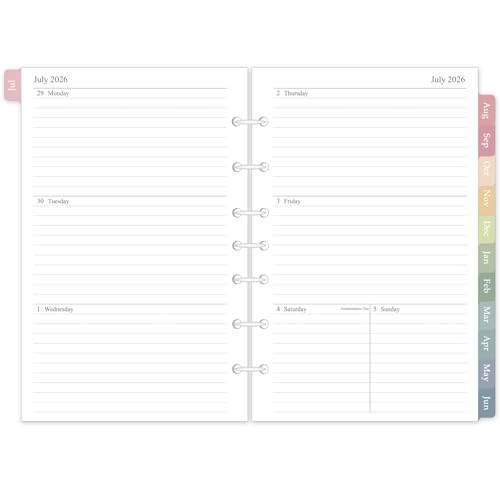
Dated refills run across a fixed calendar window, often an academic year like July 2026 to June 2027 or a calendar year like January to December 2027. They work well if you want month tabs, holidays, and yearly goal pages built in. Undated refills let you start any week without wasting pages, which suits shifting schedules, students, and anyone who skips weeks. If you want the structure of monthly tabs without losing the ability to start anytime, look for an undated refill that still pairs the weekly page with a yearly overview section.
Look at Paper Weight and Writing Feel
Paper weight, measured in gsm or gsm, directly affects how a refill handles fountain pens, markers, and highlighters. Many of the best weekly planner refills in this category sit at 100gsm acid-free, which balances thickness with flexibility and aims to reduce ghosting. Lower-weight paper can bleed with wet inks, while heavier stock can feel stiff and make 6-ring binders harder to close. When in doubt, 100gsm is a reliable middle ground for mixed pen use.
Pick a Layout That Matches Your Planning Style
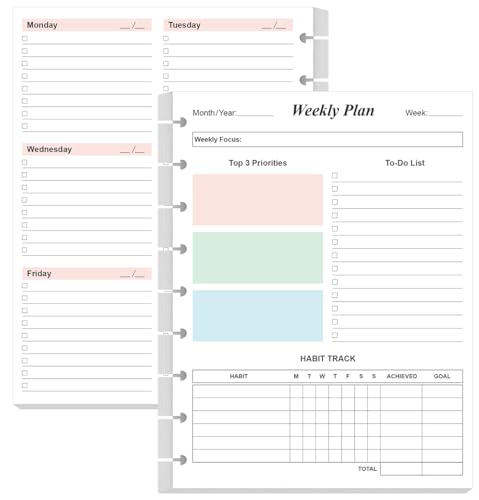
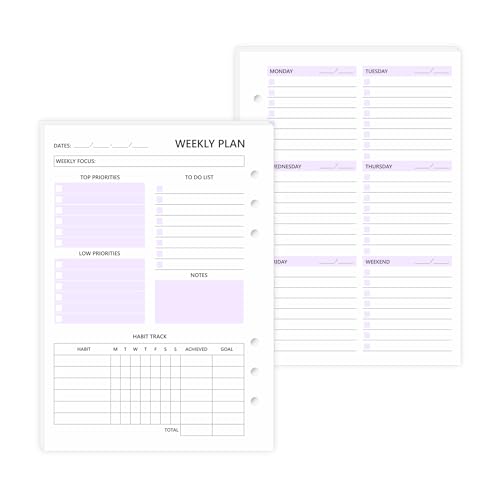
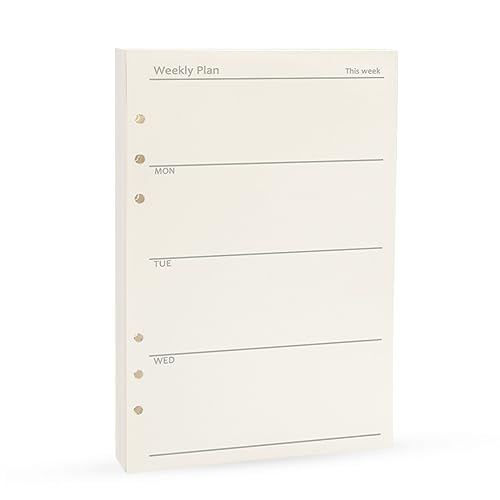
The best weekly planner refills differ widely in how much they cram onto a single page. A simple Monday-to-Sunday block suits minimalists, while richer inserts add weekly goals, three priorities, a to-do list, and a habit tracker. Two-sided layouts, like the Fynora A5 6-Hole inserts, separate goal setting from daily blocks for clearer separation. Choose based on how much structure you want to see each week rather than chasing the most feature-heavy option.
Plan for a Full Year of Sheets
A typical year needs roughly 52 weekly pages, so 53 sheets is a common sweet spot for undated inserts. Refills with only 45 sheets may not cover a full year if you plan ahead, while larger packs can extend into a second cycle. If you want top weekly planner refills that align with a calendar year, dated packs covering exactly 12 months remove the math entirely.
Laminated monthly tabs make navigation faster in dated refills, while yearly goal pages, important dates, contacts, and holidays lists add reference value beyond the weekly spread. These extras matter most if you use your planner as a central hub rather than just a weekly checklist. For minimalists, a clean weekly page with no extras often works better than a feature-packed insert that goes unused.
Final recommendation
Fynora A5 6-Hole Double-Sided Weekly Inserts ranks first overall in this specification-based comparison under the published weighted criteria.
The final choice among the best weekly planner refills depends on the documented features that match your intended use.
For most A5 6-ring users, the Yaridar A5 6-Hole Colorful Weekly Refill stands out as the first overall specification-based choice because it combines a 100gsm acid-free paper spec, a structured weekly layout with priorities and habit tracking, and 53 sheets that cover roughly a year of planning. Planners running 7-ring desk-size systems should consider the AT-A-GLANCE 2027 Weekly Refill Desk Size 4 for its hourly Monday to Friday blocks, while classic-size 9-disc Happy Planner users can rely on the Yaridar Classic 9-Disc Colorful Weekly Refill for broad discbound compatibility. Together these three options represent some of the top weekly planner refills across the most common binding systems in 2026.
Frequently Asked Questions
What size refill fits a Filofax A5?
Filofax A5 organizers use a 6-hole pattern on 5.8 x 8.3 inch pages, so any A5 6-hole weekly planner refill fits, including the Harphia A5 6-Ring and the Yaridar A5 6-Hole inserts covered above.
Are the best weekly planner refills undated or dated?
It depends on how you plan. Undated refills avoid wasted pages and suit shifting schedules, while dated refills provide month tabs, holidays, and yearly goals for structured calendar years. Many planners keep both styles on hand.
How many sheets do I need for a full year of weekly planning?
A standard year uses about 52 weekly pages, so a 53-sheet refill covers a full cycle with a small buffer. Packs with 45 sheets may fall short if you plan ahead or restart mid-year.
Will fountain pens bleed through 100gsm planner paper?
100gsm acid-free paper aims to prevent bleed-through with most fountain pens, gel pens, and markers, though very wet nibs may still ghost. Testing on a single page before committing to a full refill is the most suitable approach.
Which weekly planner refills work with Happy Planner classic size?
Classic-size Happy Planners use a 9-disc pattern at 7 x 9.25 inches. The Yaridar Classic 9-Disc Colorful Weekly Refill targets this exact format with a 53-sheet, 100gsm build.