Buying Guide
The best academic planners should match the way you actually schedule school, work, and personal commitments. A weekly-and-monthly format is the central feature across this comparison, but the products differ considerably in page size, time detail, academic tools, portability, and construction. The right choice depends less on decoration and more on how much information you need to record at each level.
Start with the academic date range
Most selections here cover July 2026 through June 2027, which aligns with a conventional US school year. PAPERAGE, Five Star, RETTACY, SUNEE, POPRUN, JEJEGO, and Homlive all document that core range. That format is useful when you want one planner to begin before fall classes and continue through the end of the academic term.
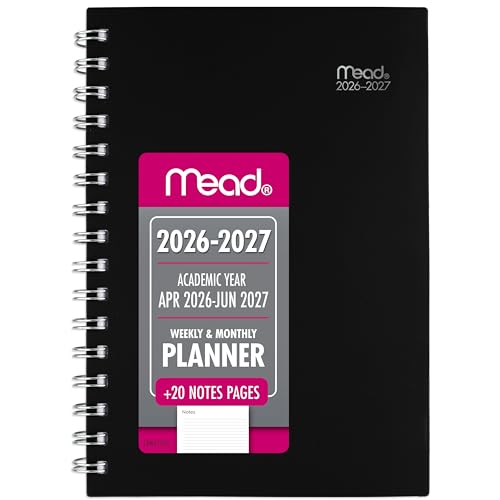
Some products extend beyond that window. Mead runs from April 2026 through June 2027, giving early planners extra preparation months. AT-A-GLANCE covers July 2026 through August 2027, which may suit users who want the planner to continue through summer.
Check the stated date range before buying. A planner labeled academic may use a different start month, and an extended range can be useful if you organize registration, summer work, travel, or early preparation in the same book.
Choose a page size for your writing habits
Large formats provide more room for assignments, lesson plans, appointments, and lists. PAPERAGE measures 9.5 by 11 inches, while Five Star and SUNEE use 8.5-by-11-inch formats. RETTACY and Forvencer also provide large A4 or letter-size layouts. These are sensible choices for users who write several details per day or need room for subjects and class schedules.
The trade-off is portability. JEJEGO, Homlive, and POPRUN use compact or medium dimensions that are easier to place in a backpack or carry between locations. Mead is smaller still at 5.5 by 8.5 inches. Compact pages can work well when your entries are short, but they may feel restrictive for long assignment notes or detailed lesson planning.
Measure the space where you normally plan. A large planner can be comfortable on a desk, while a smaller one may be more practical for classrooms, commuting, or daily bag carry.
Compare weekly layout styles
A standard weekly spread is flexible for assignments, reminders, and appointments. PAPERAGE, RETTACY, Forvencer, JEJEGO, and Homlive document lined weekly writing areas. These layouts are useful when your schedule changes from day to day and you prefer to write free-form notes rather than follow hourly blocks.
Time-specific planners are better for structured days. POPRUN documents hourly scheduling from 7:00 a.m. to 8:00 p.m., and AT-A-GLANCE provides quarter-hour appointment sections on weekdays. These designs can help users record meetings, classes, work shifts, or appointments at specific times. They may be less suitable if you prefer a blank or highly flexible weekly page.
Teacher-specific planning needs a different structure. SUNEE documents a seven-period horizontal weekly layout, along with student logs, communication pages, and checklists. Five Star also targets students with space for up to eight subjects and semester class schedules. These academic tools are more relevant when course organization is central to your planning.
Look for monthly overview features
Monthly pages are useful for exams, project deadlines, school events, appointments, and long-term goals. Reference calendars showing previous and next months appear in several listings, including Mead, Homlive, JEJEGO, and PAPERAGE. Notes areas and large daily blocks make it easier to record deadlines without crowding the weekly spread.
Tabs are another practical feature. PAPERAGE, SUNEE, RETTACY, POPRUN, Mead, JEJEGO, and Homlive document tabbed months or comparable navigation aids. Laminated or coated tabs may be preferable for frequent handling, while colorful tabs can make a planner easier to scan quickly. Tabs do not replace a good layout, but they reduce the time needed to find a specific month.
Extra pages can determine whether a planner works as a complete organization system. Five Star includes semester schedules, goal pages, and many notes pages. SUNEE adds student information, communication logs, daily schedules, graph pages, and student checklists. RETTACY includes an address book, important dates, a removable ruler, sticky index tabs, stickers, and a pen holder.
For a more general setup, look for pockets, bookmarks, elastic closures, and note pages. POPRUN documents a rear pocket, bookmark ribbons, tear-off corners, and lay-flat binding. JEJEGO includes dual storage pockets and additional lined notes. Homlive adds a ruler, pen holder, stickers, and an inner pocket. These features can keep loose papers and small planning tools with the calendar, though they also add to the overall feature set and may not be necessary for a minimalist user.
Check construction and paper details
Construction affects how a planner handles routine use. Spiral or twin-wire binding appears across the selected group and can support pages that open flat or turn easily. PAPERAGE specifically documents a lay-flat design, while POPRUN also lists lay-flat binding. Hardcover models such as JEJEGO and Homlive provide a more structured cover, whereas flexible or plastic covers may be easier to handle in a bag.
Paper descriptions are also worth comparing. PAPERAGE, RETTACY, SUNEE, and POPRUN document 100gsm paper, while Mead specifies FSC-certified paper and several listings mention ink-bleed resistance. These details describe the materials and stated design, not independent writing tests, so treat them as specification clues rather than guarantees for every pen type.
Match the planner to your role
For students, Five Star is the most explicitly subject-oriented option, while PAPERAGE combines class schedules with a large writing area. POPRUN may suit students who plan by time, and compact choices such as JEJEGO or Homlive are easier to carry.
For teachers, SUNEE is the clearest specialist because its listing documents seven-period planning, student logs, and communication sections. RETTACY is a broader educator-and-student option with substantial accessories and yearly planning pages.
For professionals or anyone managing appointments, AT-A-GLANCE offers the most structured time slots. Mead and JEJEGO are better suited to users who want a smaller general-purpose book. Those looking for a detailed desk planner may prefer Forvencer or PAPERAGE.
Final recommendation
PAPERAGE Academic Planner 2026-2027 ranks first overall in this specification-based comparison under the published weighted criteria.
The final choice among the best academic planners depends on the documented features that match your intended use.
PAPERAGE Academic Planner 2026-2027 is the highest-scoring returned product and the first overall specification-based choice. It combines a large format, full academic-year coverage, roomy weekly and monthly pages, class schedule logs, checklist pages, tabs, a pocket, and documented paper and binding features. The top academic planners are not identical, so choose Five Star for subject tracking, SUNEE for lesson planning, AT-A-GLANCE for quarter-hour appointments, or POPRUN for hourly scheduling in a medium format. If portability matters most, JEJEGO, Homlive, or Mead provide smaller documented options.
This comparison is based on public listing descriptions and specifications. It does not represent hands-on testing, independent durability measurements, or customer-opinion analysis. Recheck the product page for current availability and configuration details before purchase.
Frequently Asked Questions
What are the best academic planners for college students?
PAPERAGE and Five Star are strong specification-based options for college students because both provide full July-to-June coverage and academic-oriented planning features. PAPERAGE documents class schedule logs and monthly checklists in a large format. Five Star provides space for up to eight subjects, semester schedules, goal pages, and extensive notes pages. POPRUN is another option when hourly planning is more important than subject tracking.
Is a weekly or monthly academic planner better?
They serve different planning levels, and the selected products generally combine both. Monthly pages give a broad view of exams, deadlines, appointments, and events. Weekly pages provide space for daily tasks and more immediate details. If your schedule includes fixed appointments, AT-A-GLANCE or POPRUN offers more structured time planning. If you need flexible notes for assignments or lessons, PAPERAGE, RETTACY, JEJEGO, or Homlive may be easier to adapt.
Which academic planner is best for teachers?
SUNEE is the most teacher-specific selection because its listing documents seven-period weekly planning, student information, communication logs, daily schedules, and student checklists. RETTACY is a broader choice for educators who want a large A4 format with yearly schedules, important dates, an address book, a ruler, tabs, and other accessories. The best fit depends on whether classroom records or general weekly organization take priority.
Are compact academic planners practical?
Compact planners can be practical when portability matters and daily entries are relatively short. Mead measures 5.5 by 8.5 inches, while JEJEGO and Homlive are around 6 by 8.5 inches. These options still document weekly and monthly planning, but they provide less room than letter-size products. Review your typical entry length before choosing a smaller format, especially if you record detailed assignments, lesson plans, or time blocks.
What features help an academic planner stay organized?
Monthly tabs, reference calendars, pockets, bookmarks, and dedicated notes sections can make routine planning easier to navigate. Academic-specific additions such as class schedules, subject sections, goal pages, student logs, and checklists may be more useful than general accessories. For example, Five Star emphasizes subjects and semester schedules, SUNEE emphasizes teacher records, and RETTACY combines planning pages with tabs, a ruler, a pen holder, and storage features.