Buying Guide
The best wood phone cases are not all built the same way. Some use a real wood panel over a flexible bumper, while others combine wood veneer with leather-texture materials or a rigid internal shell. The right choice depends first on your exact phone model, then on the level of edge protection, the type of wood treatment, and whether magnetic accessories matter.
Confirm the exact phone model
Compatibility is the first filter. A case designed for one phone generation may not fit another, even when the names appear similar. Check the product’s stated size before choosing a finish. A wood case with attractive construction is still unsuitable if its camera or button openings do not match your phone.
The selected listings cover several current iPhone and Samsung models, including iPhone 15 Pro, iPhone 15 Pro Max, iPhone 16, iPhone 16 Pro, iPhone 16 Pro Max, iPhone 17 Pro, iPhone 17 Pro Max, Galaxy S24, Galaxy S25 Ultra, and Galaxy S26 Ultra. Camera layouts, button placement, and overall dimensions can change between versions, so model-specific compatibility should take priority over appearance.
Compare real wood, wood veneer, and finish treatments
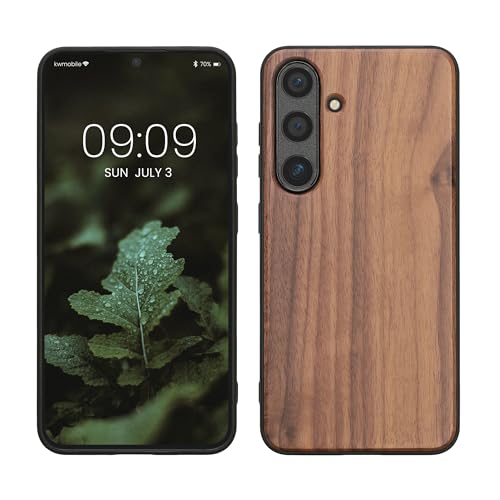
A real-wood back gives the clearest material claim. The kwmobile cases identify real wood and note that grain patterns vary, so each cover may have a slightly different appearance. Abbolinxus also explicitly describes a real natural-wood back and says its edges receive multiple polishing passes.
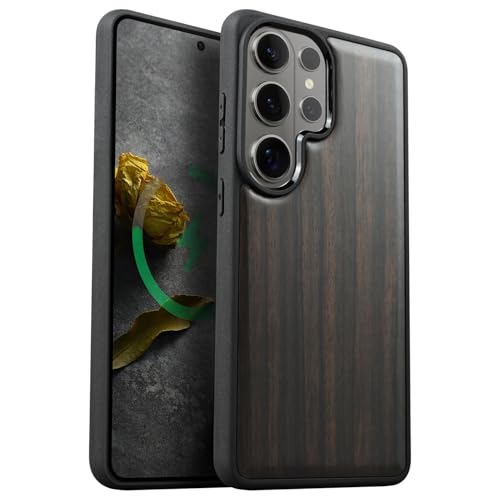
Carveit’s listings describe a natural wood panel with soft TPU backing. Several models add laser-engraved designs, including the Maya Calendar, American Flag, Yin Yang Tree, and Mountains and Deer patterns. These are useful choices when the artwork is part of the appeal, but the engraving makes the surface more visually specific than a plain grain finish.
TENDLIN takes a different approach by using wood veneer with carbon-fiber-texture leather and TPU. This is still a wood-grain hybrid, but it is not described as a solid-wood back. Mous lists walnut among its premium material finishes and combines that look with a rigid shell. Read the material wording carefully if the difference between a wood finish, veneer, and real wood is important to you.
Evaluate the protective structure
A wooden exterior does not describe the entire case. The bumper, inner layer, camera surround, and screen lip determine how the case is assembled around the phone. Carveit’s selected models use natural wood with soft TPU backing and document raised camera and screen areas. The TPU layer is described as part of the case’s protective construction.
The kwmobile cases use a hard wooden back with a flexible TPU bumper. Their listings identify protection from scratches, bumps, dirt, and everyday wear, with TPU around the edges and corners. This is a simpler structure than the more feature-heavy designs, but it may suit someone who wants a conventional wood cover.
Mous provides the most extensive protection specification in this selection: AiroShock impact-absorbing corners, a rigid shell, a reinforced camera bump, and a glass-filled polycarbonate camera surround. TENDLIN documents a deep camera cutout and a raised lip that lifts the screen away from flat surfaces. These details are more useful than a general claim that a case is protective because they explain where the protective material is placed.
Check wireless charging and magnetic accessories
Magnetic support varies considerably across wood cases. Mous specifies a magnetic array compatible with MagSafe and Qi2 accessories. Carveit’s iPhone models list built-in magnets for MagSafe and Qi wireless charging, while the Galaxy S26 Ultra model specifically names MagSafe and Qi2 technology. Abbolinxus also identifies MagSafe compatibility for its iPhone 15 Pro case.
The Carveit Galaxy S25 Ultra case documents standard Qi wireless charging but does not specify MagSafe or Qi2. The kwmobile cases do not list built-in magnetic support in the supplied evidence. If you use a magnetic car mount, wallet, battery pack, or charger, select a model whose listing explicitly names the required standard rather than assuming that a wooden exterior includes magnets.
Look at grip, edges, and daily handling
Natural wood grain can vary, which gives each case a less uniform appearance. kwmobile describes the wood surface as comfortable to hold, while Abbolinxus describes hand-polished edges with an artistic curvature. Carveit says its wood pieces are polished twice after CNC cutting and describes an ergonomic edge angle.
Slimness is another trade-off. TENDLIN describes its case as slim, while Mous lists a 0.594487-inch height and emphasizes a rigid, protective build. The Carveit cases list heights around 0.39 inches, except the iPhone 16e/17e version at 0.45 inches. Dimensions alone do not establish real-world comfort, but they help distinguish a slim hybrid from a more substantial protective case.
Match the design to your priorities
Choose Mous if impact-oriented construction and magnetic standards are more important than a minimal profile. Choose Carveit when engraved natural wood, polished edges, raised protective areas, and model-specific magnetic support are central to the decision. Abbolinxus is a useful middle ground for a real-wood back with PC, TPU, and MagSafe support.
For a straightforward wood cover, kwmobile offers clearly described real-wood backs and TPU frames across selected iPhone and Samsung models. TENDLIN is the better fit for a wood-grain hybrid with carbon-fiber texture, a slim profile, detailed cutouts, and a raised screen lip.
Final Recommendation
Carveit Wood Case for iPhone 17 Pro Max, Maya Calendar ranks first overall in this specification-based comparison under the published weighted criteria.
Mous Limitless Walnut Case for iPhone 17 Pro is the first overall specification-based choice among these best wood phone cases. Its walnut finish is paired with AiroShock corners, a rigid shell, reinforced camera protection, and support for both MagSafe and Qi2 accessories. That combination gives it the broadest documented feature set in this comparison.
For engraved natural wood, the Carveit Wood Case for iPhone 17 Pro Max provides a strong blend of laser-carved design, TPU backing, polished edges, raised protective areas, and MagSafe support. Galaxy S26 Ultra owners should consider the Carveit model because its listing specifically includes MagSafe and Qi2 compatibility. Buyers seeking the top wood phone cases should also compare their device’s exact fit and the difference between solid wood, wood veneer, and a walnut finish before selecting a case.
The best match for a simpler real-wood build is kwmobile, while TENDLIN is a practical option for iPhone 16 users who prefer a slim, textured hybrid. Abbolinxus stands out for its explicitly identified real-wood back and hand-polished edges. In every case, confirm the phone model and the accessory standard you need before ordering.
Frequently Asked Questions
What should I check first when choosing the best wood phone cases?
Check the exact phone model and generation first. Camera layouts, button placement, and dimensions differ between models. After confirming compatibility, compare the material description, bumper structure, camera protection, and charging support.
Are all wood phone cases made from solid wood?
No. The selected products use different material descriptions. kwmobile and Abbolinxus explicitly identify real wood, while Carveit describes a natural wood panel with TPU backing. TENDLIN specifies wood veneer combined with carbon-fiber-texture leather and TPU. Mous lists walnut as a material finish with a rigid shell. These distinctions matter if the wood itself is your main priority.
Which selected cases support magnetic accessories?
Mous lists MagSafe and Qi2 support. Carveit’s iPhone models list built-in magnets compatible with MagSafe and Qi charging, and its Galaxy S26 Ultra model names MagSafe and Qi2. Abbolinxus specifies MagSafe compatibility, and TENDLIN describes magnetic support for MagSafe accessories. The selected kwmobile listings do not provide magnetic-accessory specifications.
Does a wood case protect the camera and screen?
Some selected cases document those features and others do not. Carveit lists elevated camera and screen areas, Mous lists a reinforced camera bump and camera surround, and TENDLIN specifies a deep camera cutout and raised screen lip. The kwmobile listings describe TPU edge and corner coverage but do not specify raised camera or screen lips. Treat undocumented protection features as unknown rather than assuming they are included.
Can natural wood grain vary between cases?
Yes. The kwmobile listings explicitly say that each case has its own grain pattern and that the wood may vary from the product image. Carveit’s descriptions also identify an original wood panel, supporting the expectation that the surface has natural variation. Engraved designs add a more consistent pattern, but the underlying wood may still differ.