Buying Guide
The best wood step stools are not interchangeable. A low bedside platform, a tall single step, and a two-step design solve different access problems. Start with the surface you need to reach, then compare height, platform dimensions, footing, materials, and whether assembly is acceptable.
Choose the right step height
Height is the first practical filter. A 5.5- to 6.5-inch stool, such as the RayLove or CONSDAN, is intended for a modest boost beside a moderately high bed or near a low cabinet. These lower formats are easier to step onto when you do not need much extra reach, but they are not substitutes for taller designs.
An 8- to 9-inch stool provides a middle ground. The YINMIT is listed at 8 inches, while the FANATU bed step is 9 inches. These heights can suit general kitchen, bedroom, and bathroom tasks where a small platform is more convenient than a ladder. The 13-inch FANATU model is aimed at higher beds, closets, and elevated cabinets, but a taller single platform may not be the best match for every user or room.
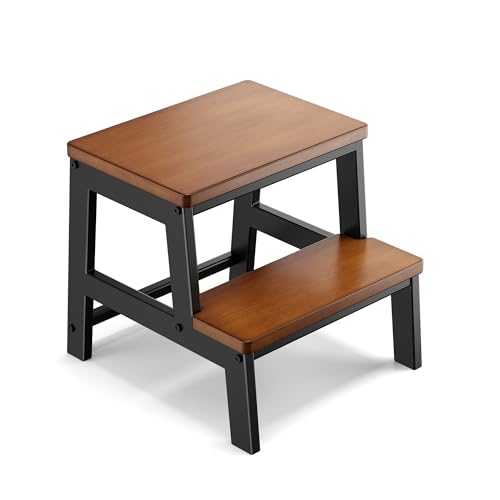
Two-step products provide staged access rather than one taller jump. StrongTek documents levels at 6.69 and 11.81 inches, and RORKEE is also a two-step design. This layout can be useful when the extra height is substantial, although it generally needs more floor and storage space than a one-step stool.
A larger standing area can make positioning easier, but it also increases the stool’s footprint. The FANATU 26-inch model is the standout for width, with a documented 26 x 11.8-inch size, non-slip grooves, and anti-slip pads. StrongTek also emphasizes wide steps, and several other selections provide platforms around 15.7 inches wide.
Look for both top-surface traction and floor contact. The RayLove uses a rubber-covered stepping surface, while the CONSDAN listing specifies a non-slip mat. StrongTek includes silicone pads, removable anti-slip strips, and rubber-capped feet. A stool with only floor pads may still have a smooth top, so distinguish between features that help the feet stay on the platform and features that help the stool stay on the floor.
Adjustability can matter on imperfect flooring. FYGUES documents adjustable rubber feet for uneven ground, while the NomNest uses non-slip rubber feet. These features are relevant for tile, hardwood, and other indoor surfaces, but the supplied listings do not establish performance on every floor type. Follow the product instructions and use a level, suitable surface.
Check the construction materials
“Wooden” does not always mean solid wood throughout. CONSDAN identifies USA-grown oak hardwood, and RORKEE describes a solid-wood top with an iron frame. The FANATU selections and StrongTek identify acacia or bamboo construction. These materials may offer a furniture-oriented appearance, but the listing evidence should guide comparisons rather than assumptions about long-term performance.
Some models combine wood with metal. FYGUES uses a solid-wood top and high-strength steel tubing; YINMIT uses P2 board with powder-coated steel tubing; NomNest combines premium wood and thickened steel. A metal frame may add structural support, but it can also change the stool’s appearance and weight. If solid wood is a priority, select a model whose listing explicitly states it.
Consider capacity carefully
Several selected listings state capacities from 300 to the current price. Those figures are manufacturer-provided specifications, not independent test results. The FANATU 26-inch and 9-inch models each state the current price, while CONSDAN and RORKEE state the current price. NomNest lists the current price, and RayLove lists the current price.
Capacity should not be the only safety screen. A stool must sit flat, remain fully assembled, and be used as directed. Platform size, surface traction, height, and floor contact all affect whether the design suits your intended task. Do not treat a published load figure as a guarantee of stability in every situation.
Decide whether assembly is acceptable
Setup varies considerably. CONSDAN is described as a one-piece design requiring no assembly. FYGUES and RORKEE also include pre-drilled holes and instructions.
If the stool will be moved frequently, portability deserves attention. The 13-inch FANATU includes a carry handle, NomNest is listed as lightweight, and the low RayLove is described as portable. Large two-step and extra-wide platforms may be more stable for their intended use but less convenient to relocate.
Final Recommendation
FANATU 26-Inch Extra-Wide Wooden Step Stool ranks first overall in this specification-based comparison under the published weighted criteria.
The final choice among the best wood step stools depends on the documented features that match your intended use.
The FANATU 26-Inch Extra-Wide Wooden Step Stool is the highest-scoring returned product and the first overall specification-based choice. Its documented combination of a 26-inch platform, acacia wood, reinforced construction, 9-inch height, non-slip grooves, and anti-slip feet gives it the broadest footing profile in this comparison.
For staged access, StrongTek is the most specification-aligned alternative because it documents two levels, wide steps, crossbars, silicone pads, and removable anti-slip strips. For a more compact bedside format, the one-piece CONSDAN oak stool avoids assembly and keeps the height low. The 13-inch FANATU is better suited to shoppers who specifically need more reach from one platform, while NomNest is the flexible pick when three adjustable heights are more useful than a higher load specification.
Among the top wood step stools, the best choice depends on the gap you need to bridge and the space available around it. Confirm the listed dimensions, height, load specification, and floor conditions before buying, and use any selected stool only on a level surface as directed.
Frequently Asked Questions
Measure the distance from the floor to the bed surface and consider whether you need one step or two. The 9-inch FANATU bed step is a middle-height option, the 13-inch FANATU provides more single-step reach, and StrongTek offers two staged levels. For a moderately high bed, the 5.5-inch RayLove or 6.5-inch CONSDAN may be more appropriate. A stool that is too short may not provide enough assistance, while an unnecessarily tall platform can be less convenient to approach.
Several selected listings identify bathroom use, including the FANATU, RayLove, StrongTek, and YINMIT models. Materials and finishes differ: FANATU documents a water-resistant finish, StrongTek describes a water-resistant bamboo finish, and YINMIT describes a waterproof, scratch-resistant top. These statements do not establish waterproofing for unlimited exposure. Keep the stool on a stable surface, follow care instructions, and avoid assuming that any wood product is designed for constant standing water.
Neither design is universally better. A two-step stool can provide gradual access to a higher surface, as shown by StrongTek’s 6.69- and 11.81-inch levels. A one-step stool usually has a simpler, more compact layout and may be easier to store. Compare the required reach, available floor space, platform dimensions, and your comfort with the stepping sequence before choosing.
Relevant documented features include a broad platform, reinforced crossbars or frames, non-slip top treatments, and grippy or adjustable feet. The FANATU 26-inch model emphasizes width and non-slip grooves; FYGUES documents adjustable rubber feet; and RORKEE describes a trapezoidal frame with rubber feet. These are specification-based indicators, not independent test findings. Stability also depends on complete assembly, a level floor, and using the stool within its stated capacity.
No. CONSDAN describes a one-piece, no-assembly design, while FANATU, FYGUES, RORKEE, StrongTek, and NomNest document assembly or pre-drilled components. Check the setup details before ordering. If the stool will be needed immediately or moved between rooms often, a ready-to-use or handle-equipped design may be more convenient than a model requiring hardware installation.